PITI stands for Principal, Interest, Taxes, and Insurance, the four costs that make up a typical monthly mortgage payment. Lenders use it, not the advertised rate alone, to judge what a loan truly costs and whether it’s affordable.
That’s why lenders apply a 28% front-end and 43% back-end DTI guideline to the full PITI number, not P&I.
Even with a fixed rate, PITI isn’t fixed, since taxes and insurance rise yearly.
What Is PITI? (Quick Answer)
| Letter | Stands For |
|---|---|
| P | Principal |
| I | Interest |
| T | Taxes |
| I | Insurance |
What PITI stands for
Lenders use PITI, not the sale price or rate alone, to decide what you can afford. Some payments add a fifth piece, private mortgage insurance (PMI), plus more for flood zones or HOAs. The Consumer Financial Protection Bureau (CFPB) defines PITI the same way.
Quick breakdown of the four parts
Principal pays down what you borrowed. Interest is the lender’s charge for it. Property taxes go to your county, collected by your lender. Homeowners insurance protects the house and is required by nearly every lender.
PITI vs Other Mortgage Terms
“Mortgage payment,” “P&I,” and “housing cost” aren’t the same thing, and mixing them up means underestimating your real cost.
PITI vs P&I
P&I stands for principal and interest (P&I), the two letters lenders advertise most. On a $320,000 loan at 6.55%, a 30-year fixed rate, P&I alone runs about $2,040 a month. Add taxes and insurance and that loan often lands closer to $2,450 to $2,650. P&I is what the bank quotes. PITI is what leaves your account.
PITI vs Total Housing Cost
HOA dues, maintenance, and utilities sit outside PITI. A $400,000 home with a $2,543 PITI can add another $200 to $400 a month in these extras. Budget for PITI, then add a buffer.
PITI vs Monthly Payment Advertised Online
A $1,999/month ad is usually P&I only, often at a promo rate. It skips your tax rate, your insurance, and PMI if you’re under 20% down. Treat ads as a starting point, not a promise.
Why PITI Matters When Buying a Home
Lenders approve based on your full payment, not the advertised P&I number, because that’s what you’ll actually owe every month.
Why lenders focus on PITI instead of just P&I
A loan that looks affordable at $2,040 P&I can turn into a stretch at $2,600 PITI once taxes and insurance are added. Every loan estimate shows the full PITI breakdown, not just P&I.
How PITI affects your mortgage approval
PITI feeds your debt-to-income ratio (DTI). Lenders check the front-end DTI ratio, PITI against income, and the back-end DTI ratio, which adds other debts. Back-end DTI should stay under 43%, front-end (your PITI alone) under 28%. On $6,000 monthly income, that’s a $1,680 PITI ceiling. PITI alone doesn’t decide approval, it’s weighed with credit score, reserves, and job history.
Breaking Down Each Part of PITI
Each letter carries a different cost, and each behaves differently over the life of your loan.
Principal
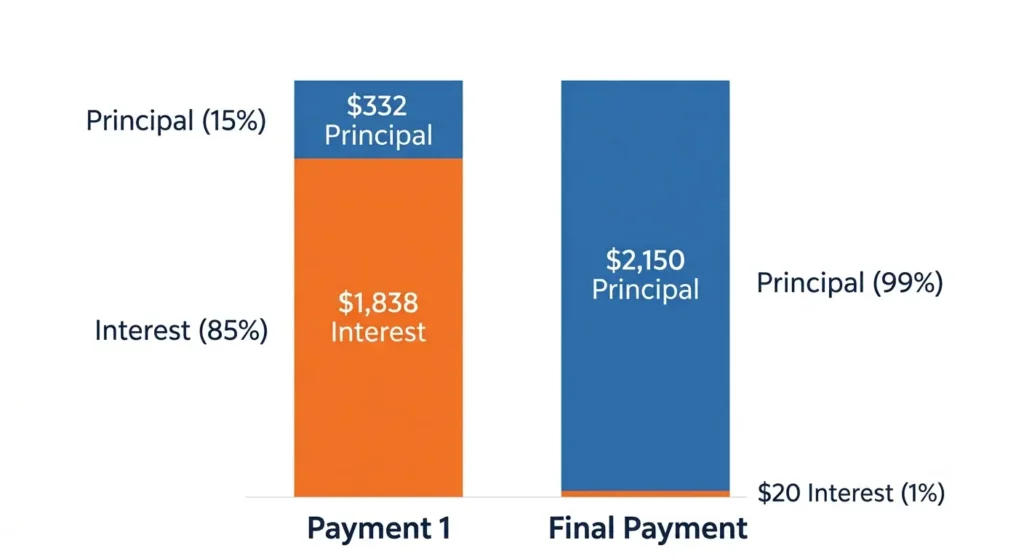
Principal is what you still owe. Early payments barely touch it; later payments reduce it faster. Extra payments, even $100 a month, shrink the loan and build equity sooner.
Interest
Interest is the lender’s fee, charged as a percent of your remaining balance. As of mid-2026, the 30-year fixed rate has averaged roughly 6.4% to 6.6%, per Freddie Mac’s Primary Mortgage Market Survey. A fixed-rate loan locks that rate for life. An adjustable-rate mortgage (ARM) can reset it after an initial period. You pay the most interest early, the least near the end.
Property Taxes
Your county, not your lender, sets the tax rate, so identical homes in different counties can carry different PITI. Reassessments raise your bill and your escrow payment. Your lender collects one-twelfth of the annual bill each month through an escrow account and pays the county for you. Escrow isn’t optional under 20% down, though larger down payments can sometimes pay taxes directly.
Homeowners Insurance
Insurance covers fire, storm, and theft, and nearly every lender requires it. Like taxes, the annual premium splits into monthly escrow payments. Premiums vary by location, age, roof, and claims history, and wildfire or flood-prone areas have seen the sharpest increases.
What Is Included—and Not Included—in PITI
PITI always includes four costs, sometimes a fifth, and never covers everything you’ll actually spend on the home.
Costs usually included
Principal, interest, property taxes, and homeowners insurance make up every standard PITI payment.
Costs that may also be included
Private Mortgage Insurance (PMI)
Under 20% down on a conventional loan adds PMI, typically $100 to $300 a month. On a $315,000 loan at 0.85% PMI, that’s about $223 a month. Under the Homeowners Protection Act, you can request cancellation once your loan-to-value (LTV) ratio hits 80% of the home’s original value, and your lender must cancel it automatically at 78%, both measured against that original value. Federal Housing Administration (FHA) loans charge MIP instead, currently 0.55% annually for most borrowers, and it can last the life of the loan if your down payment was under 10%. VA loans, backed by the U.S. Department of Veterans Affairs (VA), and USDA loans, backed by the U.S. Department of Agriculture (USDA), skip PMI and MIP entirely for eligible borrowers.
Flood insurance
FEMA flood zones require flood insurance on top of homeowners coverage, folded into escrow. It can add $50 to several hundred dollars a month depending on your risk zone.
Costs not included in PITI
Homeowners association (HOA) fees, utilities, maintenance, and closing costs sit outside PITI. Two homes with identical PITI can still cost very differently once HOA dues are added.
How to Calculate PITI
The formula is simple, and lenders verify it twice before you close.
Basic PITI formula
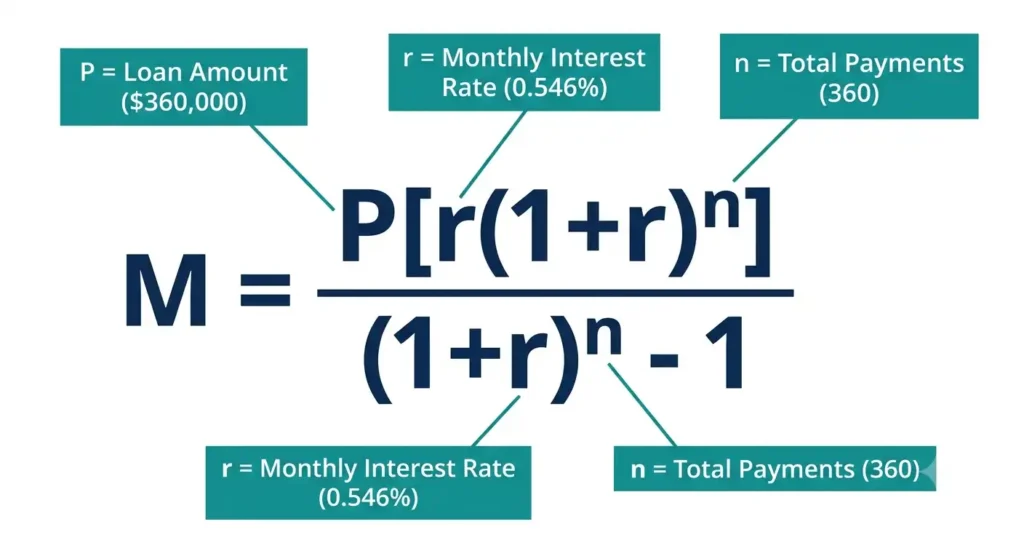
PITI equals P&I, plus one-twelfth of annual property taxes, plus one-twelfth of annual insurance, plus PMI or MIP if it applies. Before closing, your lender pulls the tax bill and an insurance quote to estimate these, first in your loan estimate, then finalized in your closing disclosure. P&I itself comes from an amortization formula based on loan amount, rate, and term. Your final escrow number can shift once your lender confirms real bills.
Step-by-step calculation example
A $382,500 loan at 7%, 30-year fixed, runs about $2,545 in P&I. Add $390 in taxes on a $425,000 home at 1.1%, and $130 in insurance. That’s $3,065 PITI before PMI. With 10% down, PMI adds about $220, for a total near $3,285.
Using a mortgage calculator
A good PITI calculator takes loan amount, rate, term, tax rate, and insurance estimate. Use your real local tax rate and a real insurance quote, not national averages, and compare a few down payment scenarios.
Real-World Examples
Three scenarios show how PMI, tax rates, and down payments each move your final number.
Example for a first-time homebuyer
A $350,000 home, 10% down, $315,000 loan at 7%: about $2,096 P&I, $446 combined taxes and insurance, $221 PMI, totaling $2,763 PITI. On $70,000 income, that’s right at the 28% affordability guideline.
Comparing two similar homes
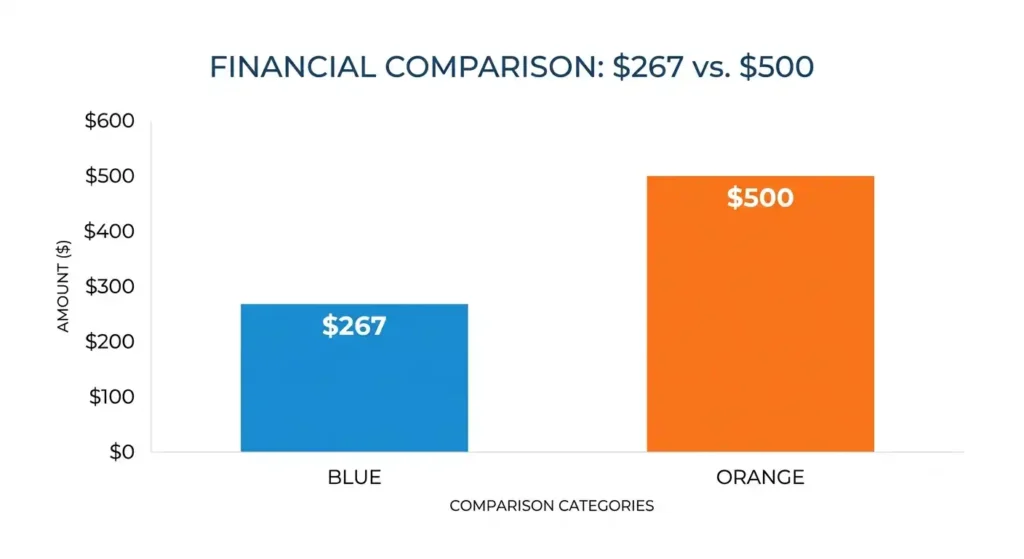
Two identical $400,000 homes: an 0.8% tax rate adds about $267 a month, a 1.5% rate adds about $500. That’s a $233 monthly gap on paper-identical homes.
How PMI changes monthly payment
A $315,000 loan at 10% down carries about $223 a month in PMI. Once the balance hits 80% of original value, usually year four to seven, PMI drops off and so does that $223.
Why Your PITI Payment Can Change
Even a fixed rate doesn’t fix your payment, because taxes and insurance move independently.
Property tax increases
Counties reassess on their own schedule. A higher assessment means a higher tax bill and a higher escrow payment, the most common reason a “fixed” payment rises.
Insurance premium changes
Premiums renew annually and have been climbing fast. An ICE Mortgage Monitor report tracking 2020 through 2024 found insurance costs rising roughly three times faster than principal, interest, and tax growth combined, driven by wildfire and storm claims, and that trend has continued into 2026. In high-risk regions, insurance can be a quarter of total PITI.
Escrow shortages
If taxes or insurance come in higher than estimated, you’ll face an escrow shortage: a higher monthly payment or a lump-sum catch-up. Read your annual escrow analysis as soon as it arrives. Refinancing resets this too. A new loan amount, rate, or term changes P&I, and a fresh escrow account means your PITI after a refinance mortgage rarely matches the old payment.
Common Myths About PITI
Three myths cause most of the budgeting mistakes buyers make.
“My mortgage payment never changes”
Only P&I is locked on a fixed-rate loan. Taxes and insurance move every year and flow straight into your total payment.
“PITI only means principal and interest”
That’s just P&I. PITI is the full picture, and skipping taxes and insurance is how buyers underestimate real cost.
“PITI includes every homeownership expense”
It doesn’t. HOA dues, maintenance, repairs, and utilities live outside PITI and still hit your budget.
Before You Buy a Home: How to Use PITI Wisely
Compare, ask, and check before you sign, not after.
Compare homes using PITI
Never compare homes by price alone. Pull the estimated PITI for each, using real tax rates and insurance quotes.
Questions to ask your lender
Ask what tax rate and insurance figure they used, whether the insurance number is a real quote, whether PMI is included and for how long, and what escrow looks like in year two.
Signs your estimated payment may be inaccurate
Watch for a suspiciously low tax estimate, no insurance figure, missing PMI despite a small down payment, or no escrow mentioned.
Frequently Asked Questions
Is PMI included in PITI?
Yes, on conventional loans under 20% down. FHA loans use MIP instead, working the same way.
Does PITI include HOA fees?
No. HOA fees are billed separately and aren’t part of standard PITI.
Why did my PITI payment increase?
Usually a tax reassessment, an insurance renewal, or an escrow shortage. Your rate likely didn’t change.
Can I lower my PITI?
A larger down payment can cut or eliminate PMI. Appealing an inflated tax assessment lowers the tax portion. Shopping insurance at renewal trims the rest.
Is PITI the same as my mortgage payment?
For most borrowers, yes. The exception is a borrower paying taxes and insurance directly instead of through escrow, which is rare and needs lender approval. The interest and tax portions of PITI can be tax deductible if you itemize; principal and insurance are not.
What is a good PITI-to-income ratio?
Most lenders want PITI under 28% of gross monthly income, and total debt including PITI under 43%. That cushion protects you when taxes or insurance rise.
Key Takeaways
The most important things to remember
PITI, not the advertised P&I number, is your true monthly cost. Know all four parts, plus PMI or MIP if it applies. Budget beyond PITI for HOA and maintenance. Verify the tax and insurance figures behind any quote before you commit.