Property tax in Texas isn’t one fixed rate. It’s a combined local charge, set separately by your school district, county, city, and any special districts, applied to your home’s taxable value after exemptions.
This locally driven structure is exactly why two homes of equal value can carry very different bills across Texas counties.
The tradeoff: no state income tax, but property tax bills run higher than the national average.
How Much Is Property Tax in Texas in 2026?
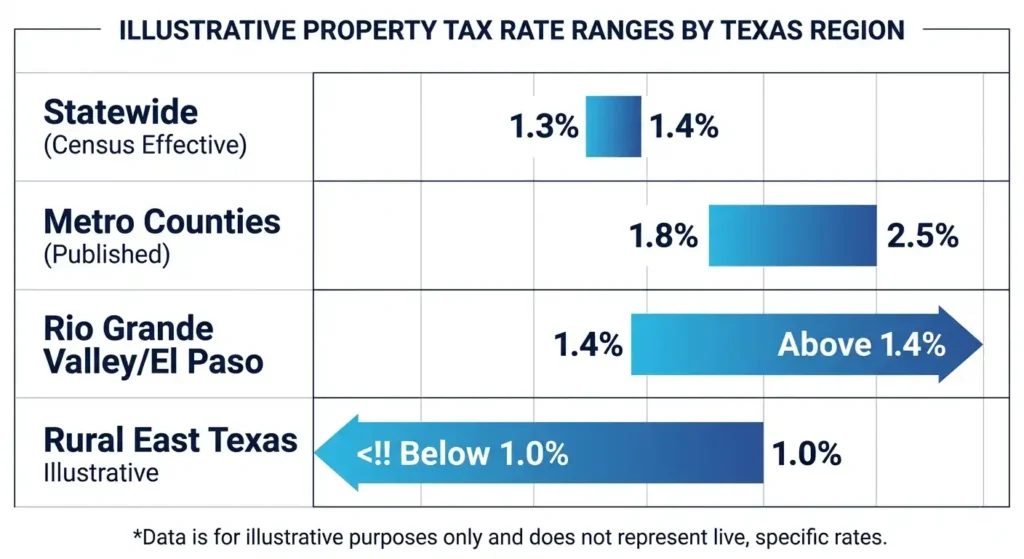
Most Texas homeowners pay 1.3% to 2.5% of their home’s value, depending on how you measure it. Census-based effective rates run 1.3% to 1.4% statewide. Combined published rates before exemptions run 1.8% to 2.5% in metro areas. There is no single number for every address.
| Rate Type | Range | What It Reflects |
|---|---|---|
| Census effective rate (statewide) | 1.3% – 1.4% | Actual taxes paid after exemptions, averaged |
| Combined published rate (metro) | 1.8% – 2.5% | Sum of adopted rates before exemptions |
| Rio Grande Valley / El Paso | Above 1.4% | Effective rate |
| Rural East Texas | Below 1.0% | Effective rate |
The Short Answer: What Most Texas Homeowners Will Pay
That’s why a Harris County home and an East Texas home worth the same can owe very different totals. Any “Texas property tax rate” you see online is a statewide average, a planning starting point, not your actual bill.
What Determines Your 2026 Texas Property Tax Bill?
Your bill starts with appraised value, what your county appraisal district thinks your home is worth as of January 1. Exemptions and appraisal limits reduce that to your taxable value. Local tax rates apply to taxable value, not appraised value. Two identical homes can owe different bills if one owner filed exemptions and the other didn’t.
2026 Texas Property Tax at a Glance
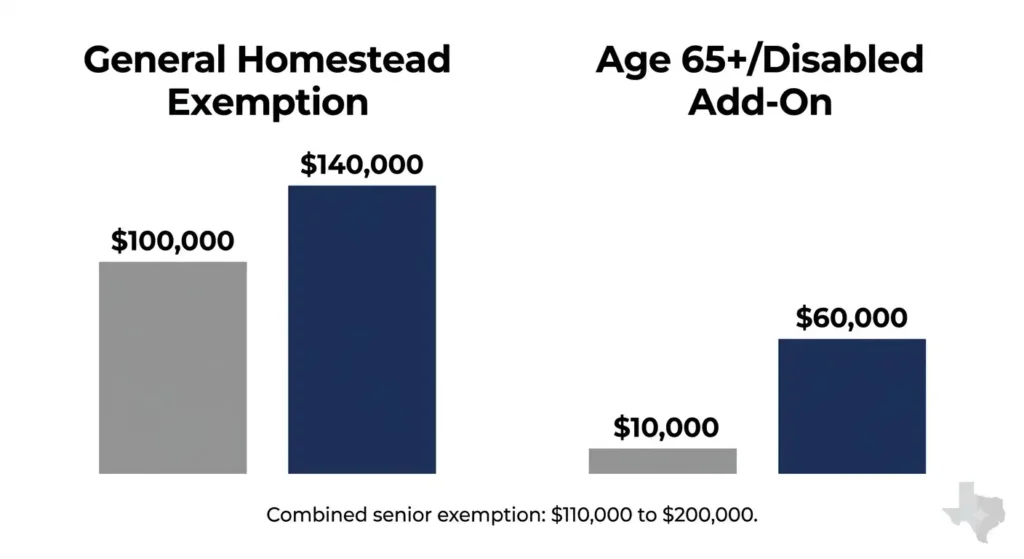
The school district homestead exemption jumped from $100,000 to $140,000 after voters approved Proposition 13 in November 2025. Homeowners 65 or older, or disabled, now get $60,000 extra, up from $10,000, for a combined $200,000. HB 8 cut school rates by about 3.31 cents per $100 of value for one year, on top of 2023’s Proposition 4 compression. The homestead appraisal cap stays at 10% a year. Local rates for 2026 finalize between August and September.
| 2026 Change | Before | Now |
|---|---|---|
| General homestead exemption (school) | $100,000 | $140,000 |
| Age 65+ / disabled add-on | $10,000 | $60,000 |
| Combined senior/disabled exemption | $110,000 | $200,000 |
| School rate compression (HB 8) | New for 2026 | -3.31 cents per $100 |
| Homestead appraisal cap | 10%/yr | 10%/yr (unchanged) |
Appraised Value vs. Taxable Value: The Difference That Changes Your Bill
Appraised value is what your county thinks your property is worth. Taxable value is what you’re billed on, after exemptions and caps.
What Is Appraised Value?
Appraisal districts use mass appraisal, a statistical, area-wide approach guided by Uniform Standards of Professional Appraisal Practice (USPAP) principles, not individual inspections. Appraisers use recent sales and property data as of January 1. Your value can rise even if you never sold or listed your home. Look it up on your county appraisal district’s website by address or parcel number. Under Tax Code Section 23.01, market value is the price a property would sell for under normal conditions, and land and improvements are appraised together as one property, not as separate line items.
What Is Taxable Value?
Taxable value is appraised value minus your exemptions and limitations. A $400,000 home with a $140,000 school homestead exemption has a $260,000 school taxable value. That’s what your school district actually taxes.
What Is Assessed Value?
In most Texas counties, assessed value and appraised value mean the same thing, since Texas doesn’t use a separate assessment ratio. It’s typically just another label for appraised value before exemptions. Confusing it with taxable value is a common source of confusion when a bill looks wrong.
Why a $500,000 Home Does Not Necessarily Pay Tax on $500,000
A $500,000 home with a homestead exemption and the 10% cap might only get taxed on $350,000 to $400,000 for school purposes. Exemptions cut taxable value directly. The cap limits how fast appraised value can climb. Some land also qualifies for special appraisal, like agricultural use. These tools stack.
How Texas Property Taxes Can Be So High
With no state income tax, Texas leans harder on property tax to fund schools, roads, and public safety, pushing bills above the national average.
Texas Has No Single Statewide Property Tax Rate
The Texas Comptroller’s office tracks data but doesn’t set rates. Location matters more than your home’s value, since two identical homes in different counties can face very different combined rates.
School District Taxes
School district taxes usually make up the largest single piece of a bill, commonly around half in many districts. The $140,000 exemption and HB 8 compression both apply specifically here, so 2026 relief is concentrated in this category.
County, City, and Special-District Taxes
You’ll also pay county tax, and city tax if you’re inside city limits. Special districts, MUDs, hospital districts, community college districts, flood control districts, add another layer, each its own line on the bill. Homes just blocks apart can carry different rates due to different MUD boundaries. Some properties even sit across a taxing-unit boundary, and the appraisal district splits which unit taxes which portion.
Why a Higher Home Value Does Not Always Mean a Proportionally Higher Bill
A 20% higher appraisal doesn’t mean a 20% higher bill. The homestead cap limits how much of that counts toward taxable value, and rates can move the other way, like HB 8’s compression. Your bill reflects both value change and rate change together.
How to Calculate Your Texas Property Tax Bill
Taxable value times tax rate, added across every taxing unit. That’s the whole formula, and it works the same way how your mortgage payment is calculated does, several separate pieces added into one monthly number. For more fundamentals like this, browse our mortgage basics section.
The Basic Texas Property Tax Formula
Rates are expressed per $100 of taxable value, so a rate of “1.2” means $1.20 per $100. Calculate separately for school, county, city, and special districts, then add. This gives an estimate; your county tax office issues the certified bill once rates are finalized.
Step 1: Find Your Property’s Appraised Value
Look up your parcel on your county appraisal district’s website. That’s your value as of January 1. It can differ from your purchase price, since appraisal districts use area market data, not your closing statement.
Step 2: Subtract Applicable Exemptions
Subtract every exemption you qualify for. The residence homestead exemption is $140,000 off school taxable value for 2026. Add $60,000 more if you’re 65 or older or disabled. Disabled veterans have separate categories, some eliminating school taxes entirely. Amounts can vary slightly by taxing unit through local-option exemptions.
Step 3: Apply Any Appraisal Limitation
For a qualifying homestead, appraised value growth is capped at 10% a year, set out in Tax Code Section 23.23. It starts the second year you hold the exemption, not the first. This caps appraised value, not your final bill. New square footage is taxed at full value on top of the capped portion.
Step 4: Apply the Local Tax Rates
Multiply each taxing unit’s taxable value by its rate, then add. The same home value can produce very different bills in Fort Bend County versus a rural county. Rates change yearly based on budgets and voter-approved measures.
Step 5: Convert the Annual Bill Into a Monthly Cost
Divide the annual estimate by 12. If you have a mortgage, this usually folds into escrow with insurance as part of your PITI payment. Escrow is an estimate, not the actual bill, so a value or exemption change can throw it out of sync.
Texas Property Tax Rates in 2026: What Rate Should You Use?
Use your property’s actual combined rate, not a statewide average. Averages help with planning; they won’t match your real bill.
Why There Is No Single Texas Property Tax Rate
Every taxing unit sets rates independently, so “the Texas rate” doesn’t exist as one number. Statewide or county averages are rough planning tools only, not a match for your specific address.
How to Find the Exact Rate for Your Property
Pull your county appraisal district record for your parcel. It lists every taxing unit and rate. Add them for your combined estimate and compare against your actual bill.
Effective Tax Rate vs. Published Tax Rate
Published rate is what the taxing unit adopts. Effective rate is what you actually pay as a percent of full market value, after exemptions. A $400,000 home at a 2.2% published rate suggests $8,800, but exemptions dropping taxable value to $300,000 bring the real bill closer to $6,600.
Why Property Tax Rates Change
Rates shift yearly under the Texas Truth-in-Taxation system, set out in Tax Code Section 26.05, which requires taxing units to disclose a no-new-revenue tax rate and a voter-approval tax rate. The no-new-revenue tax rate roughly matches last year’s revenue on existing properties and excludes new construction value, letting growing areas raise more total revenue without raising anyone’s rate. Crossing the voter-approval tax rate can trigger an election. Compression funding, like HB 8’s 2026 cut, can also push rates down.
Texas Property Tax Calculator: Example for a 2026 Home
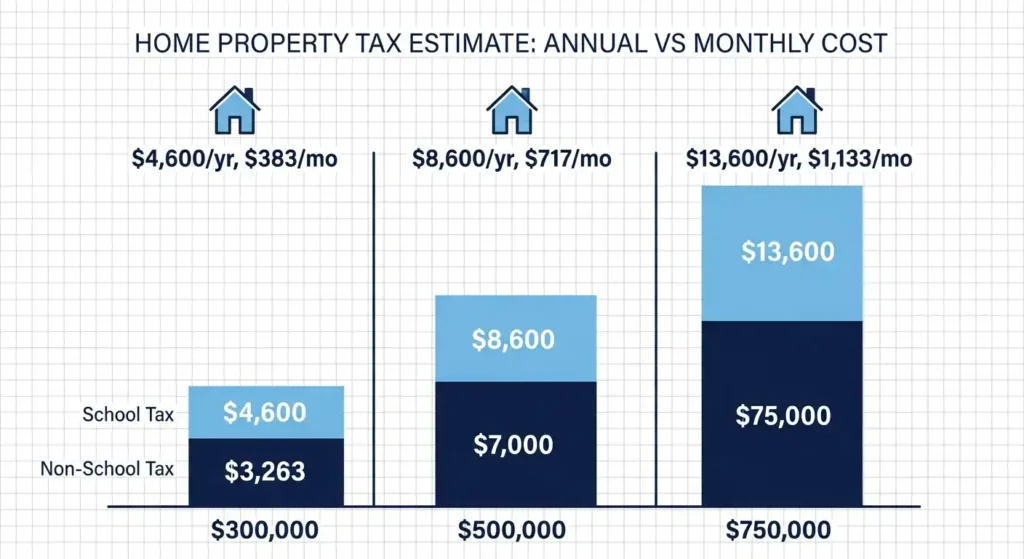
These examples use a simplified combined rate. The 1.0% school and 1.0% non-school assumptions lean toward higher-tax metro counties. Treat these as a template, not a quote.
| Appraised Value | School Taxable Value | School Tax (1.0%) | Non-School Tax (1.0%) | Total/Year | Total/Month |
|---|---|---|---|---|---|
| $300,000 | $160,000 | $1,600 | $3,000 | $4,600 | $383 |
| $500,000 | $360,000 | $3,600 | $5,000 | $8,600 | $717 |
| $750,000 | $610,000 | $6,100 | $7,500 | $13,600 | $1,133 |
Example 1: $300,000 Texas Home
Appraised value $300,000 with a homestead exemption. School taxable value: $160,000 after the $140,000 exemption; at 1.0%, that’s $1,600. Non-school taxes apply to the full $300,000; at 1.0%, that’s $3,000. Total: about $4,600 a year, or $383 a month.
Example 2: $500,000 Texas Home
School taxable value: $360,000 after exemption; at 1.0%, that’s $3,600. Non-school on the full $500,000 at 1.0% adds $5,000. Total: about $8,600 a year, or $717 a month, nearly double the $300,000 example.
Example 3: $750,000 Texas Home
School taxable value: $610,000 after exemption; at 1.0%, that’s $6,100. Non-school on $750,000 at 1.0% adds $7,500. Total: about $13,600 a year, or $1,133 a month. A sharp prior-year value jump would have been softened by the 10% cap.
Why Your Real Bill May Differ From These Examples
These use flat, rounded rates. Your actual rates, exemptions, agricultural appraisals, veteran benefits, and new construction can all shift the real number. Always pull your property’s actual CAD record before relying on an estimate.
Texas Homestead Exemption and the 10% Appraisal Cap
These are the two biggest tools for lowering a bill, and they work differently.
What the Texas Residence Homestead Exemption Does
A residence homestead is your primary residence, not a rental or second home. The Texas residence homestead exemption, required statewide under Section 11.13 of the Texas Tax Code, cuts taxable value directly, now $140,000 for school taxes in 2026. A second home or investment property never qualifies. Counties, cities, and special districts can add local-option exemptions. Moving in partway through the year still lets you qualify for that year once you establish primary residence. The exemption reduces tax; it doesn’t eliminate it.
How the 10% Homestead Appraisal Limitation Works
This caps appraised value growth year over year for a qualifying homestead. It doesn’t apply your first year of ownership, only starting the following January 1. It stops applying if the home stops being your homestead. The 10% limit is authorized by the Texas Constitution. A separate, temporary 20% appraisal limitation applies to non-homestead properties valued at $5.32 million or less for 2026, authorized only through the 2026 tax year unless renewed.
When the 10% Cap Does Not Protect the Entire Increase
New improvements, like an added bedroom or pool, are taxed at full value on top of the capped portion. If homestead status lapses, the cap stops applying. It also never applies to investment properties, vacation homes, or commercial property. It’s an appraisal cap, not a bill cap, so rate increases can still push your total up faster than 10%.
2026 Homestead Rules Homeowners Should Check
Confirm your record shows the $140,000 threshold, not the old $100,000. If 65 or older or disabled, confirm the $60,000 add-on is applied. Check for local-option exemptions from your county or city. Call your appraisal district if anything looks off.
Other Texas Property Tax Exemptions That Can Lower Your Bill
Homestead isn’t the only exemption available. Several others can stack on top of it.
Age 65 or Older and Disability Exemptions
Homeowners 65 or older, or disabled, get the extra $60,000 school exemption for 2026. This often comes with a school tax freeze locking in the dollar amount. Some also qualify for payment deferral, though interest can accrue.
Disabled Veteran Property Tax Exemptions
Exemptions scale with VA disability rating; a 100% rating can exempt the entire homestead from school taxes. This stacks separately from the standard homestead exemption.
Surviving Spouse Benefits
Surviving spouses of certain veterans, first responders, or 65-or-older homeowners can sometimes continue that exemption, if they stay in the home and remain unmarried. An application is typically required.
Agricultural, Open-Space, and Timber Appraisals
Qualifying farm, ranch, or timber land is appraised on productivity rather than market value, sharply lowering taxable value. Changing land use away from qualifying activity can trigger a rollback tax clawing back prior savings plus interest. For 2026, agricultural land uses a 10.00 percent capitalization rate and timberland uses a 7.77 percent rate, both under Tax Code Section 23.53. Business personal property, equipment and inventory, is taxed separately from real estate, though Texas now exempts the first $125,000 of a business’s personal property value, wiping out the bill for many small operations.
How to Read a Texas Property Tax Bill
Your bill isn’t complicated once you know what each line means.
Find These Numbers on Your Tax Bill
Appraised value near the top, then assessed and taxable values, lower after exemptions. Exemptions on file and the combined rate come next. At the bottom: total tax due and the delinquency date.
Understand Each Taxing Unit on the Bill
Charges break out by taxing unit: school, county, city, and any special districts, each its own line. Reviewing each line shows which unit is driving a change.
Compare Your Current Bill With Previous Years
Compare values and rates for each unit year over year. A jump can come from higher value, a higher rate, a lost exemption, or all three. Separating value from rate tells you if a protest would even help.
What to Do If the Numbers Look Wrong
Check your CAD record against your bill for errors like wrong square footage. Confirm ownership and exemptions are current. Compare against recent nearby sales. Contact your appraisal district before the deadline if something’s off.
Texas Property Tax vs. Other Homeownership Costs
Property tax is one piece of ownership cost, easy to underestimate if you’re only watching the mortgage quote. If your property sits in a planned community, HOA fees on a Texas mortgage add another recurring line item worth budgeting for too. It’s also deductible federally if you itemize, subject to the SALT cap, which rose to $40,400 for 2026 before phasing out above $505,000 in income, according to the IRS.
Property Tax vs. Mortgage Principal and Interest
Loan payment and property tax are separate obligations often bundled through escrow. Understanding principal and interest and how mortgage interest works helps you see exactly where your escrow dollars are going each month. A low rate can mask a high local tax burden. Always add estimated tax to principal and interest when comparing homes.
Property Tax vs. Homeowners Insurance
Both usually flow through escrow but move independently. Insurance shifts with coverage and risk; tax shifts with value and rate. Track both as part of total housing cost.
Property Tax by Texas Location
Metro counties like Harris, Tarrant, and Collin see combined published rates commonly cited between 1.7% and 2.5%, though Census-based effective rates run lower, often 1.3% to 2.1%. Rio Grande Valley and El Paso areas can push past 1.4%. Rural East Texas counties often fall under 1.0%. Always check the specific property’s actual rate, and factor it into how much house you can afford in Texas before you shop by county.
What to Check Before Buying a Home in Texas
The bill you see house hunting often isn’t the bill you’ll pay as owner.
Review the Property’s Current Tax Record
Pull the full appraisal and tax history from the county appraisal district. Check the value trend, current exemptions, and every taxing unit listed.
Do Not Assume the Seller’s Tax Bill Is Your Future Bill
The seller’s exemptions don’t transfer to you; file your own homestead application. A sale can trigger a fresh market-value look. Property tax attaches to the property, not to whoever owned it earlier in the year, which is why closing statements typically prorate the current year’s bill between buyer and seller by days owned, one line among several covered in our guide to Texas mortgage closing costs. Once the sale closes, the seller owes nothing further and future bills follow the property to you.
Estimate the Future Tax Bill Before Making an Offer
Use current taxable value and rates, then model your own homestead exemption after closing. Also model a higher appraisal scenario. Add the estimate into your monthly affordability math alongside your down payment for a house and, if it applies, private mortgage insurance.
Red Flags That Deserve Extra Research
An unusually low current bill may reflect exemptions or a cap that won’t carry to you. Missing exemptions, large recent value jumps, and unreflected renovations are all worth checking before you offer.
Property Tax Escrow: Why Your Mortgage Payment May Change
If tax is bundled into your mortgage, your payment isn’t as fixed as it feels.
How Escrow Pays Your Property Taxes
Your lender collects a portion of estimated annual tax with each payment and pays the tax collector from that account. This runs alongside your loan’s mortgage amortization schedule, though the two track separately since one pays down debt and the other covers taxes and insurance. The number on your statement is an estimate, not the actual liability.
Why Your Monthly Mortgage Payment Suddenly Increased
If your actual bill exceeds the lender’s estimate, you get an escrow shortage, usually spread over the next year’s payments. Annual escrow analysis and recent reassessments are common triggers, and the effect can feel bigger or smaller depending on whether you chose a fixed vs adjustable rate mortgage or a 15-year vs 30-year mortgage term.
What to Do When Escrow and the Tax Bill Do Not Match
Compare your mortgage statement to your actual county tax bill. Confirm taxes were paid on time. Check if the lender is using an outdated estimate. Contact your servicer if something’s off.
Texas Property Tax Scenarios: What Would You Pay?
Real situations rarely match a textbook example. Here’s how common ones play out.
Scenario 1: First-Time Texas Homeowner
File your homestead exemption application immediately; it isn’t automatic. Don’t assume the seller’s old bill applies to you. Pull your own CAD record and confirm the details, and lean on our first-time home buyer guide for everything else worth checking in your first year of ownership.
Scenario 2: Your Appraisal Jumped by 20%
Compare this year’s value to last year’s. If you’ve held the homestead exemption a full year, the 10% cap should have limited the hit to taxable value. If the jump looks disconnected from comparable sales, that’s grounds for a protest.
Scenario 3: Your Neighbor Pays Less Tax
Compare actual property characteristics first, not just addresses. Check whether your neighbor has exemptions you don’t. If properties are genuinely comparable and values differ, unequal appraisal becomes a valid protest argument.
Scenario 4: Your Property Tax Is Higher Than Your Escrow Estimate
This usually means your lender’s projection predates your latest appraisal or a rate hike. Expect a shortage spread across future payments, and a payment adjustment going forward.
Scenario 5: You Forgot to Claim the Homestead Exemption
Texas allows late applications in many cases, often up to two years after the delinquency date. Approval can bring a refund. Check your county’s process; it’s often not too late.
Scenario 6: You Disagree With the Appraisal After the Deadline
Missing the standard deadline doesn’t always close every door. Limited late-protest circumstances exist, mainly around clerical errors or homestead corrections. Check directly with your appraisal district.
Texas Property Tax Deadlines You Cannot Afford to Miss
Missing a Texas deadline is one of the most avoidable ways to overpay.
| Date | Event |
|---|---|
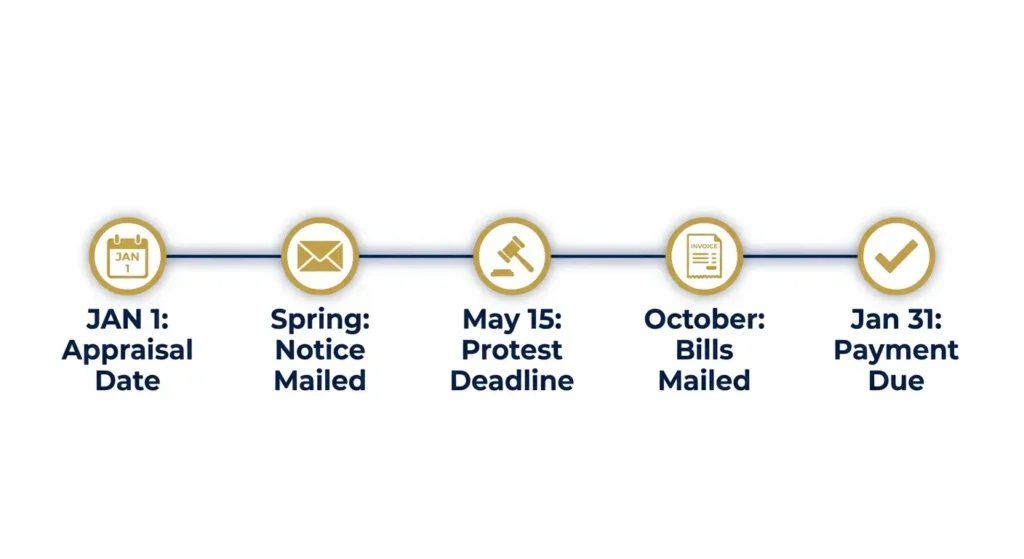
| January 1 | Ownership and condition set that year’s appraisal |
| Spring | Notice of Appraised Value mailed |
| May 15 (or 30 days after notice) | Protest deadline |
| October | Tax bills mailed |
| January 31 | Payment due; penalties and interest start after |
January 1: The Key Appraisal Date
Your property’s condition and ownership on January 1 sets that year’s appraisal, even if you buy later in the year. This date also anchors homestead eligibility.
Spring Appraisal and Protest Deadlines
A Notice of Appraised Value, required under Tax Code Section 25.19, goes out in spring. The standard protest deadline is May 15 or 30 days after mailing, whichever is later. Many districts offer an informal conference before a formal Appraisal Review Board hearing.
Property Tax Bill and Payment Deadlines
Bills are mailed in October under Tax Code Section 31.01. Payment is due by January 31 the following year, and Tax Code Section 33.01 triggers penalties and interest after that.
What Happens If You Miss a Deadline?
Missing payment triggers penalties and interest, and in extreme cases a tax lien or foreclosure. Missing a protest deadline generally locks in that year’s value, with only narrow exceptions. Talk to a professional if the stakes are high.
Texas Property Tax Troubleshooting: What to Do If Your Number Looks Wrong
Most surprises trace to one of four causes.
“My Tax Bill Is Much Higher Than Last Year”
Compare this year’s values to last year’s. Check for rate increases and missing exemptions. If the increase traces to appraised value and looks off, a protest may still be available.
“My CAD Record Shows the Wrong Home Details”
Document errors like wrong square footage with photos. Contact your appraisal district for a correction; you may still have protest rights on top.
“My Homestead Exemption Is Missing”
Confirm eligibility, then check whether an application was filed. Ask about late-filing rules and any resulting refund process.
“I Already Paid but Won My Protest”
A successful protest updates the appraisal roll and recalculates your liability. If you already paid the higher amount, you’re typically owed a refund; confirm with your taxing unit.
Common Texas Property Tax Myths and Misconceptions
A few persistent myths cause real financial mistakes.
“Texas Has No Property Tax”
Texas skips a state income tax entirely and leans on property tax to cover schools, roads, and public safety instead. Renters don’t get a bill directly, since the lease is with the landlord, but landlords typically build the cost into rent.
“Texas Has One Property Tax Rate”
No single statewide rate exists. Every taxing unit sets its own, and your total is the sum of whichever units cover your address.
“The 10% Cap Means My Tax Bill Can Only Rise 10%”
The cap limits appraised value growth, not your final bill. Rate increases and new construction can still push your bill up faster than 10%.
“The Appraisal District Sets My Property Tax Rate”
The appraisal district only sets value. Each taxing unit adopts its own rate. The tax assessor-collector handles billing based on both.
“My Purchase Price Automatically Determines My Property Tax”
Appraisal districts use area market data, not your individual purchase price, so the two numbers can differ. Exemptions and caps apply after that.
How to Lower Your Texas Property Tax Legally
None of this requires anything sketchy, just claiming what you qualify for.
Claim Every Exemption You Qualify For
Confirm your homestead exemption and check age, disability, veteran, or surviving spouse benefits. Verify agricultural appraisal if applicable. Check your CAD record every year.
Challenge an Incorrect Property Valuation
If value looks too high versus comparable sales, gather that data and file a protest. Unequal appraisal is also a valid basis. File before the deadline.
Monitor Your Property Record Every Year
Read your annual notice, compare values, and verify exemptions and rates every single year.
Avoid “Tax-Saving” Shortcuts That Create Problems
Only claim exemptions you genuinely qualify for; incorrect claims can bring back taxes, penalties, and interest. Verify eligibility directly with your appraisal district.
Should You Protest Your Texas Property Tax Appraisal?
If your value doesn’t match reality, a protest is the most direct fix.
Signs Your Property May Be Overvalued
Compare against recent comparable sales, check for factual errors, and note condition issues the appraisal missed.
What You Can Protest
Excessive appraised value, unequal appraisal, factual errors, and exemption or special-appraisal denials are all protestable.
How the Texas Property Tax Protest Process Works
File a formal Notice of Protest, using Form 50-132, the Property Owner’s Notice of Protest, with your local Appraisal Review Board before the deadline. Many districts offer an informal conference first. A formal ARB hearing follows if unresolved.
2026 Texas Property Tax Protest Deadline
May 15 or 30 days after your notice was mailed, whichever is later. Check your specific notice for the exact date; narrow exceptions allow late protests.
What Evidence Gives You the Strongest Case?
Recent comparable sales carry the most weight. Photos of condition issues and unequal-appraisal comparisons also help. Some homeowners hire a property tax protest company instead; most charge a percentage of savings, often a third to half, so confirm the fee structure and whether you owe anything if the protest fails.
What Happens After the ARB Decision?
A successful protest updates the appraisal roll and your tax calculation. If you disagree, a Texas property tax appeal can move forward through binding arbitration or district court. Already-paid amounts may be refunded. Changes apply only to the current year.
Texas Property Tax FAQs
How much is property tax in Texas on a $300,000 house?
No single statewide figure applies. Using a rough 2% combined rate and a filed homestead exemption, a $300,000 home lands around $4,500 to $5,000 a year. Your actual number depends on your county’s data and current rates.
What is the average property tax rate in Texas in 2026?
Census-based effective rates run 1.3% to 1.4% statewide. Combined published rates before exemptions run 1.8% to 2.5% in metro areas. Use these for rough planning only.
Does Texas have a homestead property tax exemption?
Yes, mandatory statewide for school taxes. For 2026, it’s $140,000, plus $60,000 for homeowners 65 or older or disabled. Some counties and cities add local-option exemptions.
How much can my Texas property appraisal increase each year?
For a qualifying homestead, 10% per year, starting the year after a full appraisal cycle. New improvements are taxed at full value on top of the capped portion.
When are Texas property taxes due?
Bills mail in October; payment is due by January 31 the next year. Penalties and interest start after that. Some counties offer installment plans.
How do I protest my Texas property tax appraisal?
File a Notice of Protest with your county Appraisal Review Board by your deadline, generally May 15 or 30 days after your notice was mailed. Form 50-132 is the standard state form. Gather comparable sales and condition evidence.
Can I get a refund if I overpaid Texas property taxes?
Yes, after a won protest, a retroactively approved late exemption, or an appraisal roll correction. Contact your county tax office to confirm the process.
Why are Texas property taxes so high?
No state income tax means heavier reliance on property tax. Combined rates from overlapping taxing units add up. Exemptions and compression measures help offset this, but the structure keeps rates relatively high nationally.
Your 2026 Texas Property Tax Action Checklist
If You Are Checking an Existing Tax Bill
Pull your values from your CAD record. Confirm exemptions. Review each taxing unit’s rate. Compare against last year.
If Your Appraisal Looks Too High
Pull comparable sales. Document errors or condition issues. Check your protest deadline. Build your evidence before filing.
If You Are Buying a Texas Home
Review the tax record before offering. Estimate future taxes using current value and rates, not the seller’s bill. Model a value increase. Add the estimate to your affordability math, or run the full picture through our how much house can I afford tool. If you have questions specific to your situation, our team is happy to help through our contact page.
If You Want to Reduce Your Bill
Verify every exemption you qualify for. Check the 10% cap and special appraisals. Consider a protest. Track deadlines and documentation.
Key Takeaways: What Your Texas Property Tax Really Depends On
The Four Numbers That Matter Most
Appraised value, exemptions and limitations, taxable value, and your combined local tax rate.
The Three Checks to Make Before Paying
Verify your property record, your exemption status, and your total bill and deadline.
The Three Actions That Can Save Money
Claim every exemption you qualify for, correct inaccurate property information, and protest an unsupported or unequal appraisal.
Where to Verify the Official 2026 Information
Use the Texas Comptroller of Public Accounts, specifically its Property Tax Assistance Division, available through Texas.gov property taxes resources. Use your county appraisal district for your property’s values and exemptions, and your local tax assessor-collector for billing. The Comptroller also publishes a Property Taxpayers’ Bill of Rights, covering your right to protest, your right to equal and uniform taxation, and your right to inspect appraisal information. Always confirm current-year deadlines and rates directly.