The Texas homestead exemption cuts $140,000 from your home’s taxable value for school district taxes, available to any owner who occupies the property as their principal residence on January 1, lowering the school portion of the bill, not erasing it.
That $140,000 figure reflects Proposition 13’s 2026 increase from $100,000, confirmed against current Texas Comptroller guidance and Tax Code Section 11.13.
Savings are real but partial, since county and city taxes still apply. If you are still weighing what you can comfortably buy, our guide on how much house you can afford in Texas factors these tax savings into the bigger budget picture.
Texas Homestead Exemption 2026: The Quick Answer
| Exemption Type | 2026 Amount | Applies To |
|---|---|---|
| Age 65 or disabled (additional) | $60,000 | School district taxable value |
| Combined senior/disabled total | $200,000 | School district taxable value |
| Effect | Shrinks what gets taxed, not the final bill amount | Actual dollar savings depend on your local tax rate |
How Much Is the 2026 Homestead Exemption?
The general homestead exemption for school district taxes is $140,000 in 2026, up from $100,000, under Proposition 13 and Senate Bill 4 (Texas Constitution Article VIII Section 1-b, Texas Tax Code Section 11.13, Chapter 11 of the Texas Property Tax Code, which governs ad valorem taxation statewide). It comes off your appraised value before the tax rate applies. At a 1% rate, that is roughly $1,400 a year in savings, not a $140,000 discount, and if you want the full picture of how Texas property taxes are calculated beyond just the homestead piece, that breakdown covers rates, deadlines, and regional differences. Local cities, counties, and special districts can add their own optional exemptions, which is why identical homes can owe different amounts. The Texas Legislature set the current amount, and the Texas Comptroller of Public Accounts publishes the official Texas Comptroller property tax forms each year. School districts must grant this exemption; counties, cities, and special districts are not required to.
Who Can Claim the Texas Homestead Exemption?
You need ownership interest and the home must be your principal residence, not a rental or vacation house. You must occupy it as of January 1 of the tax year. Texas allows only one homestead exemption at a time.
What Should You Do First?
Check your county appraisal district’s website to see if the exemption is already listed. Every property falls under one specific district, not the Texas Comptroller. If it is missing, an application is required. Also check whether you qualify for the over-65 or disabled person exemption, since those often go unclaimed.
How the $140,000 Texas Homestead Exemption Actually Works
The exemption does not touch market value. It only reduces the taxable value used for school tax, and different taxing units may apply different amounts.
What the $140,000 Exemption Reduces
Appraised value is what the county thinks your home is worth, generally the same figure as assessed value in Texas. Taxable value is what remains after exemptions, and that is the number the tax rate applies to. For school taxes, $140,000 comes off the appraised value: a $350,000 home becomes $210,000 taxable. Other taxing units calculate their own taxable value under their own rules.
Why Your Actual Savings May Be Different
School districts are just one taxing unit on your bill. Counties, cities, and special districts like hospital or water districts set their own rates and optional exemptions, and not all match the $140,000 school exemption. A 10% local homestead exemption raises your total savings, and the over-65 or disabled exemption adds more on the school side. Property tax is only one piece of your monthly cost, alongside HOA fees on a Texas mortgage and Texas homeowners insurance costs.
How Much Money Can the Exemption Save?
Multiply your school tax rate by $140,000 for your school tax savings. At 1%, that is about $1,400 a year. At 1.2%, like parts of Houston, it is about $1,680. Add local exemptions and county and city rates, and total annual savings run $1,400 to $2,000 for most homeowners. On a $500,000 home, $140,000 off leaves $360,000 taxable, about $3,960 a year at a 1.1% school rate, roughly $1,540 less than an unexempted bill. If you want to see how this savings plays into your full monthly payment, our mortgage calculator walks through the whole PITI breakdown.
Texas Homestead Exemption vs. the 10% Appraisal Cap
These two benefits get confused, but they solve different problems.
What the Homestead Exemption Does
The exemption reduces taxable value on your residence homestead, lowering the base your tax rate applies to. It renews automatically once approved and does not change what your home is worth or would sell for. It is separate from the Texas Constitution’s homestead protections against most creditors, which apply automatically and are not filed with the appraisal district.
What the 10% Homestead Appraisal Cap Does
The cap limits your home’s taxable value increase to 10% over last year’s appraised value, or current market value, whichever is lower, under the residence homestead appraisal limitation (Tax Code Section 23.23). It does not apply the year you buy, only starting the second year you own and occupy the home. If your $300,000 home hits $360,000 in market value, the cap limits taxable value to $330,000. If the market drops, taxable value must drop too, since the cap only limits increases. New improvements, like a room or pool, are added on top; routine repairs do not count as improvements.
Why You Can Have Both Benefits
The exemption lowers taxable value; the cap limits how fast it can rise. They stack once your homestead is on file. This is why long-time owners often pay less than a neighbor with an identical new purchase, since capped value can sit below market value for years.
Who Qualifies for a Texas Homestead Exemption?
Basic Residence Homestead Requirements
You need ownership interest, full or partial, and the property must be your principal residence in Texas. Renters and investment property owners do not qualify.
Can You Claim More Than One Homestead?
No. Texas allows one residence homestead exemption per person or married couple. A vacation home or a rental you do not live in does not qualify. Claiming two triggers a review.
What Property Types Can Qualify?
Single-family homes, condominiums you occupy, and manufactured homes with proper title documentation all qualify. Homes on leased land can qualify too, with more paperwork to prove ownership of the structure and the right to occupy the land.
How to Apply for the Texas Homestead Exemption
Form 50-114: Residence Homestead Exemption Application
Form 50-114, published by the Texas Comptroller of Public Accounts, is free to download through the Comptroller’s website or your county appraisal district. It covers the general exemption plus boxes for age-65 and disabled-person exemptions. File it once with your local appraisal district, not the Comptroller. Heirs without a full deed often pair it with Form 50-114-A and the Residence Homestead Exemption Affidavits.
What Information and Documents May Be Required
You need basic property and ownership information, plus proof this is where you live. Most districts want a Texas driver’s license or state ID matching the address; a Texas identification card works too. Respond quickly if asked for more, since incomplete paperwork causes most denials.
Where to Submit the Application
File with your county appraisal district, not the Comptroller and not the tax assessor-collector. Each of Texas’s 254 counties has its own district. Many accept online filing; keep proof of submission.
When Should You File the Texas Homestead Exemption?
Standard Filing Window
The window runs January 1 through April 30. Some counties extend to May 1. File early to give the district time before tax statements go out.
What Happens If You Miss the Deadline?
Late applications are accepted up to two years past the delinquency date, and can trigger a retroactive exemption and refund. You will need proof you occupied the home during the year claimed.
Do You Have to Reapply Every Year?
No, it renews automatically as long as you keep living there. You only resubmit if something changes, like turning 65. Some counties periodically ask homeowners to reconfirm eligibility, and state law now requires appraisal districts to re-verify every homestead exemption at least once every five years, so do not ignore a verification notice even if nothing in your situation has changed.
New Homeowners: When Can You Claim the Exemption?
If you are working through a purchase for the first time, our first-time home buyer guide, down payment options, and breakdown of Texas mortgage closing costs cover the steps that come before the exemption paperwork even starts.
Buying a Home During the Tax Year
The previous owner’s exemption does not transfer to you automatically. File your own Form 50-114 as soon as you move in, and the district will update its records for the applicable tax year.
Moving From One Texas Home to Another
Remove the exemption from your old home and file fresh on the new one; you cannot claim both. Moving from Travis County to Williamson County, for example, means removing the exemption in Travis and filing new in Williamson. The 10% cap resets at the new address. Seniors with a school tax ceiling can carry it forward using a residence homestead exemption transfer certificate, Form 50-808.
Selling a Homesteaded Property
Your exemption ends at sale. The buyer files their own application once they own and occupy the home. Filing or removing the exemption has no effect on sale price, since it affects tax bills, not market value.
Additional Texas Homestead Exemptions You May Qualify For
Beyond the standard $140,000 exemption, four other categories can lower your bill further: age, disability, veteran status, and local-option exemptions, each with its own rules and paperwork.
Age 65 or Older Exemption
Homeowners who turn 65 get an additional $60,000 off school taxable value, for $200,000 combined with the standard $140,000 (Texas Constitution Article VIII Section 1-b, Tax Code Section 11.13(c)). Ownership and principal residence are still required. The school tax ceiling is separate: it freezes your school tax dollar amount at the level you first qualified, while the exemption just reduces taxable value each year. Even at $200,000 combined, most owners still owe county and city tax, since those units are not required to match. A surviving spouse can often keep this exemption if they were 55 or older when their spouse died and still live in the home.
Disabled Person Exemption
Texas uses the Social Security disability standard. Qualifying homeowners get an additional exemption similar in structure to the over-65 benefit, with documentation required. You cannot claim both age-65 and disabled at full value on the same home; Texas treats them as alternatives.
Disabled Veteran Homestead Exemptions
Disabled veterans qualify for exemptions scaled to their VA disability rating under Tax Code Section 11.22 for partial ratings. Veterans rated 100% disabled or individually unemployable qualify for a full homestead exemption under Tax Code Section 11.131. Surviving spouses of qualifying disabled veterans often retain the benefit.
Local Homestead Exemptions
Counties, cities, and other taxing units can offer optional homestead exemptions, part of the wider set of property tax exemptions Texas makes available. These run 5% to 20% of home value, with a $5,000 minimum dollar exemption. Counties must separately offer at least a $3,000 county homestead exemption for farm-to-market road and flood control purposes. Savings depend heavily on location. Seniors and disabled homeowners who still cannot cover their bill can apply for a property tax deferral, which postpones collection until the home sells.
Texas Homestead Exemption Examples
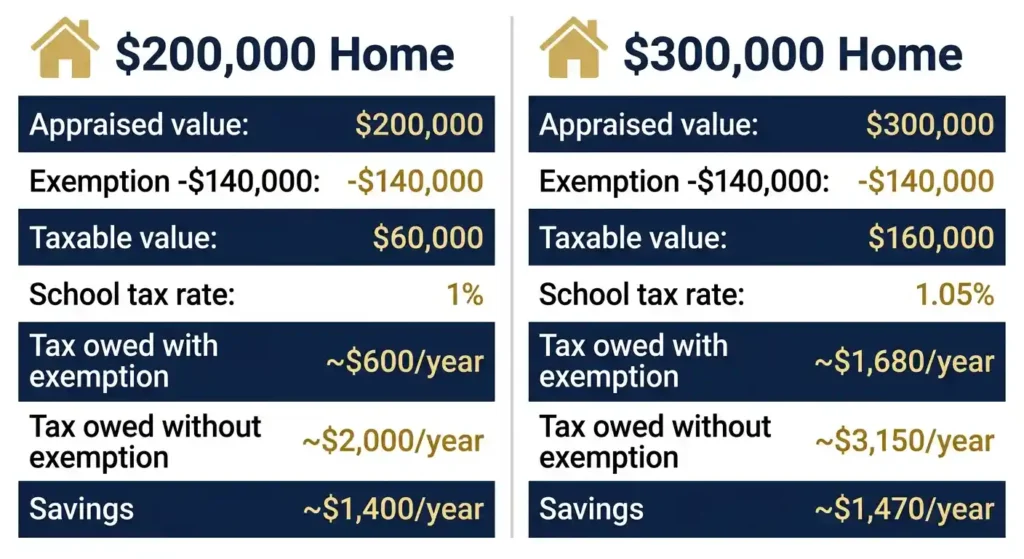
Example: $200,000 Texas Home
| Item | Amount |
|---|---|
| Appraised value | $200,000 |
| Exemption | -$140,000 |
| Taxable value | $60,000 |
| School tax rate | 1% |
| Tax owed with exemption | ~$600/year |
| Tax owed without exemption | ~$2,000/year |
| Savings | ~$1,400/year |
Example: $300,000 Texas Home
| Item | Amount |
|---|---|
| Appraised value | $300,000 |
| Exemption | -$140,000 |
| Taxable value | $160,000 |
| School tax rate | 1.05% |
| Tax owed with exemption | ~$1,680/year |
| Tax owed without exemption | ~$3,150/year |
| Savings | ~$1,470/year |
Example: Home With a 10% Appraisal Cap
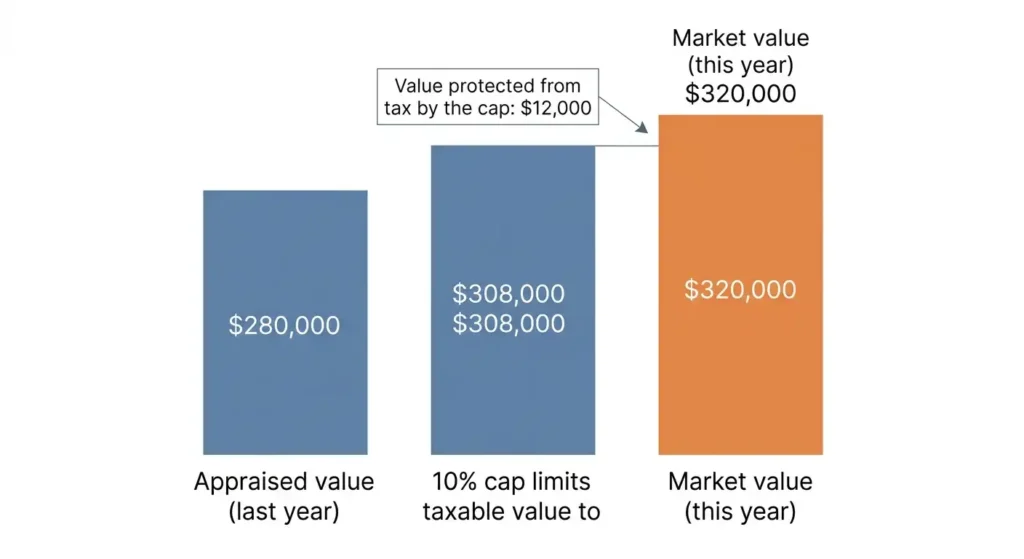
| Item | Amount |
|---|---|
| Appraised value (last year) | $280,000 |
| Market value (this year) | $320,000 |
| 10% cap limits taxable value to | $308,000 |
| Value protected from tax by the cap | $12,000 |
A new deck’s value is added on top of the capped number, since new construction is not protected by the cap.
Example: Senior or Disabled Homeowner
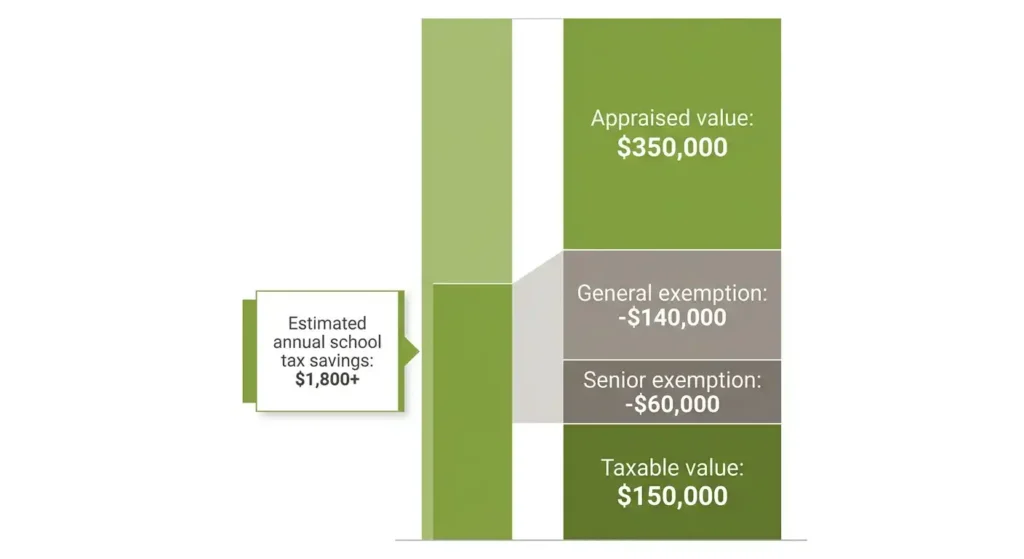
| Item | Amount |
|---|---|
| Appraised value | $350,000 |
| General exemption | -$140,000 |
| Senior exemption | -$60,000 |
| Taxable value | $150,000 |
| Estimated annual school tax savings | $1,800+ |
A school tax ceiling also freezes their school bill even if the district’s rate rises later.
Special Situations That Can Change Your Eligibility
Inherited or Heir Property
Heirs without a formal probate transfer can often still qualify if they occupy the property as their principal residence, usually with an affidavit of heirship. A sibling who inherits a share and moves in can typically claim the exemption on their portion before the estate is fully settled.
Married Couples and Multiple Owners
Married couples share one exemption tied to their principal residence, even if only one spouse is on the deed, and only one spouse needs to actually live there. Unrelated co-owners, including an unmarried couple who both live in and own the home, can each claim their share. Claiming separate homesteads within a married household is a common mistake districts catch.
Surviving Spouses
A surviving spouse can often continue an exemption without reapplying, especially the age-65 exemption, if they were 55 or older when their spouse died and still live there. Disabled veteran surviving spouses have separate continuation rules. A death certificate and proof of residence are usually required. Remarrying generally ends this benefit, since it applies to unmarried surviving spouses.
Trusts and Other Ownership Arrangements
A home held in a qualifying trust can still get the exemption if the trust grants a qualifying beneficial ownership interest. Districts may request the trust agreement. Call the district before filing to avoid delays.
Temporary Absence From the Home
A hospital stay, deployment, or work assignment generally does not cancel the exemption if you intend to return and are not renting the home out. Moving away permanently or converting to a rental ends eligibility. Notify the district if your situation changes for long.
Common Texas Homestead Exemption Mistakes and Myths
“The $140,000 Means I Save $140,000 in Taxes”
This is the most common mix-up: $140,000 comes off what gets taxed, it is not a dollar-for-dollar cut to what you owe. Savings depend on your local school tax rate.
“The Homestead Exemption Is Automatic”
It is not, usually. File Form 50-114 with your county appraisal district; do not assume your lender handled it at closing.
“The 10% Cap Means My Property Taxes Can Only Rise 10%”
The cap limits appraised value, not your bill. Rate increases can push your bill up more than 10%, and new improvements fall outside the cap entirely.
“I Can Claim a Homestead Exemption on Every Property I Own”
Texas allows one homestead exemption per person or married couple, tied to your principal residence. Rentals and vacation homes are excluded.
“I Must Reapply Every Year”
It renews automatically. You only resubmit if circumstances change, like turning 65 or moving.
How to Check If Your Texas Homestead Exemption Is Active
Check Your County Appraisal District Record
Search your property on the appraisal district’s website. Look for the residence homestead exemption line and confirm taxable value reflects it. Compare against your actual tax bill.
What to Do If the Exemption Is Missing
Confirm eligibility, mainly ownership and occupancy as of January 1. If missing, contact the district and submit Form 50-114. If you never filed, ask about late or retroactive relief, sometimes covering two full tax years. If approved but not yet on your bill, check the certification date, since exemptions approved after the roll is locked often show up on the next bill.
What to Do If the Appraised Value Looks Wrong
Review your appraisal notice, checking market value and capped value. If market value looks inflated, file a protest with the Appraisal Review Board. If your exemption application itself was denied, you can appeal that too, separate from any value protest.
Texas Homestead Exemption FAQ
How much is the Texas homestead exemption in 2026?
The general school district exemption is $140,000. Homeowners 65 or older, or disabled, add $60,000 for $200,000 combined. This shrinks the value that gets taxed, it is not a direct cut to the bill itself.
Who qualifies for the Texas homestead exemption?
Ownership plus a principal residence you actually live in. One homestead exemption per person or couple.
How do I apply for a homestead exemption in Texas?
File Form 50-114 with your county appraisal district, with proof of ownership and a Texas ID matching the address.
When is the Texas homestead exemption deadline?
April 30 of the tax year. Late applications are accepted up to two years past the delinquency date, with possible retroactive refunds.
Is the Texas homestead exemption automatic?
No. Check your appraisal district’s website; do not assume it transferred from the previous owner.
Does the Texas homestead exemption lower property taxes?
Yes, indirectly, by reducing taxable value. Actual savings depend on your school tax rate and any local exemptions.
What is the 10% homestead exemption cap?
It limits appraised value increases to 10% a year above last year’s value or current market value, whichever is lower. New improvements are not covered.
Can I claim a homestead exemption on a second home?
No. Only your principal residence qualifies. Vacation and rental properties do not.
Can I get a homestead exemption if I am 65 or older?
Yes, an additional $60,000 on top of the general $140,000, with ownership and residence requirements. Surviving spouses may continue the benefit.
Can I get a homestead exemption if I am disabled?
Yes, under Texas’s Social Security-based disability standard, with documentation required. It works similarly to the age-65 benefit.
Your 2026 Texas Homestead Exemption Checklist

Before You Apply
- Confirm principal residence status as of January 1
- Verify ownership details match county records
- Check if an exemption is already listed
- Note any age-65 or disabled exemptions that may also apply
When You Apply
- Complete Form 50-114, checking the correct boxes for every exemption you qualify for
- Attach your Texas driver’s license or state ID
- Include any other requested documents
- Submit to your county appraisal district and keep proof
After Approval
- Confirm the exemption appears on your account
- Review your updated taxable value
- Check for applicable local exemptions and watch future appraisal notices for errors
- If your mortgage is escrowed, do not expect an immediate payment drop, since lenders usually recalculate once a year, see our PITI payment breakdown for how taxes fit into your monthly payment
- Estimate your next bill by multiplying your new taxable value by last year’s combined tax rate
For more Texas homeownership guides, browse our mortgage basics category or learn more about our editorial team.