Homeowners insurance in Texas is a policy that pays to repair or rebuild your home, replace belongings, and cover liability claims after a covered loss, with real gaps that catch first-time buyers off guard.
I’ve reviewed dozens of Texas declarations pages, and the coverage buyers assume exists rarely matches what’s actually in writing.
The tradeoff: broader protection costs more, and Texas premiums already rank among the nation’s highest.
Homeowners Insurance in Texas: The Quick Answer
Texas homeowners insurance costs more than most states, and the wind and flood rules trip people up most.
How much does homeowners insurance cost in Texas?
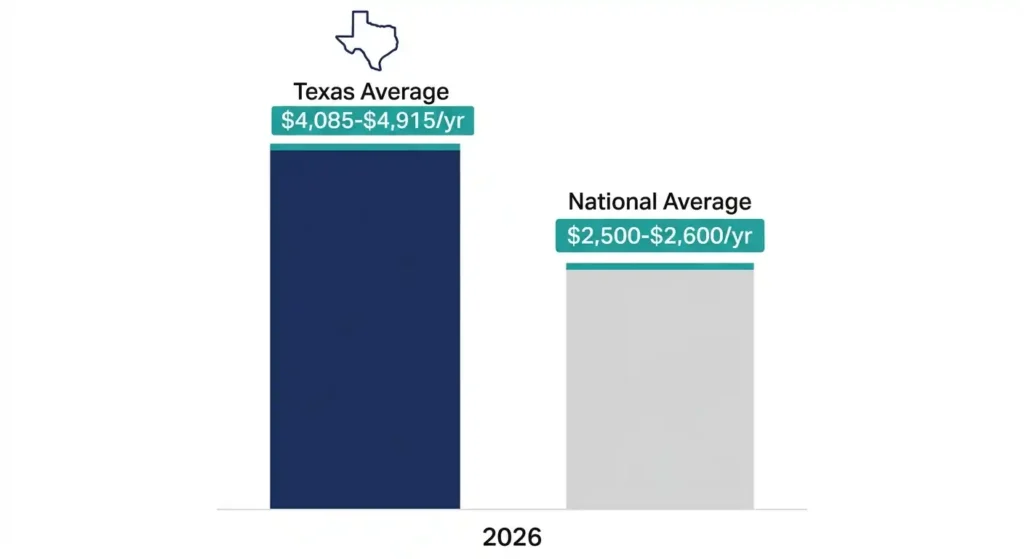
In 2026, Texas homeowners pay $4,085 to $4,915 a year for $300,000 in dwelling coverage, about $340 to $410 a month. Your number depends on location, roof, and deductible. This premium is the “I” and property taxes are the “T” in your monthly PITI payment, while HOA dues sit outside PITI as a separate cost on top.
Is homeowners insurance required in Texas?
State law doesn’t require it. Your mortgage lender does, and escrows the premium into your payment. Let coverage lapse and your lender can force-place a pricier, thinner policy. Once the mortgage is paid off, coverage is optional but still financially important.
What coverage does a standard Texas homeowners policy provide?
A standard policy bundles dwelling, personal property, liability, and additional living expenses. Most Texas policies write the dwelling on an open-peril, or all-risk, basis and personal property on a named-peril basis. Read the declarations page, it tells you exactly what you bought.
The three-policy question Texas homeowners must answer
Most Texans need one policy: homeowners. Add flood insurance if you’re near water or low-lying land. Add separate wind and hail coverage if you’re in a coastal county where standard policies exclude it.
What Does Homeowners Insurance Cover in Texas?
Coverage breaks into five parts, and knowing the lines between them prevents denied claims.
Dwelling coverage
Dwelling coverage rebuilds your home’s structure at current rebuild cost, not market value. It pays for fire, storm, and other structural losses.
Personal property coverage
This covers furniture, clothes, and electronics, usually capped at 50 to 70 percent of your dwelling limit. Jewelry and firearms have smaller sublimits. Keep a home inventory for faster claims.
Other structures coverage
Detached garages, fences, sheds, and pools usually fall under a percentage of your dwelling limit. A driveway is often treated separately and sometimes excluded from wear damage. Unusual structures may need their own endorsement.
Liability and medical payments coverage
Liability pays if a visitor is hurt or you damage someone else’s property, often capped at $100,000 to $300,000. An umbrella policy adds cheap extra protection above that.
Additional living expenses and loss of use
This pays for temporary housing and food if a covered loss makes your home unlivable. Limits are capped by dollar amount or time, so check both.
What Homeowners Insurance Does Not Cover in Texas
Exclusions matter as much as coverage.
Flood damage
Rising water is never covered, including storm surge and heavy rain pooling in. A burst pipe inside your walls is a separate, covered water damage claim. Most flood coverage runs through the National Flood Insurance Program, known as NFIP. Hurricane Harvey showed this best: most Houston homes that flooded in 2017 sat outside mapped high-risk zones, and standard policies paid nothing.
Wind and hail exclusions on the Texas coast
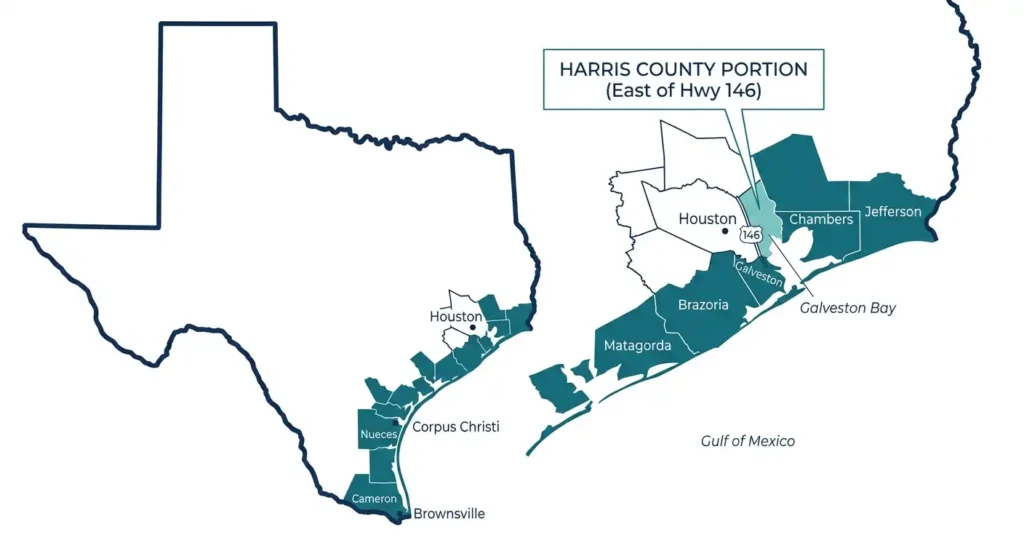
Inland, wind and hail usually ride with your standard policy. In the 14 first tier coastal counties along the Texas Gulf Coast, plus parts of Harris County east of Highway 146 near Galveston Bay, insurers write “ex-wind” policies that carve it out. TWIA, the Texas Windstorm Insurance Association, or a private wind carrier fills that gap.
Common exclusions homeowners overlook
Earthquake, termites, wear and tear, and mold from a slow leak are standard exclusions. Foundation damage is only covered if a sudden event caused it. Wind-driven rain coverage depends on whether wind first created an opening for water.
Maintenance problems versus sudden covered damage
Insurance pays for sudden, accidental damage, not slow deterioration from skipped maintenance. A burst pipe is covered; a pipe dripping for two years is not.
Texas Homeowners Insurance Cost: What You Should Expect
Texas costs run well above the national average.
Current Texas homeowners insurance cost benchmark
The 2026 statewide average is $4,085 to $4,915 a year for $300,000 in dwelling coverage, roughly 60 to 90 percent above the national average of $2,500 to $2,600. Treat it as a benchmark, not your quote, and factor it into how much house you can afford in Texas before you set your budget.
What determines your Texas home insurance premium?
Location, rebuild cost, home and roof age, materials, and claims history plus deductible drive your number most. Most insurers also factor in a credit-based insurance score. A 2026 Texas law lets you request a re-underwrite with current credit data once every 12 months, and insurers must notify you in writing if credit data raised your premium.
Why Texas insurance can cost more in high-risk areas
Hail hits North Texas and Dallas-Fort Worth every spring. Tornadoes track through Central Texas and San Antonio. Hurricanes threaten Houston, Corpus Christi, Beaumont, Brownsville, and the Gulf Coast. Wildfire risk adds to it in the Hill Country and West Texas.
Why two similar Texas homes can have different premiums
ZIP code risk, rebuild cost, roof material, and claims history all shift the number. A metal roof versus shingles alone can shift a quote by hundreds a year.
How to Calculate Your Real Homeowners Insurance Cost
Your quote is a starting number, not your full exposure.
Annual premium versus monthly insurance cost
Divide your annual premium by twelve for the real monthly cost. Keep it separate from escrowed property taxes, and add any flood or wind premiums on top. If you want the full picture, see how your mortgage payment is calculated.
Calculate a percentage deductible in dollars
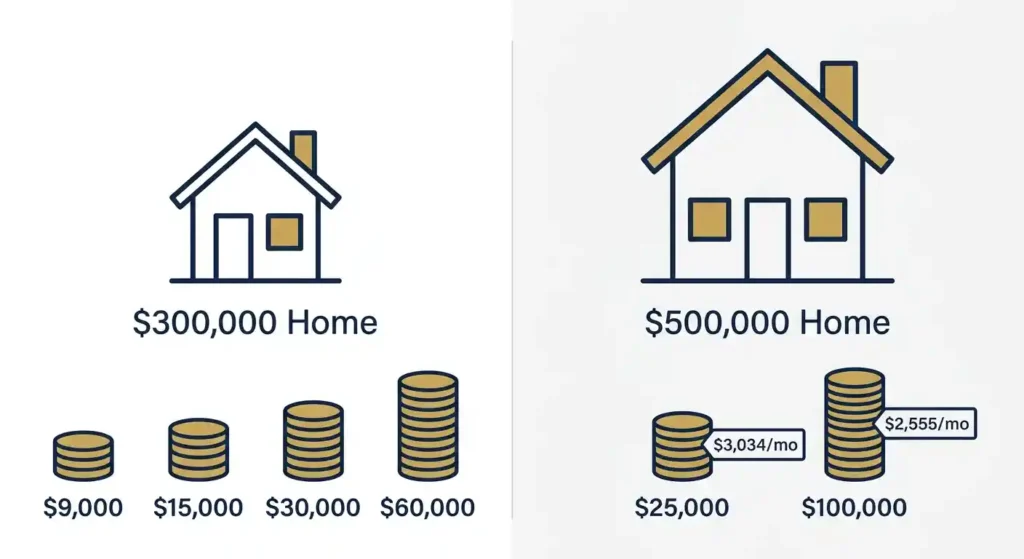
Apply the percentage to your dwelling limit, not your premium. On a $300,000 dwelling limit:

| Deductible % | Dollar Amount |
|---|---|
| 1% | $3,000 |
| 2% | $6,000 |
| 3% | $9,000 |
| 5% | $15,000 |
Compare a low-premium policy with a high-deductible policy
A lower premium often means a higher percentage deductible. Compare the annual savings against what you’d actually owe in a real claim.
Estimate your potential total insurance exposure
Add homeowners, flood, and wind premiums, plus your largest possible deductible, for your real worst-case annual cost, and weigh it against how much down payment you’ll need to close in the first place.
How Texas Homeowners Insurance Deductibles Work
Deductibles confuse more homeowners than any other policy detail.
Dollar deductibles versus percentage deductibles
A dollar deductible is fixed, like $1,000. A percentage deductible scales with your dwelling limit, so it rises as your coverage limit rises.
Wind and hail deductibles
Many Texas policies carry a separate wind and hail deductible, often 1 to 5 percent of your dwelling limit, on top of or instead of the standard one.
What happens when damage costs less than your deductible?
On a $300,000 dwelling limit with a 5% deductible, that’s $15,000. A $6,500 roof repair gets paid entirely out of pocket. Filing a small claim can also raise your renewal price or hurt future eligibility, so weigh that first.
How to choose an affordable deductible
Pick a deductible your emergency savings can actually cover, not just the one with the lowest premium.
Replacement Cost vs. Actual Cash Value in Texas
This decides what you actually collect after a claim.
What replacement cost coverage means
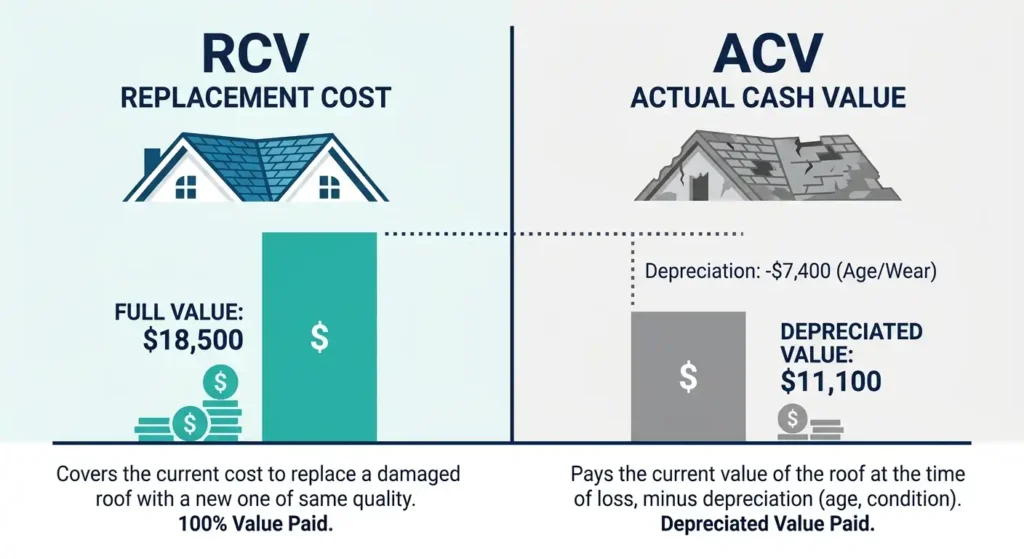
Replacement cost, often shown as RCV, pays current repair or rebuild cost with no age deduction.
What actual cash value means
Actual cash value, ACV, subtracts depreciation for age and condition. An older roof pays out far less than a new one costs.
Which coverage should a Texas homeowner choose?
If your lender requires replacement cost, that decision is made. If you have a choice, replacement cost wins for long-term protection, even at a higher premium.
| RCV (Replacement Cost) | ACV (Actual Cash Value) | |
|---|---|---|
| Depreciation | None | Subtracted |
| Payout | Full current rebuild cost | Depreciated value |
| Premium | Higher | Lower |
| Best for | Long-term protection | Lowest upfront cost |
Homeowners Insurance vs. Flood Insurance vs. Wind Insurance
Three policies, three separate jobs.
What homeowners insurance covers
Core structure, belongings, and liability protection, minus flood everywhere and wind on parts of the coast.
What flood insurance covers
A separate policy, through NFIP or a private carrier, pays for rising water damage to your building and, if added, your belongings.
What wind and hail insurance covers
Wind and hail losses specifically, usually through TWIA or a private wind carrier for eligible coastal properties.
Which combination of policies do you need?
Inland, away from flood zones: homeowners only. Flood-prone inland: add flood. Gulf Coast: homeowners, flood, and wind, often all lender-required.
Texas Coastal Homeowners: TWIA and Windstorm Coverage
Coastal buyers need this section most.
When a Texas homeowner may need TWIA
TWIA applies in the 14 first tier coastal counties, including Galveston, Brazoria, Nueces, and Cameron, plus the part of Harris County east of Highway 146.
TWIA eligibility requirements
You need a property in the territory, one declination letter from a private insurer, and, for structures built or altered since 1988, a WPI-8 windstorm certificate of compliance.
Why TWIA should not be treated as a complete homeowners policy
TWIA only covers wind and hail, not fire, theft, liability, or flood. You still need a standard homeowners policy and, often, flood coverage.
Why waiting until a hurricane approaches can be a mistake
Insurers and TWIA stop writing new coastal policies once a storm enters the Gulf. Flood policies carry a 30 day waiting period. Lock in coverage before hurricane season.
How to Compare Texas Homeowners Insurance Quotes
Two similar-priced quotes can offer very different protection.
Compare the coverage limits first
Line up dwelling, personal property, liability, and additional living expense limits before comparing price.
Compare deductibles side by side
Check both the standard and any wind and hail deductible, converted to dollars, on every quote.
Compare exclusions and endorsements
Check flood, wind and hail, water, and mold exclusions, and whether high-value items need a separate endorsement.
Compare replacement cost and ACV
Confirm whether dwelling and personal property settle on replacement cost or ACV, and how each insurer depreciates roofs.
Compare the insurer, not just the price
Confirm the insurer is licensed with the Texas Department of Insurance, check financial strength, and check claims history. An independent agent can quote multiple insurers at once. The Office of Public Insurance Counsel and tools like HelpInsure help you compare rate filings using data from the Texas Statistical Plan for Residential Risks.
How Much Homeowners Insurance Coverage Do You Need?
More coverage isn’t automatically better, but under-insuring is the common mistake once you’ve already worked out how much house you can afford.
Calculate the right dwelling coverage
Base your limit on current rebuild cost, not market value, to avoid a costly shortfall after a total loss.
Estimate personal property coverage
Use a home inventory to size this limit, and schedule high-value items that exceed standard sublimits.
Choose liability coverage
Size liability to your actual assets and risk, and add an umbrella policy if your standard limit runs thin.
Review other structures and loss-of-use limits
Check that detached structures and temporary housing limits match real costs in your area.
Special Texas Home Insurance Situations
Some situations need extra attention.
First-time homebuyer buying with a mortgage
Your lender requires proof of insurance before closing, usually with replacement cost coverage matching your loan, and it typically shows up as a line item in your Texas mortgage closing costs. New construction typically quotes lower than an older resale home. If you’re working through the rest of the process, our first-time home buyer guide and our breakdown of how PMI works cover the other costs that stack up alongside your insurance premium.
Home with an older roof
Roofs older than 15 to 20 years draw heavy underwriting scrutiny in 2026 and may only qualify for ACV coverage. Get an inspection before shopping.
Home in a flood-prone area
Check your flood zone status, since many homes flood outside the official map. Remember the 30 day waiting period.
Coastal Texas home
Plan on TWIA or private wind coverage plus flood insurance alongside your standard policy, and confirm your roof can get a WPI-8 certificate.
Home with expensive jewelry, art, or collectibles
Get valuable items appraised and scheduled separately, since standard sublimits fall short.
Home used for Airbnb or another business
Standard policies often exclude business use. Ask about a home-sharing endorsement or a dedicated short-term rental policy.
What to Do If You Cannot Find Affordable Texas Home Insurance
A decline or high price isn’t the end of the road.
Why an insurer may decline your home
Location risk, roof age, claims history, and vacancy all raise decline odds, since empty homes draw extra scrutiny.
What to do after a nonrenewal
Under a 2026 Texas law, insurers must now state the specific reason for a decline, cancellation, or nonrenewal in writing without you having to ask. Read that notice closely, shop immediately, and address the specific reason given so you can fix it before applying elsewhere.
When the Texas FAIR Plan Association may matter
The Texas FAIR Plan Association is Texas’s insurer of last resort, requiring proof that at least two insurers declined you. Shop the private market first.
How to reduce the risk of an insurance gap
Keep your old policy active until the new one is confirmed, notify your lender, and save your documents.
How Homeowners Insurance Claims Work in Texas
Knowing this before disaster hits saves time and money.
What to do immediately after covered property damage
Stop further damage, photograph everything first, and hold off on permanent repairs until your adjuster sees it. Call your insurer promptly.
How the deductible affects the claim payment
Your insurer subtracts the applicable deductible, standard or storm, from the approved repair cost. Replacement cost claims often pay in two steps.
What to do if your claim is denied or underpaid
Get the insurer’s reasoning in writing, check it against your policy, and get your own estimates. A Texas Department of Insurance complaint is a normal step; claim handling is governed by the Texas Insurance Code and Texas Administrative Code.
When a claim dispute needs additional help
For large or repeatedly underpaid claims, a public adjuster or insurance attorney can be worth the cost.
Real Texas Homeowners Insurance Scenarios
Numbers land better with examples.
A $300,000 Texas home with a 2% deductible
That’s a $6,000 deductible. On $20,000 in hail damage, you pay $6,000 and the insurer pays $14,000.
A coastal Texas homeowner after a hurricane
A hurricane can trigger three claims at once: wind through TWIA, structural damage through homeowners, and storm surge through flood, each with its own deductible.
A homeowner whose roof is damaged by hail
Hail is a standard covered peril. Your wind and hail deductible applies, and replacement cost versus ACV decides your actual payout.
A homeowner whose house floods during a storm
Standard homeowners insurance pays nothing for flood. Only a separate flood policy responds.
A homebuyer comparing two insurance quotes
A cheaper quote with a lower limit and a 5% deductible can cost more at claim time than a pricier quote with a 2% deductible.
Common Texas Homeowners Insurance Myths
Let’s clear these up.
| Myth | Fact |
|---|---|
| Insurance is legally required in Texas | Only your mortgage lender requires it |
| Homeowners insurance covers flooding | Always excluded, needs a separate flood policy |
| A 5% deductible means 5% of the repair bill | It’s 5% of your dwelling limit, a flat dollar amount |
| The cheapest quote is the best deal | Not if limits, deductibles, or exclusions are worse |
| Market value sets how much coverage you need | Rebuild cost sets your dwelling limit |
“Homeowners insurance is legally required in Texas.”
Correct only until the mortgage is paid off; after that it’s your own financial call.
“My homeowners insurance covers flooding.”
Even homes outside FEMA’s mapped zones flood in Texas storms, so this gap catches more people than the map suggests.
“A 5% deductible means I pay 5% of the repair bill.”
On $300,000, that’s a flat $15,000, regardless of whether the repair costs $10,000 or $50,000.
“The cheapest quote is the best deal.”
Run a real claim scenario through both quotes before deciding; the “savings” often disappear the moment you file.
“My home’s market value determines how much insurance I need.”
Land value doesn’t need insuring, it can’t burn down, but construction and labor costs absolutely do.
Texas Homeowners Insurance Shopping Checklist
Work through this before you commit.
Before requesting quotes
- Gather property details
- Get a rebuild cost estimate
- Build a home inventory
- Pull your claims and roof history
Questions to ask every insurer
- What’s covered and excluded?
- What are both deductibles, in dollars?
- Is it replacement cost or ACV?
- Are flood and wind and hail separate?
Before choosing a policy
- Match coverage limits across quotes
- Convert deductibles to dollars
- Verify the insurer and agent are licensed
Before canceling an existing policy
- Confirm the new policy is active
- Notify your lender
- Avoid any coverage gap
Frequently Asked Questions About Homeowners Insurance in Texas
How much is homeowners insurance in Texas?
$4,085 to $4,915 a year for $300,000 in dwelling coverage in 2026, or roughly $340 to $410 a month.
Is homeowners insurance mandatory in Texas?
Not by state law, but mortgage lenders require it.
Does homeowners insurance cover flooding in Texas?
No. It’s always excluded and needs a separate flood policy.
Does homeowners insurance cover hail and wind damage in Texas?
Usually yes inland. On the coast, it’s often excluded, and TWIA or a private wind carrier fills the gap.
What is a normal homeowners insurance deductible in Texas?
Fixed dollar deductibles or 1 to 2 percent of dwelling coverage, with a separate 1 to 5 percent wind and hail deductible common in storm areas.
How can I lower my homeowners insurance cost in Texas?
Shop multiple insurers, ask about bundling and security discounts, and consider impact-resistant roofing for wind mitigation savings.
Why is homeowners insurance so expensive in Texas?
Severe weather exposure statewide, rising construction costs, and heavy catastrophe risk in insurer pricing.
Can I get homeowners insurance if other companies deny me?
Yes, through the private market, TWIA for eligible coastal wind and hail risk, or the Texas FAIR Plan as a last resort.
What is the difference between replacement cost and actual cash value?
Replacement cost pays current rebuild cost with no depreciation; actual cash value subtracts depreciation, cutting payouts on older items like roofs.
Do I need flood insurance if I am not in a flood zone?
Worth considering. Homes outside mapped zones still flood regularly in Texas storms.
What to Check Before You Buy Texas Homeowners Insurance
A final pass before signing.
Confirm the policy protects the risks that matter for your location
Match your coverage to your homeowners, flood, and wind and hail exposure.
Confirm you can afford the worst-case deductible
Add up standard, percentage, and storm deductibles against your emergency savings.
Confirm the policy can rebuild your home
Check that your dwelling limit reflects current construction costs and that you’re on replacement cost coverage.
Confirm there are no hidden coverage gaps
Check exclusions, endorsements, and any special-use coverage you need.
Confirm the policy before you sign
Compare declarations pages, verify the effective date, and confirm your lender has what it needs.
Final Texas Homeowners Insurance Takeaway
The four numbers to know before choosing a policy
Annual premium, dwelling coverage limit, standard deductible, and storm or percentage deductible.
The three coverage questions to answer
Do you need flood coverage? Do you need separate wind and hail coverage? Are your valuables adequately covered?
The final comparison before buying
Weigh coverage against premium, deductible against savings, exclusions against real risk, and insurer reliability against price.
Once your insurance numbers are locked in, run them through our mortgage calculator to see your full monthly payment. For related reading, our mortgage basics category covers the rest of the homebuying process, and you can learn more about who writes these guides on our about page.
You can also browse our full post index, site pages, and category list directly.