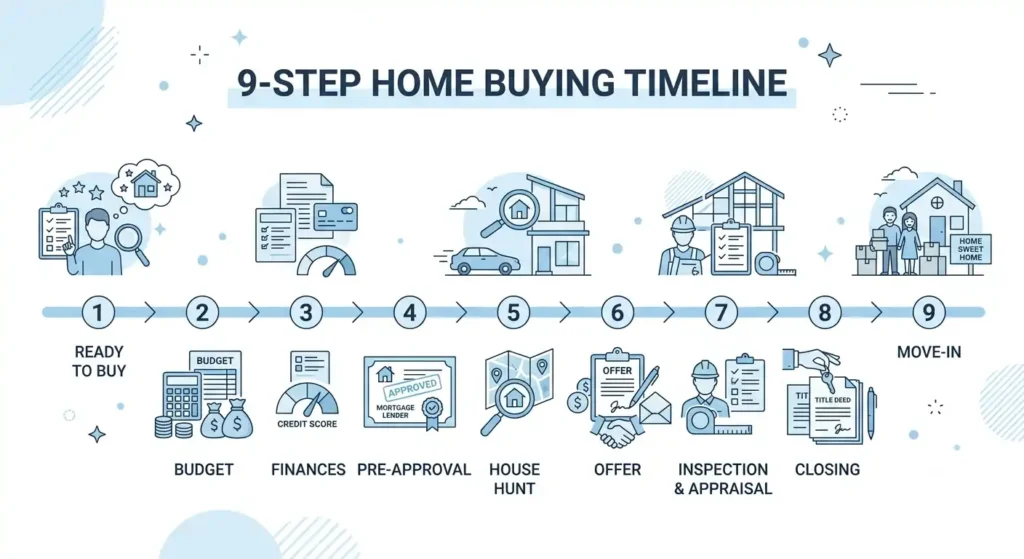
Most Texas buyers can afford a home priced at three to four times their gross annual income, once property taxes and insurance are factored in. Your down payment, existing debt, and local tax rate shift that number significantly.
That range holds up against 2026 Texas mortgage, tax, and insurance data, though your specific county and loan terms will move it. See our about us page for how we build and check these numbers.
Texas property taxes run above the national average, so budget beyond the mortgage payment alone.
How Much House Can You Afford in Texas?
That three-to-four-times-income range plays out differently in practice: a debt-free buyer sits near the top of it, while someone with a car payment or student loans lands closer to the bottom. If you want the national version of this math first, our guide on how much house you can afford breaks down the same rules outside Texas.
Start With Your Comfortable Monthly Housing Budget
Set your budget from your gross income, not a lender’s max approval, which might clear you for $2,800 a month you should not actually spend. Protect savings and daily life first, then set your real housing ceiling.
See What Different Incomes Could Afford
A single person earning $75,000 and a couple earning $75,000 combined can land in very different price ranges once debt enters the picture. Income sets the ceiling. Debt decides how close you get to it.
What Your Monthly Payment Really Includes
Your payment is never just principal and interest. Taxes and insurance add hundreds monthly, PMI joins if you put down under 20%, and HOA dues stack on last. Lenders call this full stack PITI: principal, interest, taxes, and insurance.
Texas Home Affordability Calculator: What Numbers Do You Need?
You need five numbers: income, debt, down payment, interest rate, and loan term. Skip one and any Texas mortgage calculator gives you a fantasy, not a budget.
Income and Take-Home Pay
Lenders use gross monthly income, but you live on take-home pay. A $90,000 Texas salary still loses money to federal tax and FICA even with no state income tax, so check the payment against your real paycheck too.
Existing Monthly Debt
Car loans, student loans, and credit card minimums all eat into your budget through your debt-to-income ratio. A $450 car payment can knock $40,000 to $60,000 off your buying power.
Down Payment and Available Cash
Your down payment for a house changes your payment, your PMI, and your closing-day cash need. 3% down moves you in faster but adds PMI and a bigger loan; 20% down kills PMI but ties up more cash. Keep separate money for closing costs and emergencies either way.
Mortgage Rate and Loan Term
One percentage point on your rate can shift buying power by tens of thousands of dollars, whether you choose a fixed vs adjustable rate mortgage. A 30-year loan lowers the payment while a 15-year builds equity faster but costs more monthly. Credit score moves your rate too, so hold one rate assumption steady across every comparison.
How to Calculate How Much House You Can Afford in Texas
Four steps: set your payment ceiling, subtract taxes and insurance, add PMI and HOA, then convert what’s left into a home price.
Step 1: Set Your Maximum Monthly Housing Payment
Start near 28% of income, then adjust down for savings goals or upcoming life changes. Never treat a lender’s max as your personal number.
Step 2: Subtract Texas Property Taxes and Insurance
Texas effective property tax rates run roughly 1.2% to 1.6% statewide depending on the source, and can swing from under 1% in parts of Harris County to over 2.5% in pockets of Fort Bend and Dallas. Pull the actual local rate, convert it to a monthly figure, and subtract it first.
Step 3: Add PMI and HOA Costs
PMI applies below 20% down, typically 0.5% to 1% of the loan yearly. Confirm real HOA dues and ask about pending special assessments before you commit.
Step 4: Convert the Affordable Payment Into a Home Price
What’s left after taxes, insurance, PMI, and HOA is your principal and interest budget. See how your mortgage payment is calculated to get a loan amount, add your down payment, then confirm the price with a lender. A quick look at a mortgage amortization schedule also shows how much of each payment builds equity versus covers interest.
Why Texas Property Taxes Can Change What You Can Afford
Texas has no state income tax, so property tax carries more weight in your monthly payment than in most states.
How Texas Property Taxes Affect Your Monthly Payment
Two $350,000 homes can carry very different payments if one sits at a 1.2% effective rate and the other at 2.4%. Listing price alone tells you almost nothing.
Texas Residence Homestead Exemption
The residence homestead exemption lowers your school district taxable value. Texas voters raised it from $100,000 to $140,000 for the 2026 tax year under Proposition 13, with an extra $60,000 for owners 65 or older or disabled, for a combined $200,000. It’s covered under Texas Tax Code Section 11.13, and the Texas Comptroller of Public Accounts publishes current rules. You must apply, it only covers your main home, and buying after January 1 usually means waiting until the next tax year to claim it. Verify amounts with the county appraisal district.
Why You Should Not Simply Copy the Seller’s Tax Bill
The listed tax bill reflects the seller’s exemptions, not yours, and the county often reassesses closer to sale price after closing. Pull the current appraised value yourself.
Other Texas Property-Tax Factors
Your bill stacks county, city, school district, and sometimes a MUD or PID, or public improvement district, rate. A municipal utility district can push combined rates past 2.5%, so ask if the property sits inside one before you buy.
How Homeowners Insurance Changes Texas Affordability
Insurance is a real line item in Texas, not a rounding error.
Why Insurance Belongs in the Affordability Calculation
A $200 monthly premium changes your loan capacity the same way a higher rate would. Get a property-specific quote before making an offer.
Texas Insurance Costs Can Vary by Property
Location, roof age, construction, and coverage limits move your premium. Coastal and Hill Country homes often face higher wind and hail risk, and flood coverage is usually separate. The Texas Department of Insurance publishes consumer rate comparisons.
What Happens When Insurance Costs Rise
A renewal jump of $50 to $100 a month hits your escrow instantly. Ask your agent about local rate trends before closing.
How Your Down Payment Changes How Much House You Can Afford
Down payment size changes your loan, your PMI, and your post-closing cash at once.
3% to 5% Down
Gets you in faster with less upfront cash, but adds private mortgage insurance, or PMI, and a bigger loan, so your payment runs higher. Keep an emergency fund even so.
10% Down
Shrinks the loan and PMI versus 3% to 5% down while keeping more cash than 20% down, often the sweet spot for many buyers.
20% Down
Eliminates PMI, saving $100 to $300 a month, but ties up more cash. Weigh that guaranteed savings against keeping money liquid.
How Debt-to-Income Ratio Affects Texas Home Affordability
Your debt-to-income ratio, or DTI, is what lenders trust most.
What Is Debt-to-Income Ratio?
DTI divides total monthly debt, including the new mortgage, by gross monthly income. Housing alone versus income is your front-end ratio; total debt versus income is back-end, usually capped near 36%.
How a Car Payment Changes Your Buying Power
A $500 car payment can cut mortgage qualification by $60,000 to $80,000. Factor in auto insurance too, since DTI ignores it but your budget can’t.
How Student Loans and Credit Cards Affect Affordability
Stacked debts can shrink approval by six figures. Compare paying down debt versus growing your down payment before you shop.
Lender Approval vs. What You Can Actually Afford
Approval and comfortable affordability are two different things.
Why Preapproval Is Not Your Personal Budget
A lender’s number reflects their risk, not your retirement contributions or childcare costs. Set your own lower ceiling when those priorities matter.
The 28% and 36% Rules: Useful Starting Points, Not Guarantees
The 28/36 rule caps housing at 28% of gross income and total debt at 36%, but it wasn’t built around Texas tax rates. Use it as a first pass, then adjust.
How to Decide Your Personal Maximum
Compare the payment to real take-home pay, then stress-test it against a rough month. If every scenario feels tight, renting longer while you save is the safer move, not a failure.
How Much House Can You Afford at Different Texas Income Levels?
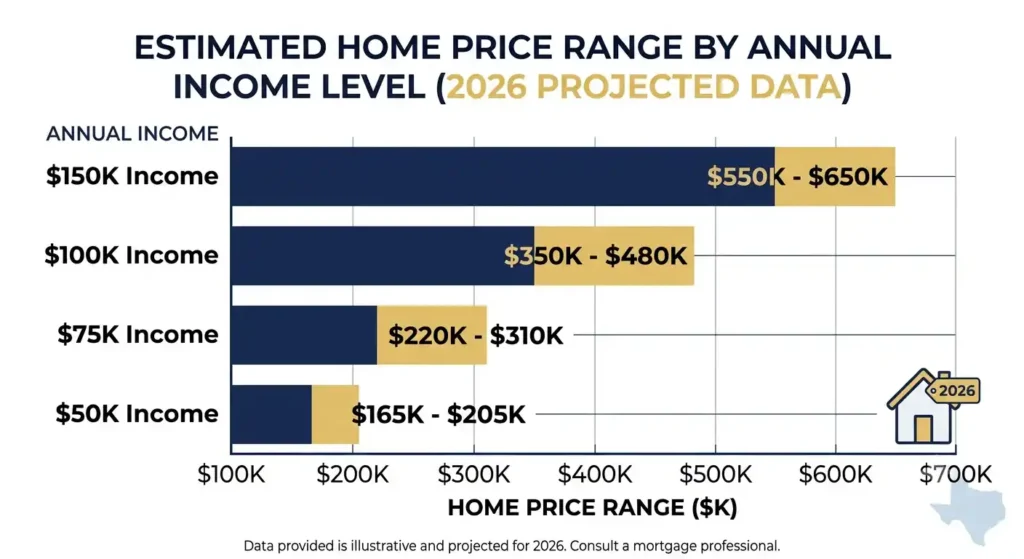
These ranges assume a 30-year loan around 6.7%, close to the 2026 average, with typical Texas tax and insurance costs.
| Annual Income | Monthly Housing Budget | Affordable Home Price |
|---|---|---|
| $50,000 | $1,100 – $1,200 | $140,000 – $170,000 |
| $75,000 | $1,700 – $1,800 | $220,000 – $260,000 |
| $100,000 | $2,300 – $2,400 | $300,000 – $350,000 |
| $150,000 | $3,400 – $3,600 | $480,000 – $550,000 |
$50,000 Annual Income
Keep debt light here since existing payments cut into this range fast.
$75,000 Annual Income
This tier covers a lot of suburban Texas inventory outside the priciest metro cores.
$100,000 Annual Income
Assumes 10% down; a higher rate can pull the ceiling down by $20,000 or more.
$150,000 Annual Income
Dual-income households should check how much of this range rides on a single job.
How Much House Can You Afford in Major Texas Cities?
The same paycheck stretches differently by city, mostly due to local tax and insurance costs.
| City / Metro | Effective Property Tax Rate | What It Means Monthly |
|---|---|---|
| Houston (Harris County) | ~2% – 2.5% | +$400 – $600 on top of P&I |
| Dallas (Dallas County) | ~2% – 2.6% | Higher end of the DFW range |
| Fort Worth (Tarrant County) | ~1.85% – 2.4% | $15,000 – $25,000 more affordable than Dallas County at the same payment |
| Austin (Travis County) | Highest in the state | Median tax bill over $10,000/yr |
| San Antonio & smaller markets | Generally lower | Lighter tax burden, lower prices |
Houston
Rates shift block to block, so verify the exact rate for the property, not just the county average.
Dallas-Fort Worth
Suburbs like Frisco and McKinney in Collin County often carry higher rates tied to newer, fast-growing school districts.
Austin
Above-average home prices stack on top of the state’s highest tax bills, so buyers often look to surrounding counties for a lower payment.
San Antonio and Other Texas Markets
Texas is not one market. Evaluate each city on its own tax rate and price level.
Real Texas Home Affordability Examples
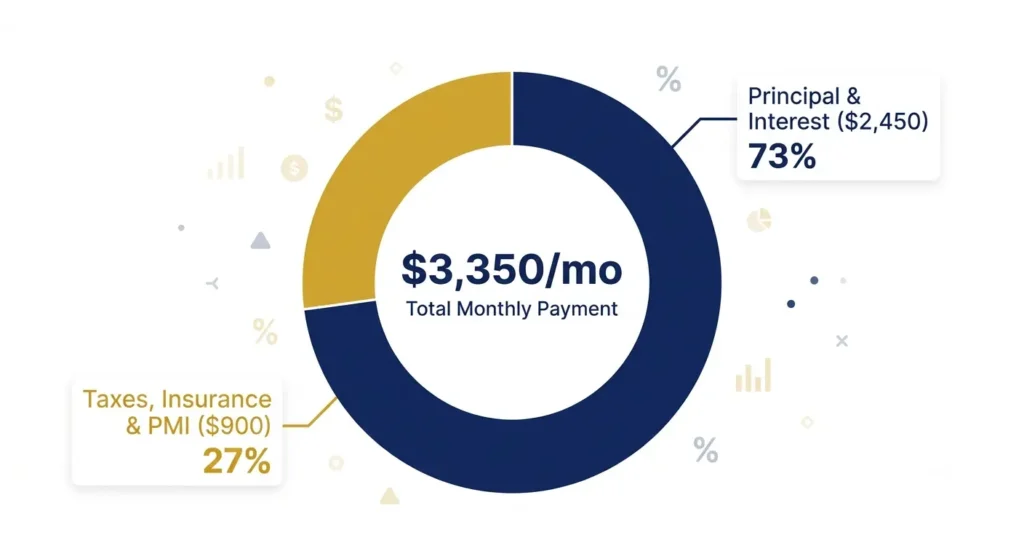
Example: $400,000 Home With 5% Down
A $380,000 loan with PMI. At 6.7%, principal and interest runs near $2,450, and the full payment with taxes, insurance, and PMI lands near $3,300 to $3,400, fitting incomes around $140,000 to $150,000.
Example: $400,000 Home With 20% Down
A $320,000 loan with no PMI. At 6.7%, principal and interest falls to about $2,050, and the full payment lands near $2,700 to $2,800, lowering the required income by $20,000 or more.
Example: $500,000 Home With Significant Monthly Debt
An $800 monthly car and student loan payment can push DTI past comfortable territory even with strong income, capping the loan lower than expected. Paying down debt first often unlocks more house than a bigger down payment would.
Example: Same Income, Different Texas Properties
Two $100,000-income buyers can land in different ranges: one home in a low-tax, no-HOA suburb might support $340,000, while a similar home in a high-tax MUD district with $150 HOA dues might only support $300,000.
Hidden Texas Homeownership Costs That Can Break Your Budget
The mortgage payment is rarely the whole story.
Closing Costs and Prepaid Expenses
Closing costs in Texas commonly run 2% to 5% of price as a rule of thumb, covering lender fees, title work, and prepaid taxes and insurance. Keep this cash separate from your down payment.
Maintenance and Repairs
A common rule of thumb sets aside 1% of home value yearly, though older homes need more. Budget it monthly.
HOA Fees and Special Assessments
Confirm current dues directly with the HOA and ask about pending special assessments before closing.
Utilities and Other Recurring Costs
Bigger homes mean bigger utility bills, and Texas summers push AC costs up. Factor in commute costs too. New construction often has lower early repair costs but can carry higher HOA dues or a MUD rate still climbing.
What Can Make Your Affordable Home Price Drop?
Higher Mortgage Rates
A half-point rate increase can cut buying power by $15,000 to $25,000, since how mortgage interest works means even a small rate shift moves your monthly cost fast. Rerun your numbers if rates move.
Higher Property Taxes
Texas taxing units set new rates each year, typically August through September, so your bill can rise the year after you buy.
Higher Insurance Premiums
Renewal increases hit your payment instantly. Ask about local rate trends before finalizing your budget.
Changes in Income or Household Expenses
A job change, new baby, or shift to variable income can change what you can afford even if the mortgage payment stays the same. Build in room for that.
Common Myths About How Much House You Can Afford
“If a Lender Approves It, I Can Afford It”
Approval reflects bank risk, not your retirement goals or emergency cushion. Your real max is usually lower.
“Texas Has No State Income Tax, So Housing Is Cheaper”
Above-average property taxes often erase that savings. Compare total housing cost, not just the tax line.
“The Mortgage Payment Is Just Principal and Interest”
Taxes, insurance, PMI, and HOA usually add several hundred dollars a month on top.
“A 20% Down Payment Always Makes the Most Sense”
Draining savings to hit 20% isn’t automatically smart. Weigh PMI savings against keeping cash liquid.
“The Seller’s Property Taxes Tell Me What I Will Pay”
Their bill reflects their exemptions and assessed value, not yours. Verify with the appraisal district.
How to Stress-Test Your Texas Home Budget Before Buying
Test a Higher Interest Rate
Add half a point to a full point and recalculate. If it still fits, you have real breathing room.
Test Higher Taxes and Insurance
Increase estimates by 10% to 15% and see where the payment starts to feel tight.
Test an Emergency Expense
Model a $6,000 roof or $4,000 AC replacement hitting right after closing, and confirm your emergency fund can absorb it.
Test a Temporary Income Reduction
Imagine one income disappearing for a few months. If your reserves cover less than three months, reconsider your price point.
How to Choose a Safe Texas Home Price Before Making an Offer
Set a Target Price Below Your Absolute Maximum
Shop 5% to 10% under your ceiling to leave room for negotiation and surprises.
Verify the Specific Property’s Costs
Pull actual tax history, get a real insurance quote, and confirm HOA dues before writing an offer.
Compare the Property With Your Full Monthly Budget
Add the payment to your full monthly budget, not just current rent, and check that savings and transportation costs still fit.
Get a Mortgage Preapproval After Setting Your Budget
Apply only after you know your personal ceiling, and don’t raise your target just because a lender offers more. Review the Loan Estimate closely; the Consumer Financial Protection Bureau offers a free guide for reading one.
What to Do After You Know How Much House You Can Afford
Turn the Number Into a Home Search Range
Set a hard maximum and a comfortable preferred range under it, and skip anything above your ceiling.
Prepare the Cash Needed to Buy
Keep down payment funds separate from closing costs and your emergency fund. The Texas Department of Housing and Community Affairs runs My First Texas Home for buyers who haven’t owned in three years, and our first-time home buyer guide walks through the full process step by step.
Compare Mortgage Options
A conventional loan suits strong credit and a solid down payment; an FHA loan through the Federal Housing Administration helps with less cash upfront; a VA loan through the U.S. Department of Veterans Affairs and a USDA loan through the U.S. Department of Agriculture can offer zero down payment options for those who qualify. The 2026 VA loan limit for most Texas counties, including Harris County, is $832,750 with no down payment required for eligible veterans with full entitlement.
Recalculate Before You Sign
Update tax and insurance numbers for the actual property, confirm final loan terms, and make sure the payment still fits before signing.
Frequently Asked Questions About How Much House You Can Afford in Texas
How much house can I afford on a $50,000 salary in Texas?
Typically $140,000 to $170,000 with light debt and a modest down payment.
How much house can I afford on a $100,000 salary in Texas?
Typically $300,000 to $350,000, depending on down payment and county tax rate.
How much house can I afford with a $150,000 salary in Texas?
Typically $480,000 to $550,000. Dual-income households should check reliance on a single job.
Is it better to use the 28% rule or my actual budget?
Use the 28% rule as a starting point, then adjust for your real expenses and Texas tax and insurance costs.
How much should I put down on a Texas house?
Depends on your reserves and how much PMI savings matter. 10% often balances payment and liquidity; 20% removes PMI but ties up more cash.
Does Texas property tax affect how much house I can afford?
Yes. Rates vary by more than a full percentage point between counties, directly changing your payment.
Should I buy a house at the maximum amount my lender approves?
Generally no. Set a personal ceiling below the lender’s max to protect savings and peace of mind.
Can I afford a house if I have student loans or a car payment?
Yes, but they reduce buying power through DTI. Paying down debt first can unlock more house than a bigger down payment.
How much money should I have left after buying a house?
Enough for closing costs plus three to six months of expenses in reserve.
Texas Home Affordability Checklist
Numbers to Gather Before Calculating
Gross household income, monthly debt, available down payment and cash, and expected rate and loan term.
Property Costs to Verify
Annual property taxes, insurance premium, PMI status, and any HOA dues or special assessments.
Final Affordability Checks
Your comfortable monthly payment, total cash to close, remaining emergency savings, and how the payment holds up under a higher rate or a tighter month.
For more guides like this, browse our full mortgage basics collection.