A mortgage payment is calculated by running your loan amount, interest rate, and loan term through the standard amortization formula, then adding property taxes, homeowners insurance, and PMI if your down payment is under 20 percent.
That combined figure, often called PITI, explains why online estimates rarely match a lender’s actual Loan Estimate.
Basic calculators still miss PMI, escrow shortfalls, and rate-driven swings that meaningfully raise the real payment.
What Is a Mortgage Payment and How Is It Calculated?
Calculating the loan itself is not the same as affordability. Affordability asks whether that payment actually fits your income, not just what the formula produces.
The Simple Answer
Each payment splits between interest and principal once those three inputs run through the formula. Affordability is separate, measured through your debt-to-income ratio (DTI), based on income and debts rather than the formula alone.
The Four Parts of a Mortgage Payment
Lenders call it PITI, short for Principal, Interest, Taxes, and Insurance. Principal is what you borrowed. Interest is the lender’s fee for lending it. Taxes are property taxes collected through your lender. Insurance means homeowners insurance, plus private mortgage insurance if your down payment is under 20 percent. Add all four for your real payment.
Why Many Homebuyers Get Confused
A quick calculator shows one number; your lender’s Loan Estimate shows a bigger one, since it accounts for the full PITI breakdown rather than principal and interest alone.
Mortgage Payment Comparison Scenarios
Three common choices, side by side.
15-Year vs 30-Year Mortgage
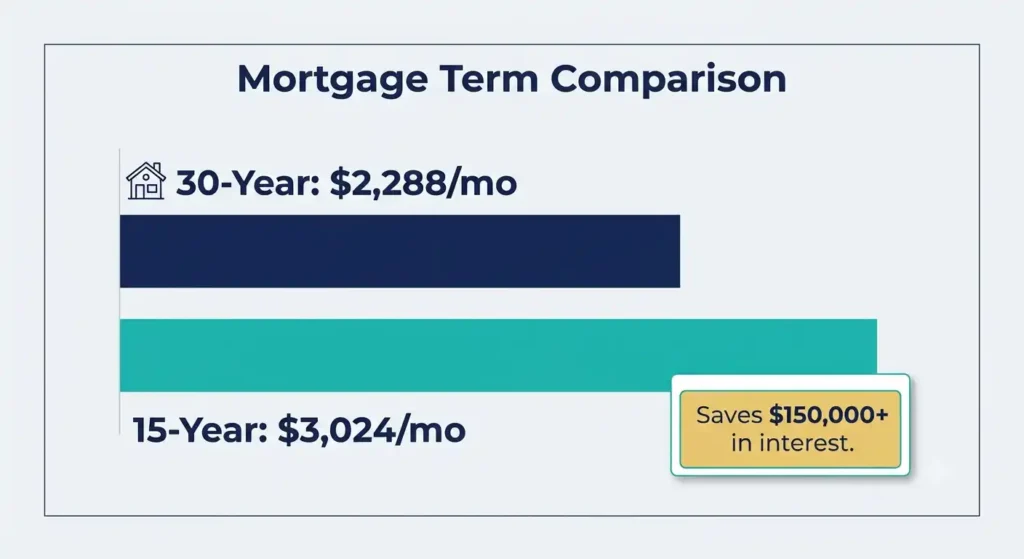
The 15-year option costs more monthly but you own the home in half the time and save well over $150,000 in interest. Total interest on the 30-year version can exceed what you originally borrowed, which is exactly why a shorter term saves so much. The tradeoff is whether your budget can absorb the higher payment now.
6% vs 7% Interest Rate
A single percentage point adds tens of thousands in extra interest over 30 years. Locking a good rate, or buying it down with points, can matter more than shopping for a cheaper home.
5% vs 20% Down Payment
A bigger down payment lowers your loan-to-value ratio (LTV), cutting both your monthly principal and interest and the lender’s risk. Below 20 percent down, PMI applies. Hit 20 percent equity and it drops off.
| Scenario | Monthly Payment | Key Difference |
|---|---|---|
| 30-year @ 6.55% | ~$2,288 | Lower payment, more total interest |
| 15-year @ 5.93% | ~$3,024 | $736 more/month, saves $150,000+ in interest |
| 6% rate | ~$2,159 | Baseline |
| 7% rate | ~$2,395 | +$236/month, +$85,000 over 30 years |
| 5% down | $380,000 loan, 95% LTV | PMI required |
| 20% down | $320,000 loan, 80% LTV | No PMI |
The Mortgage Payment Formula Explained
One formula, used by every lender.
The Standard Mortgage Formula
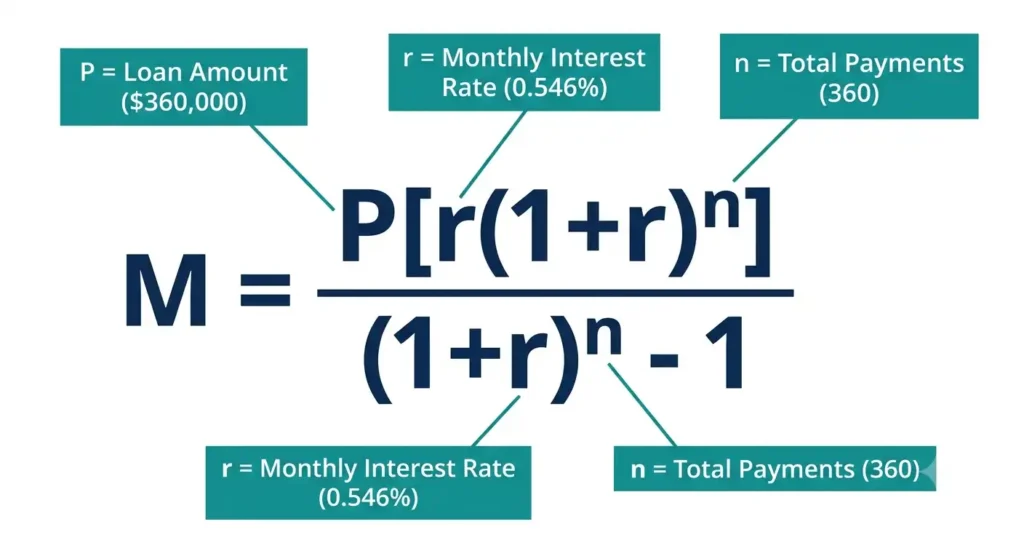
Monthly principal and interest equals P times [r(1+r)^n] divided by [(1+r)^n minus 1]. P is loan amount, r is monthly interest rate, n is total payments. Annual rate divided by 12 gives r; loan years times 12 gives n. Run the three numbers for one fixed payment.
What Each Variable Means
Loan Amount
Loan amount is home price minus down payment. A $400,000 home with $40,000 down leaves a $360,000 loan. Bigger loan, bigger bill. Most buyers use a conventional loan within conforming loan limits, $832,750 for most counties in 2026. Above that, you’re in jumbo loan territory, with a higher rate and stricter approval.
Interest Rate
Your quoted rate is annual; the formula uses monthly, so divide by 12. A 6.55 percent annual rate is about 0.546 percent monthly. Your credit score drives your rate, which is why two buyers on the same home can get different payments. Your rate also differs from your annual percentage rate (APR), which folds in lender fees.
Loan Term
Loan term is how many years you repay, commonly 10, 15, 20, or 30. Longer term, smaller payments, more total interest. Shorter term, bigger payments, less interest overall.
Understanding Mortgage Amortization
The schedule behind your fixed payment.
What Amortization Means
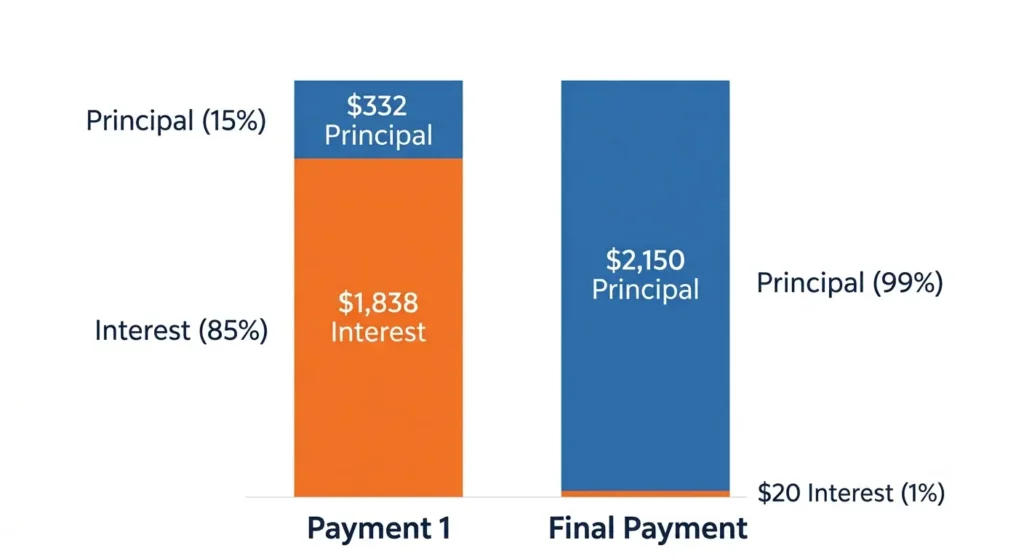
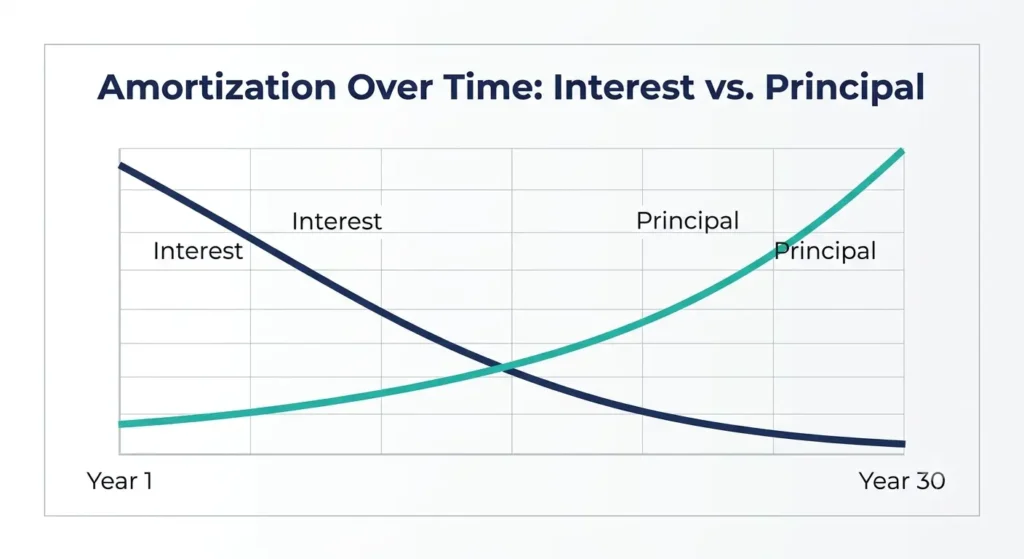
Amortization pays off a loan through equal scheduled payments. The payment stays fixed; what it covers shifts. Interest dominates early, principal takes over later, until the balance hits zero on schedule.
Why Early Payments Mostly Go Toward Interest
Interest is calculated on your remaining balance, highest early on. On a $360,000 loan at 6.55 percent, payment one sends about $1,965 to interest and $323 to principal. As the balance shrinks, more of each payment cuts principal.
Reading an Amortization Schedule
An amortization schedule lists every payment: principal, interest, remaining balance. The interest share shrinks monthly while principal grows. By year 15 of a 30-year loan, interest often still exceeds principal. It shows your equity at any point.
Why Your Mortgage Payment Is Higher Than the Formula Result
The formula covers principal and interest only. Your real bill adds more.
Property Taxes
Local governments set property taxes on assessed value, and they rarely stay flat. The national average runs around 1 percent of home value yearly. Your lender collects it monthly through escrow. A higher assessment means a higher payment.
Homeowners Insurance
Lenders require homeowners insurance. Premiums depend on home value, location, and coverage, typically $200 to $215 a month nationally in 2026, more in coastal or disaster-prone areas. Renewal increases can raise your payment even with an unchanged loan.
PMI and Mortgage Insurance
Private Mortgage Insurance (PMI) applies under 20 percent down, protecting the lender. It runs 0.5 to 1 percent of loan amount yearly, about $150 to $300 a month on a $360,000 loan. At 20 percent equity you can request removal, and federal law requires automatic cancellation at 78 percent of the home’s original value. FHA loans differ: insured by the Federal Housing Administration (FHA), part of the U.S. Department of Housing and Urban Development (HUD), they charge FHA mortgage insurance premium (MIP) instead, which often lasts the life of the loan.
Escrow Accounts
Escrow, held by your lender or mortgage servicer, collects and pays your taxes and insurance so you avoid one huge bill. Lenders require it to avoid tax liens. A yearly escrow analysis adjusts your payment if taxes or insurance rose. Some borrowers with strong equity can pay these themselves instead, unless their loan type requires escrow regardless. HOA dues, if you have them, are billed separately and aren’t part of PITI, though lenders count them when qualifying you.
Step-by-Step Mortgage Payment Calculation Example
Real numbers through the formula.
Example Scenario
A $400,000 home, 10 percent down ($40,000), leaves a $360,000 loan. You lock a 30-year fixed rate at 6.55 percent, matching Freddie Mac’s July 2026 average.
Calculate the Monthly Principal and Interest Payment
Divide 6.55 percent by 12 for a monthly rate of about 0.00546. Multiply 30 years by 12 for 360 payments. Run the formula on $360,000 for a payment of about $2,288.
Add Taxes and Insurance
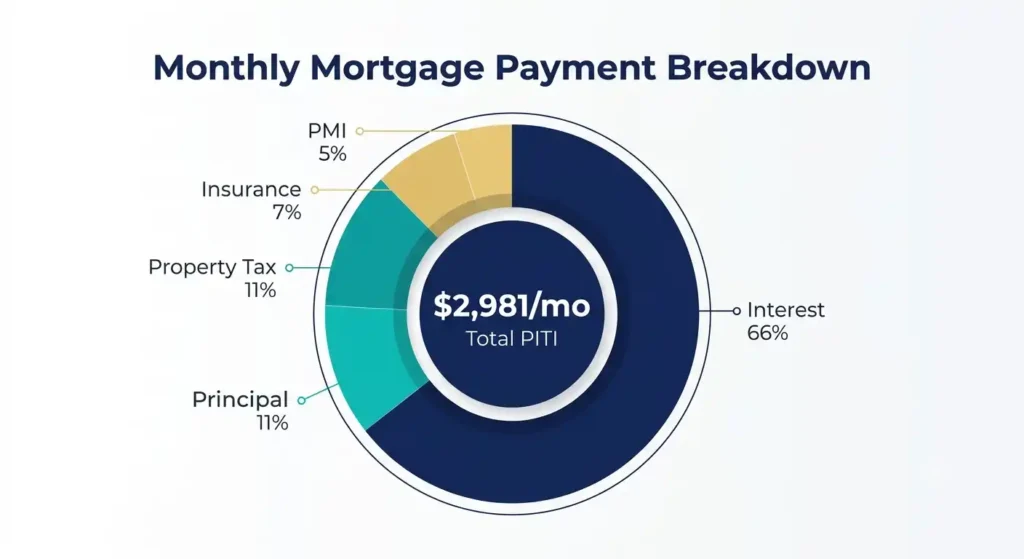
Property tax at 1 percent is $4,000 a year, about $333 a month. Insurance runs about $210 a month in 2026. PMI adds about $150. Total payment: about $2,981.
| Component | Monthly Amount |
|---|---|
| Principal (month 1) | ~$323 |
| Interest (month 1) | ~$1,965 |
| Property tax | ~$333 |
| Homeowners insurance | ~$210 |
| PMI | ~$150 |
| Total PITI | ~$2,981 |
Final Monthly Payment Breakdown
Principal Portion
Month one sends about $323 of the $2,288 payment to your balance. That share grows every month.
Interest Portion
The remaining $1,965 of that first payment covers interest on the $360,000 balance, the biggest early chunk, shrinking over time.
Taxes and Insurance Portion
The remaining $693 a month funds escrow for taxes, insurance, and PMI, none of it touching your balance, and it can rise over time.
How Different Mortgage Types Change the Calculation
Loan type changes how and when your payment moves.
Fixed-Rate Mortgages
A fixed-rate mortgage locks principal and interest for the full term, 15, 20, or 30 years. The formula runs once at closing and never changes, making budgeting predictable even as taxes and insurance shift.
Adjustable-Rate Mortgages (ARMs)
An adjustable-rate mortgage (ARM) starts fixed for five or seven years, then adjusts with the market. The initial payment uses the same formula; after adjustment, rate and payment reset, adding uncertainty.
Interest-Only Mortgages
During the interest-only period, payments cover interest alone; the balance stays put. Once that period ends, the payment jumps to cover principal too.
Balloon Mortgages
A balloon mortgage is calculated as if it lasts 30 years, but comes due in 5 or 7. You make small payments, then owe the remaining balance in one lump sum, often refinancing or selling first.
What Happens If You Pay Extra Toward Your Mortgage?
Extra payments change the math for every payment after.
Extra Principal Payments
Extra amounts go straight to principal, lowering the balance interest is calculated on, so future interest drops too. Small extra payments compound into real savings.
One Extra Payment Per Year
One full extra payment a year can cut four to six years off a 30-year mortgage. On the $360,000 example, that alone could save tens of thousands in interest.
Biweekly Payments
Biweekly payments mean 26 half-payments a year, equal to 13 full payments instead of 12, with the extra going to principal. Check for lender fees first.
Common Mortgage Payment Myths
A few beliefs don’t survive the math.
Fixed-Rate Means Your Total Payment Never Changes
Your rate stays fixed, but taxes, insurance, or an escrow shortfall can still raise your total bill.
Lower Monthly Payments Always Mean a Better Loan
A lower payment often means a longer term and more total interest. Compare total interest paid, not just the monthly number.
Every Payment Builds Equity Equally
Amortization front-loads interest, so early payments build equity slowly. Five years into a 30-year loan, you’ve usually paid off far less than a fifth of the balance.
Online Calculators Always Match Lender Numbers
Basic calculators often skip taxes, insurance, PMI, and HOA dues, and use national averages instead of your actual numbers, so your Loan Estimate can differ by hundreds of dollars.
How to Estimate Your Mortgage Payment Before Applying
You can estimate this yourself with the right numbers, or work backward from a target payment to a home price.
Information You Need
Gather target home price, down payment, a realistic 2026 interest rate, and a local property tax estimate from your county assessor or a listing.
Using a Mortgage Calculator
Enter home price, down payment, rate, and term into our mortgage payment calculator for a full PITI breakdown, confirming it includes taxes, insurance, and PMI. Run a few scenarios side by side.
Verifying a Lender’s Estimate
Check your numbers against your lender’s Loan Estimate, a standardized form required by the Consumer Financial Protection Bureau (CFPB). Confirm tax, insurance, and PMI assumptions, and check every fee. Closing costs are one-time, separate from your monthly payment, so a low payment with high closing costs isn’t automatically the better deal, and the lowest rate isn’t always the cheapest loan once fees are counted.
Frequently Asked Questions
How do lenders calculate monthly mortgage payments?
Loan amount, monthly rate, and total payments run through the amortization formula, then taxes and insurance get added.
What is included in a mortgage payment?
Principal, interest, property taxes, and homeowners insurance, plus PMI under 20 percent down. Together: PITI.
Why is my mortgage payment higher than expected?
Escrow costs like taxes and insurance, or PMI with a smaller down payment, which basic calculators often skip.
How much difference does a 1% interest rate change make?
On a $360,000 loan, 6 percent to 7 percent adds about $236 a month and roughly $85,000 over 30 years.
Can I calculate a mortgage payment manually?
Yes, with P times [r(1+r)^n] divided by [(1+r)^n minus 1], using loan amount, monthly rate, and total payments.
Does a larger down payment lower monthly payments?
Yes. It shrinks the loan amount and can eliminate PMI at 20 percent down.
Why does my payment change if I have a fixed-rate mortgage?
Your rate stays fixed, but escrow for taxes and insurance can rise, adjusting your total payment.
How can I pay off my mortgage faster?
Extra principal payments, one extra payment a year, biweekly payments, or refinancing to a shorter term. Refinancing reruns the formula fresh with a new loan amount, rate, and term.
Key Takeaways
What to Remember About Mortgage Payment Calculations
Payment comes from loan amount, rate, and term through a fixed amortization formula. The real bill usually adds taxes, insurance, and possibly PMI. The payment stays flat while its principal-interest mix shifts. Affordability is separate from calculation, and both matter.
Next Steps Before Buying a Home
Run your own PITI numbers before talking to a lender. Compare terms and rates, not just monthly payments. Check total housing costs against your real budget before you sign. For more foundational guides like this one, browse our mortgage basics section, or learn more about our team and calculators.