Principal is the amount you borrowed; interest is what you pay to borrow it. Every loan payment splits between the two, with the mix shifting steadily from mostly interest toward mostly principal over the loan’s term.
That shift follows a fixed amortization schedule, recalculated every payment cycle using the loan’s remaining balance, rate, and term.
Early payments barely dent the balance, and some loans still charge penalties for paying principal down faster.
Principal vs Interest at a Glance
Here’s the side-by-side breakdown, then a real number to make it concrete.
Quick Comparison Table
| Principal | Interest | |
|---|---|---|
| What it is | The money you borrowed | The cost of borrowing it |
| How it’s set | Fixed at loan signing, drops as you pay | A rate applied to what you still owe |
| Builds equity | Yes | No, it’s a cost, not an asset |
| Changes over time | Shrinks with each payment | Shrinks too, but starts much higher |
The Short Answer
On a $350,000 mortgage at 6.3%, early payments go mostly to interest, then that flips. Both pieces show up in every payment until the loan hits zero.
What Is Principal?
Principal is the number on the loan document, what you owe before interest.
Principal Explained Simply
Buy a $400,000 house with 12% down and your loan principal starts at $352,000. That’s the original amount. Your remaining balance drops slowly at first. Total repayment adds interest on top, so you pay back more than $352,000 over 30 years.
Where You’ll See Principal
Mortgages carry the biggest principal balances, which is why the payoff math matters most for first-time home buyers. Auto and personal loans work the same way, smaller and shorter. Student loans can add interest before you even graduate.
What Is Interest?
Interest is the price of borrowed money. No lender lends for free.
Interest Explained Simply
Lenders charge interest because they’re taking on risk, and it’s how banks make money. Interest is calculated on your current balance, not the original amount, so the more you owe, the more piles up. It works in reverse too: money in a savings account earns interest instead of costing it, same math, opposite direction.
How Interest Is Calculated
Four things drive it: remaining balance, interest rate, loan term, and payment schedule. Most installment loans use simple interest on the remaining balance. Credit cards often use compound interest, where unpaid interest gets added to the balance and starts charging its own interest. Two loans of the same amount can cost very different amounts in interest if the rate or term differs.
Principal vs Interest Comparison
These two pull in opposite directions for the life of a loan.
Side-by-Side Comparison Table
| Principal | Interest | |
|---|---|---|
| Definition | Amount borrowed | Cost of borrowing |
| Purpose | Repays the debt | Pays the lender |
| Who benefits | You, through equity | The lender, through profit |
| Effect on balance | Reduces it directly | Doesn’t reduce balance at all |
Biggest Differences
Principal builds equity. Interest is pure cost. Principal payments cut your balance dollar for dollar; interest never touches it. On a $300,000 loan at 6%, you’ll pay roughly $347,000 in interest alone over the full term.
How Loan Payments Really Work
Your monthly payment is really two payments in one.
What Happens to Your Monthly Payment
Interest gets calculated first, on your current balance and rate. Whatever’s left goes to principal. That’s why the payment stays the same for 30 years while the principal share keeps growing.
Why Early Payments Go Mostly to Interest
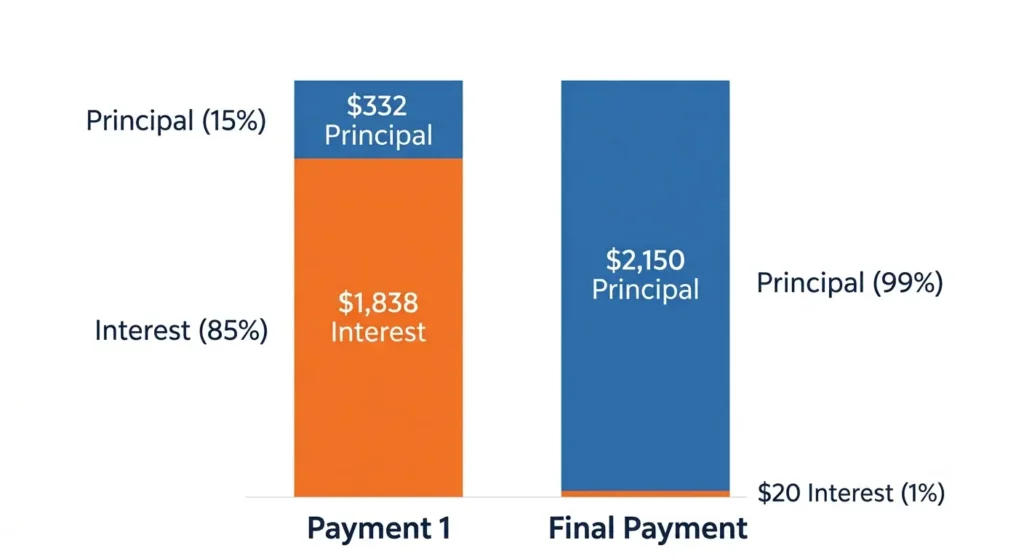
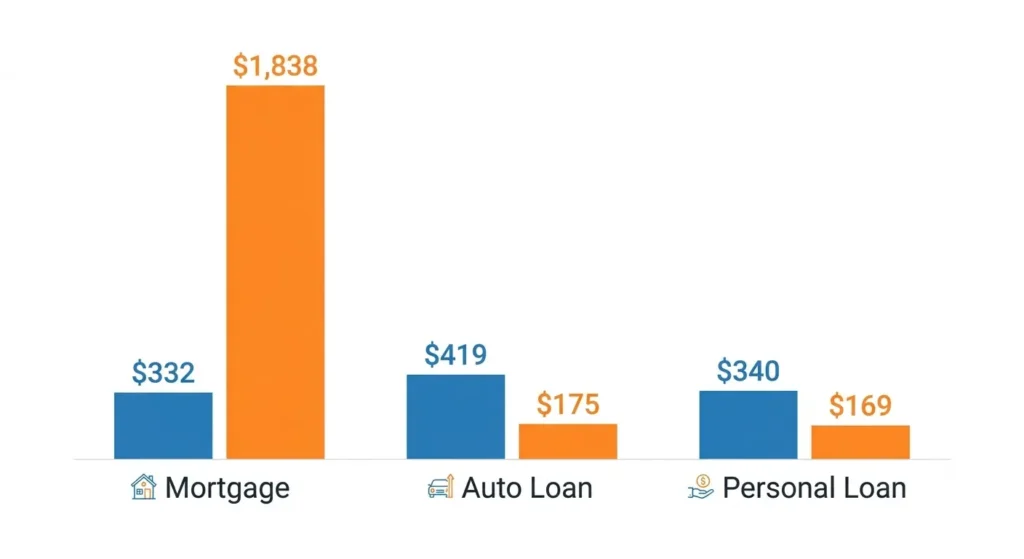
Your balance is highest early on, so interest takes the biggest bite. On a $350,000 loan at 6.3%, the first payment is about $1,838 interest and $332 principal, out of a $2,170 total. As the balance drops, that split shifts. This shift is called amortization.
Understanding Amortization
Amortization is the schedule behind every fixed loan payment.
What Is an Amortization Schedule?
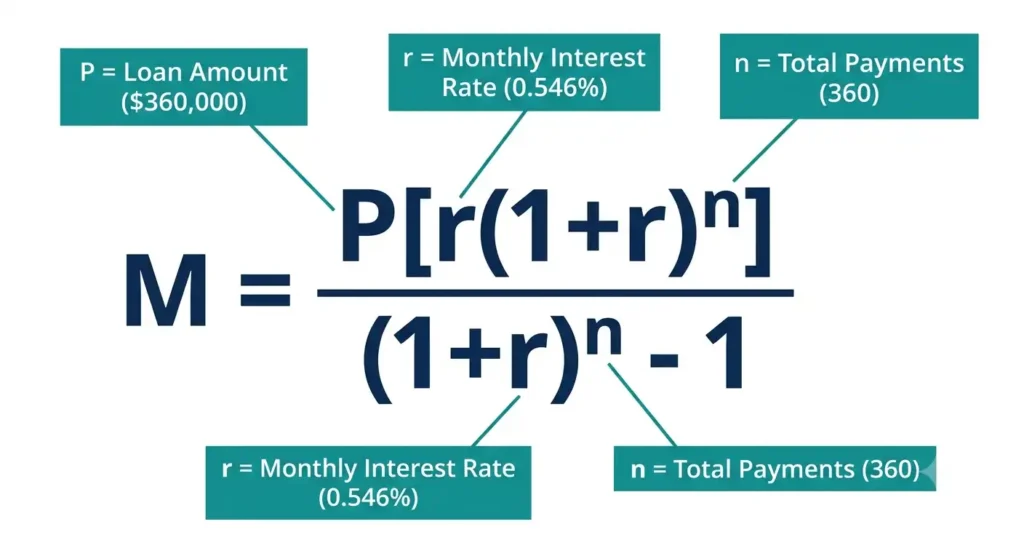
It lists every payment for the life of the loan: interest paid, principal paid, and remaining balance after each one. If you want the full formula behind that number, see how your mortgage payment is calculated.
Reading an Amortization Table
First Payment
On a $350,000 loan at 6.3%, payment one sends about $332 to principal, $1,838 to interest. Balance drops to roughly $349,668.
Middle of the Loan
By year 15 of a 30-year loan, the split has flipped: interest keeps shrinking, principal keeps growing, and equity builds faster.
Final Payments
In the last year, almost the whole payment is principal. The final payment might be $2,150 principal and under $20 interest. Once the balance hits zero, interest stops completely.
Real Examples
Numbers make this clear fast.
Mortgage Example
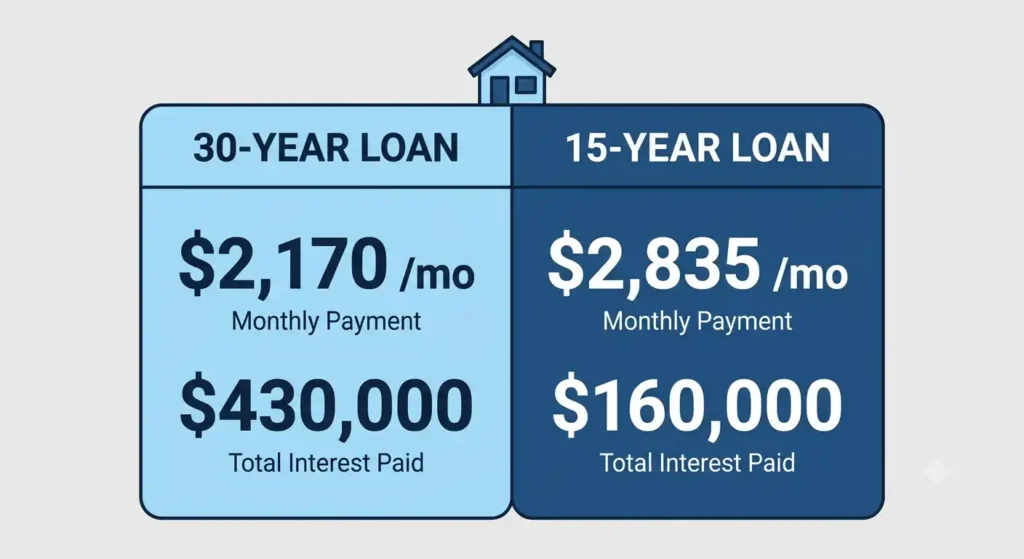
A $350,000 mortgage at 6.3%, near the current Freddie Mac 30-year average, over 30 years runs about $2,170 a month. Total interest over 30 years lands north of $430,000, more than the loan itself. Shorten it to 15 years at 5.4% and the payment rises to about $2,835 a month, but total interest drops to roughly $160,000.
Auto Loan Example
A $30,000 auto loan at 7% over five years costs about $594 a month, split roughly $175 interest and $419 principal on the first payment. Car loans shift to mostly principal much faster than mortgages.
Personal Loan Example
A $15,000 personal loan at 13.5%, close to the 2026 average for good credit (Credible), over three years runs about $509 a month. The first payment is roughly $169 interest. Total repayment is about $18,324, meaning about $3,324 in interest.
Principal vs Interest Across Different Loan Types
Not every loan handles this the same way.
Mortgage Loans
Mortgages amortize over 15 or 30 years, so equity builds slowly at first. Fixed rate loans keep payments steady. An adjustable-rate mortgage (ARM) can shift the interest portion when the rate resets. For more on how mortgages work day to day, browse our mortgage basics coverage.
Credit Cards
Credit cards don’t amortize. Interest accrues daily on the revolving balance, and minimum payments barely touch principal. Paying the statement balance in full each month is the only way to avoid interest entirely.
Student Loans
Interest can start accruing while you’re still in school. On a $30,000 student loan at 6.52%, the current federal undergraduate rate for 2026-27 (Department of Education), that’s about $163 a month in interest before any principal gets paid.
Personal and Auto Loans
These use fixed installment schedules like a mortgage, just shorter, so they reach mostly-principal payments years sooner.
What Happens When You Pay Extra Toward Principal?
Extra money toward principal shifts your loan math in your favor.
Benefits of Extra Principal Payments
Extra principal payments cut interest directly, since interest is based on the remaining balance. An extra $200 a month on that $350,000 mortgage at 6.3% could shave years off the loan and save tens of thousands in interest, while building equity faster.
When Extra Payments Make Sense
Best if you’re staying long term, your finances are stable, you’re free of higher interest debt, and you already have an emergency fund.
When Extra Payments May Not Be Best
Pay down 22% credit card debt first, since it costs far more than a mortgage rate. Limited cash flow, upcoming big expenses, or better investment options are also good reasons to hold off.
Common Myths About Principal and Interest
A few misunderstandings trip up most borrowers.
Myth: Banks Keep Most of Your Money
Not true. Amortization means your declining balance drives how much interest accrues. As the balance drops, so does the lender’s cut, until principal makes up nearly all of the payment by the end.
Myth: Extra Payments Don’t Help
They do. Every extra dollar cuts principal directly, lowering future interest and speeding up payoff. Just confirm your lender applies it to principal, not next month’s bill.
Myth: Interest Is Charged Upfront
It isn’t a lump sum. Interest accrues continuously on the remaining balance and recalculates each cycle, which is why early payments carry more interest.
Common Mistakes Borrowers Make
Small misunderstandings cost real money.
Misreading Loan Statements
Your balance doesn’t drop by the full payment, since interest takes a share first. Missing a payment doesn’t pause anything either: interest keeps accruing, and the missed amount gets added to what you owe.
Comparing Loans Incorrectly
A lower payment with a longer term or lower rate can still cost more overall, so payment size alone is a poor way to shop. Interest rate and annual percentage rate (APR) aren’t the same either, since APR adds fees. Even a higher payment doesn’t guarantee a faster payoff, if the extra money is just covering a higher rate instead of extra principal. Check the loan term and total interest, not just the monthly number.
Frequently Asked Questions
Is principal the same as loan balance?
No. Original principal is what you borrowed at signing. Loan balance is what remains today. Payoff amount is the exact figure to close the loan on a specific date, which can include a few extra days of interest.
Why doesn’t my balance drop by my payment amount?
Interest gets deducted first. Only what’s left goes to principal, which is why amortization slows early balance drops.
Can I pay only the principal?
No, both go together each month. Extra money can go straight to principal, though some loans charge a prepayment penalty for paying down too fast.
Does paying extra principal lower monthly payments?
Usually not, unless you request a recast or refinance. Extra principal payments shorten the term instead.
Is principal included in every payment?
Yes, on amortized loans. Interest-only loans are the exception, with interest-only payments for a set period first.
What’s the difference between principal, interest, and escrow?
Principal and interest cover the loan. Escrow covers property taxes and insurance. All three together make PITI, your full monthly housing payment.
Key Takeaways
What Every Borrower Should Remember
Principal reduces debt. Interest is the cost of borrowing it. Amortization shifts more of each payment to principal over time. Extra principal payments reliably cut total interest cost.
Next Steps Before Signing a Loan
Get the full amortization schedule before you sign anything. Then compare your loan estimate against your closing disclosure, since the numbers should match closely. Compare APR, not just rate, and estimate total interest over the full term so you know what you’re really committing to. Decide now whether extra principal payments fit your plan, and keep in mind that refinancing later resets the whole equation with a new balance, rate, and amortization schedule. Before any of that, run the numbers on how much house you can afford so your target loan amount is realistic from the start. The Consumer Financial Protection Bureau (CFPB) requires both documents in writing, and the Federal Trade Commission (FTC) offers free resources if a lender seems out of line.
This guide is part of our ongoing mortgage education series. Learn more about our team and calculators on our About Us page, or explore the full site through our posts, pages, and category sitemaps.