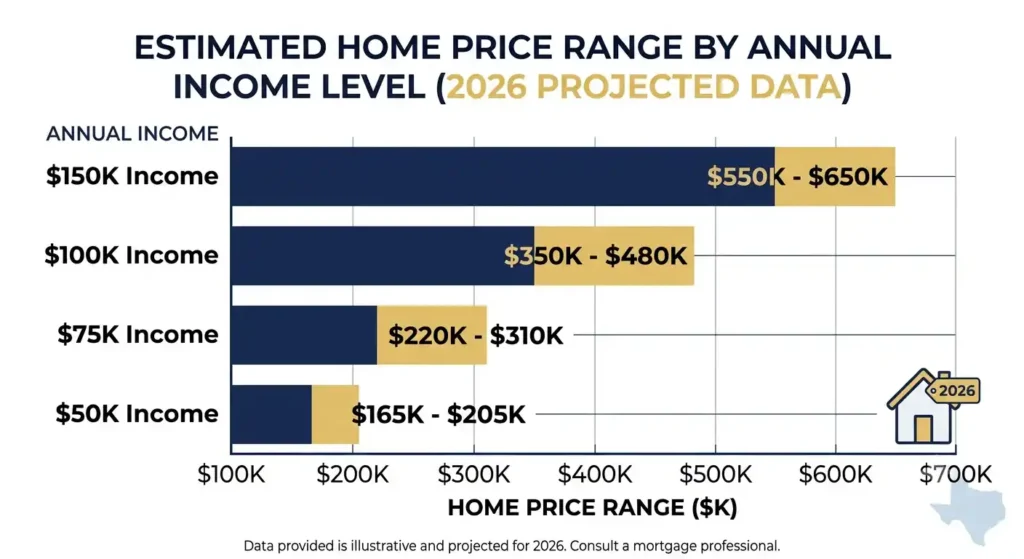
A first-time home buyer, under HUD’s definition, is anyone who hasn’t owned a primary residence in the past three years. This guide walks that buyer through every step of buying a home, from financial readiness to closing.
That three-year eligibility window surprises many repeat buyers, since the four loan programs covered here rarely get compared side by side.
Following every step doesn’t guarantee approval, since credit, income, and debt limits still decide it.
Start Here: The Complete First-Time Home Buying Roadmap
Buying your first home feels overwhelming without a map. This guide is that map, laid out step by step so nothing catches you off guard.
What This Guide Will Help You Accomplish
This guide covers the full path from deciding to buy through holding your keys, in order, so you know what each stage needs and roughly how long it takes.
The Home Buying Process at a Glance
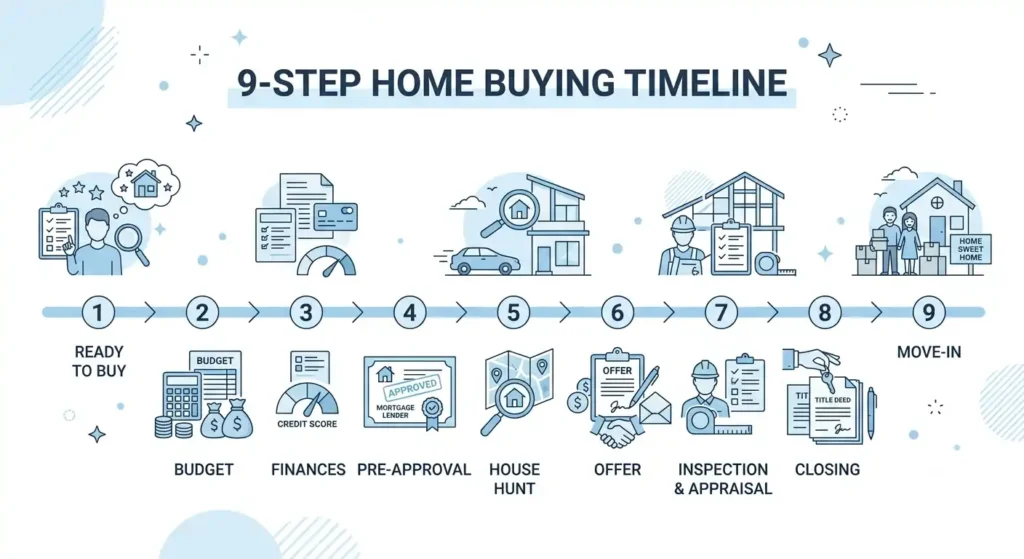
Closing usually takes 30 to 60 days after a signed contract, though prep work before that can take months. The path runs from finances to pre-approval, house hunting, offer, inspection, appraisal, and closing. Most delays come from missing paperwork.
Quick Checklist Before You Begin
Before shopping, confirm four things: steady income, savings beyond your down payment, good credit, and ready documents like pay stubs, tax returns, and bank statements.
Step 1 — Decide Whether You’re Ready to Buy
Buying is a lifestyle decision, not just a financial one. Rushing it is the most common first-time buyer regret.
Signs You’re Financially Ready
You’re ready with stable income, three to six months of expenses saved separately from your down payment, a working budget, and manageable debt.
Should You Rent Longer or Buy Now?
Renting offers flexibility, buying builds equity. In 2026, wage growth is finally outpacing home price growth in many markets. If you might move within two years, renting avoids paying closing costs twice.
Questions to Ask Yourself Before Buying
Ask if your job feels secure, if you plan to stay in the area, and if buying fits your five-year goals, not just this year’s mood.
Step 2 — Know Exactly What You Can Afford
Getting this wrong means missing homes you could afford, or buying one you can’t.
Calculate Your Real Home Budget
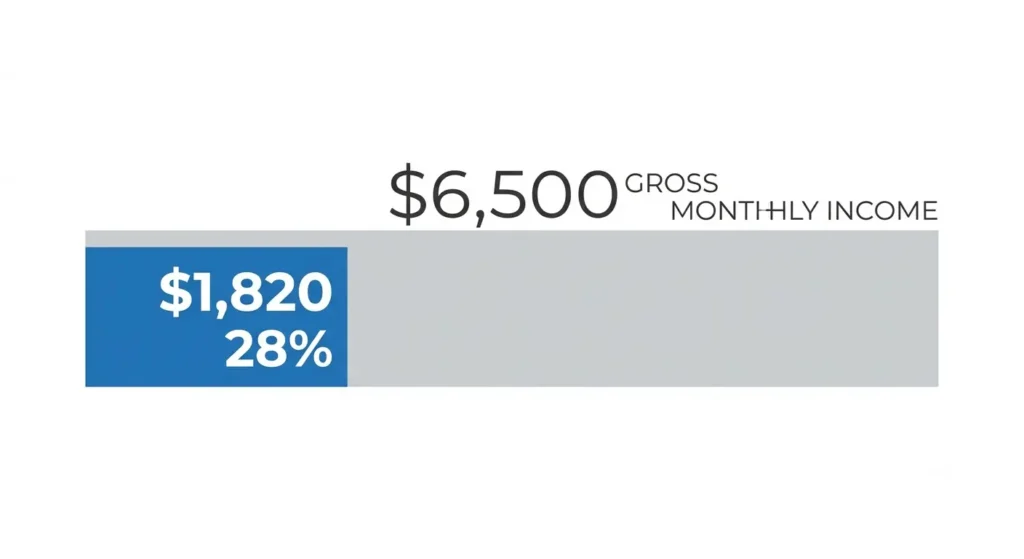
Keep your total monthly housing payment under 28 percent of gross income. On $6,500 a month, that’s about $1,820 for principal, interest, taxes, and insurance. Lenders often approve more than that. Approval isn’t the same as comfortable. Run your own numbers with a mortgage payment calculator to see where you land, and check out our full breakdown of how much house you can afford for the full formula lenders use.
Costs Beyond the Mortgage
Upfront Costs
Down payment aside, closing costs run 2 to 5 percent of the loan, plus moving costs and cash for early repairs. If you want the full math behind your monthly number, see how your mortgage payment is calculated.
Ongoing Monthly Costs
Property taxes and homeowners insurance usually get bundled into your payment through an escrow account, where your lender collects and pays them for you. HOA fees add on top if you have them. Budget 1 percent of your home’s value yearly for maintenance, the cost people forget most. Homeowners insurance protects your property, mortgage insurance protects the lender if you default, don’t confuse the two. This whole bundle, principal, interest, taxes, and insurance, is what lenders call PITI, and it’s worth understanding before you commit to a monthly number.
How Lenders Determine Affordability
Most lenders still use 43 percent debt-to-income as a benchmark, though that hard cap was replaced years ago with a flexible, price-based standard. FHA can stretch past 43 percent with strong compensating factors, conventional underwriting can reach 50 percent, and VA loans use residual income instead of a fixed ratio. Lenders also check your credit, job history, and cash reserves. Student loans and car payments count against you here too.
Step 3 — Prepare Your Finances Before Applying
Smart prep here can save you thousands over the life of your loan.
Improve Your Credit Before Applying
Pull your credit reports and fix errors. Pay down revolving balances, especially cards, and skip new credit inquiries before applying.
Save for More Than the Down Payment
Keep a separate emergency fund, plus cash for closing costs, the inspection, and a repair reserve. Buyers who spend everything on the down payment alone often regret it within six months.
Documents You’ll Need
Gather proof of income, two years of tax returns, recent bank statements, and ID before you apply.
Step 4 — Get Pre-Approved for a Mortgage
Pre-approval is your ticket in, sellers won’t take an offer seriously without it.
Pre-Qualification vs Pre-Approval
Pre-qualification is a rough estimate, pre-approval verifies your documents and credit, so sellers trust it more. Letters typically last 60 to 90 days, so time it close to your house hunt. The Consumer Financial Protection Bureau’s free CFPB Home Loan Toolkit walks through the process lender-neutral.
Compare Your Mortgage Options
For a deeper dive into rates, terms, and lending rules, browse our full mortgage basics collection alongside the comparison below.
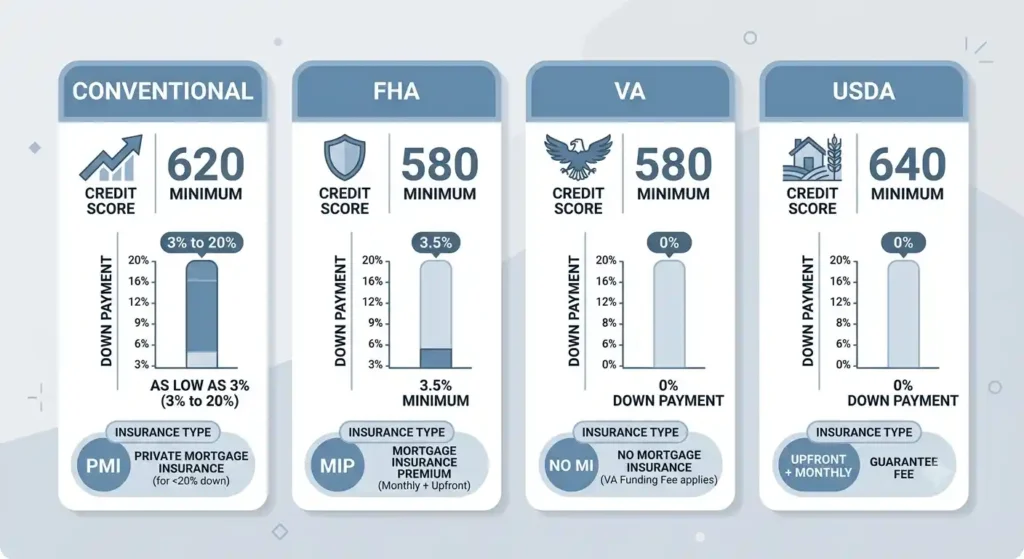
| Loan Type | Min. Credit Score | Min. Down Payment | Mortgage Insurance |
|---|---|---|---|
| Conventional | ~620 | 3% | PMI, removable at 80% LTV |
| FHA | 580 | 3.5% | MIP, usually stays for loan term |
| VA | No fixed minimum | 0% | None, funding fee instead |
| USDA | No fixed minimum | 0% | Guarantee fee (income limits apply) |
Conventional Loans
Needs a credit score around 620 or higher, with down payments as low as 3 percent. Under 20 percent down means paying private mortgage insurance until you build equity, usually removable once your balance drops below 80 percent of the home’s value. Most are backed by the Federal National Mortgage Association (Fannie Mae) or the Federal Home Loan Mortgage Corporation (Freddie Mac), overseen by the Federal Housing Finance Agency.
FHA Loans
Backed by the Federal Housing Administration, allows 3.5 percent down with a 580 credit score. The tradeoff is a Mortgage Insurance Premium (MIP) that usually lasts the loan term, unlike PMI it rarely disappears without a refinance.
VA Loans
Eligible service members and veterans can buy with zero down. There’s a funding fee, but it often beats paying private mortgage insurance.
USDA Loans
Zero down for eligible rural buyers, with income limits, check both before counting on it.
How to Compare Lenders
Compare APR, not just rate, since APR includes fees. Decide fixed-rate mortgage versus adjustable-rate mortgage (ARM) first. The Truth in Lending Act (TILA) requires APR to be calculated the same way everywhere, which makes comparing fair. Get a Loan Estimate from each lender, ask if discount points make sense for how long you’ll stay, and ask how they handle rate locks and delays.
Step 5 — Find the Right Home
This is the fun part, and where budgets quietly get abandoned. Start shopping only once your pre-approval letter is in hand. Choose a real estate agent you trust, and ask how many first-time buyers they’ve closed recently. You can use the seller’s agent, but your own buyer’s agent negotiates for you instead of the seller.
Choose the Right Neighborhood
Weigh real commute time, school ratings even without kids, since it affects resale value, crime data, and planned development nearby.
Choose the Right Property Type
Single-family homes offer the most control. Condos and townhouses cost less but add HOA fees and rules. New construction means fewer early repairs at a premium. A fixer-upper can get you into a pricier area, but only with a real repair budget and timeline.
Home Tour Checklist
Check the foundation, test major systems like heating and plumbing, and look for water stains or damage signs before you fall for the kitchen.
Step 6 — Make a Strong Offer Without Overpaying
The strongest offer isn’t always the highest one, it’s the smartest for the situation.
Decide How Much to Offer
Base it on recent comparable sales and market conditions, not just the listing price. Set a firm max before you fall for the house.
Understand Offer Terms
Earnest Money Deposit
Usually 1 to 3 percent of the price, it shows you’re serious, and it’s refundable if you back out for a reason covered by contingencies. Walk without one and you risk losing it.
Purchase Contingencies
An inspection contingency lets you renegotiate or exit over problems. An appraisal contingency protects you if the home appraises low. A financing contingency covers a failed loan, and a home sale contingency ties your purchase to selling your current home.
What Happens After Your Offer Is Accepted
The contract starts a clock: pay earnest money by deadline, schedule inspection, and coordinate with your agent, lender, and title company.
Step 7 — Complete the Inspection, Appraisal, and Underwriting
This stage catches problems before they become yours.
Home Inspection Explained
Inspectors check the roof, foundation, plumbing, electrical, and appliances. Common issues include old wiring and worn roofing, foundation cracks or mold are serious red flags. Specialty inspections for pests or radon cost extra. After the report, ask the seller for repairs, a closing credit, or a price cut, and ask your inspector what they’d fix first.
Inspection vs Appraisal
Inspection protects you by revealing condition, appraisal protects the lender by confirming value. You order the inspection, the lender orders the appraisal, a clean inspection doesn’t guarantee a matching appraisal.
What if the Appraisal Comes in Low?
Ask the seller to lower the price, bring extra cash, or challenge it with new comparable sales. Sometimes the deal falls apart here, which is exactly what the appraisal contingency is for.
Mortgage Underwriting
Underwriters recheck your income, assets, credit, and the property before final approval, and may re-request documents. New debt, like a car loan, and a job change mid-process can both stall your closing.
Step 8 — Prepare for Closing Day
The final stretch of paperwork before the home is yours.
Review Your Closing Disclosure
Compare it line by line against your original Loan Estimate. Confirm the rate, terms, and costs match, and flag unexplained changes.
Final Walkthrough Checklist
Confirm agreed repairs happened, test major systems, check included appliances, and match the property to what you toured.
What Happens at Closing
You sign the documents, pay cash to close, and get the keys once ownership is recorded with the county. Before that, the title company runs a title search to confirm clean ownership, and title insurance protects you if a problem surfaces later. The Real Estate Settlement Procedures Act (RESPA) is why your Closing Disclosure has to match your Loan Estimate so closely.
Step 9 — Move Into Your New Home
The paperwork’s done, now the house becomes your home.
First Week Checklist
Change the locks, set up utilities before move-in, update your mailing address, and locate the water and gas shutoffs.
First-Year Homeowner Priorities
Focus on preventive maintenance, budget monthly for repairs, keep building emergency savings, and organize your home documents in one place.
First-Time Home Buyer Programs and Financial Assistance
Over 2,600 assistance programs exist nationwide in 2026, and owning brings tax benefits renters don’t get, like deductions on mortgage interest and property taxes.
Federal Loan Programs
Conventional, FHA, VA, and USDA loans each fit different buyers, matching the right one to your credit and savings can save thousands. Any of them can also be paired with the down payment assistance programs below, stacking the savings further.
Down Payment Assistance Programs
Grants never get repaid. Forgivable loans cancel if you stay long enough. Deferred-payment loans delay repayment until you sell or refinance. Eligibility usually hinges on income limits and first-time buyer status.
State and Local Assistance
Most states run a housing finance agency with its own assistance, usually with income limits and a primary-residence rule. Apply early, funding often runs out. A HUD-approved housing counseling agency can review your options for free.
Common Myths About Buying Your First Home
Bad information keeps good buyers waiting longer than they need to.
You Need 20% Down
The typical first-time buyer puts down 10 percent, not 20, according to NAR’s 2025 buyer data. FHA goes as low as 3.5 percent, VA allows zero down for eligible buyers. Skipping 20 percent just means paying mortgage insurance until you build equity.
Pre-Qualified Means Guaranteed Approval
Pre-qualification is an estimate, not a promise, final approval depends on underwriting verifying every document.
Renting Is Always Cheaper
Renting looks cheaper monthly but builds no equity. Over years, owning often wins once you count the equity built, even with maintenance costs.
Common First-Time Home Buyer Mistakes
Most of these are avoidable once you know they’re coming.
Financial Mistakes
Maxing your budget leaves no cushion. Ignoring maintenance and insurance costs, skipping an emergency fund, and not comparing lenders all cost buyers later.
Home Shopping Mistakes
Falling for the first showing rushes decisions. Skipping neighborhood research, skipping the inspection to compete, and ignoring resale value all backfire later.
Closing Mistakes
A big purchase before closing can tank approval. Missed deadlines can cost your earnest money. Sloppy paperwork causes scrambling, and wire fraud scams during closing have cost buyers their entire down payment.
Frequently Asked Questions
How much money do I need to buy my first home?
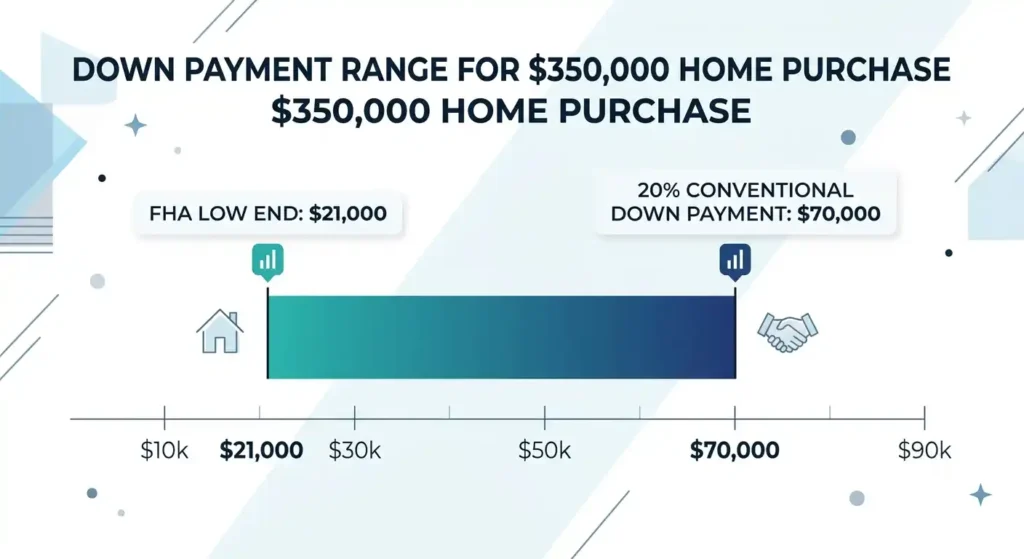
Beyond your down payment, budget for closing costs, an emergency fund, and moving expenses. For a $350,000 home, expect $21,000 to $70,000 upfront depending on loan program and down payment size.
What credit score do I need?
FHA accepts 580 or higher, conventional wants 620 or higher. A higher score gets a better rate, but strong income and savings can offset a lower one.
How long does the home buying process take?
Expect 30 to 60 days once your contract is signed. Missing paperwork, appraisal issues, or extra underwriting requests are the usual culprits behind delays.
Should I get pre-approved before looking at homes?
Yes. It sets your real budget and makes sellers take you seriously, otherwise you risk touring homes outside what you can actually afford.
How do I choose the best mortgage?
Match the loan program to your down payment and credit, then compare lenders on APR and fees, not just the advertised rate.
What happens if my mortgage is denied?
Common causes are high debt-to-income, new debt taken on mid-process, or unverifiable income. You can often fix it and reapply, or switch lenders.
Final Home Buying Checklist
Before You Apply
- Check your credit
- Build your savings
- Estimate affordability
- Gather documents
Before You Make an Offer
- Get pre-approved
- Compare lenders
- Research neighborhoods
- Tour homes
Before Closing
- Complete the inspection
- Review your Closing Disclosure
- Schedule the final walkthrough
- Prepare closing funds in the required form
After You Move In
- Secure the property
- Build a maintenance schedule
- Track housing expenses
- Revisit your financial goals
Internal links in this guide were mapped against mortgageestimator.online’s post sitemap, page sitemap, and category sitemap.