A mortgage amortization schedule is a table breaking every payment into interest, principal, and remaining balance, from first payment to last, showing a fixed-rate borrower exactly how a loan pays down over time.
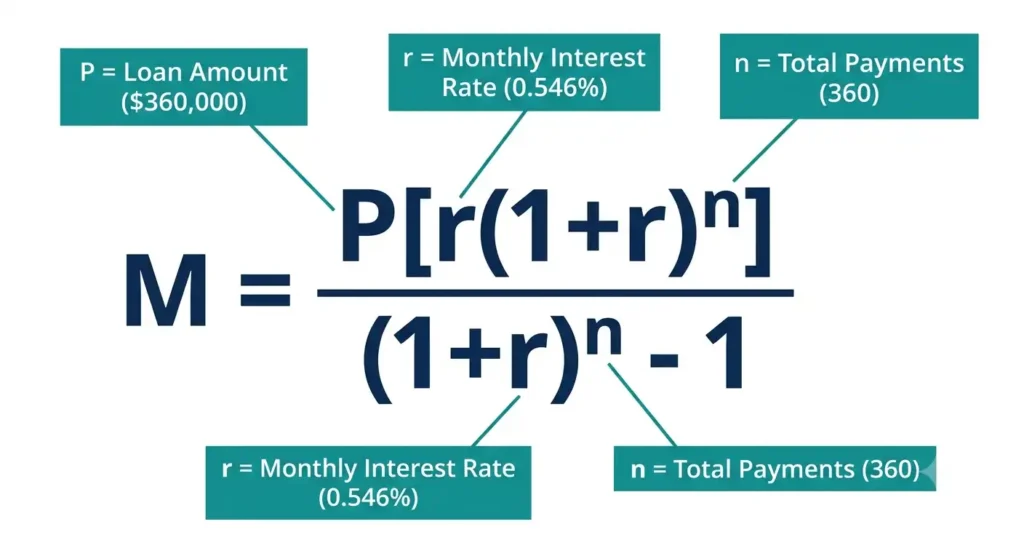
That formula never changes: monthly interest equals balance times rate divided by twelve, per standard amortization math and current Freddie Mac PMMS data.
Front-loaded interest often surprises new homeowners, and small rounding differences can appear versus online calculators.
What Is a Mortgage Amortization Schedule?
That interest, principal, and balance breakdown is the core building block behind every mortgage. It’s different from a general payment schedule, which just lists due dates and amounts without splitting those out.
Mortgage amortization explained in plain English
Amortization means paying off a debt in fixed, regular installments, usually 15 or 30 years of equal monthly payments. Unlike a credit card, the structure is locked from day one. The lender already knows exactly how much interest you’ll pay in month 1 and month 240.
Why every mortgage comes with an amortization schedule
Lenders must give you this schedule under the Truth in Lending Act (TILA), enforced by the Consumer Financial Protection Bureau (CFPB). Projected numbers appear on your Loan Estimate, finalized numbers on your Closing Disclosure. Most servicers also let you view it anytime online. For more on how mortgages work from the ground up, our mortgage basics hub covers related topics in one place.
Quick Answer: How Mortgage Payments Change Over Time
Your payment stays fixed on a fixed-rate loan, but what it covers shifts. Early payments are mostly interest. Late payments are mostly principal.
The principal vs. interest breakdown
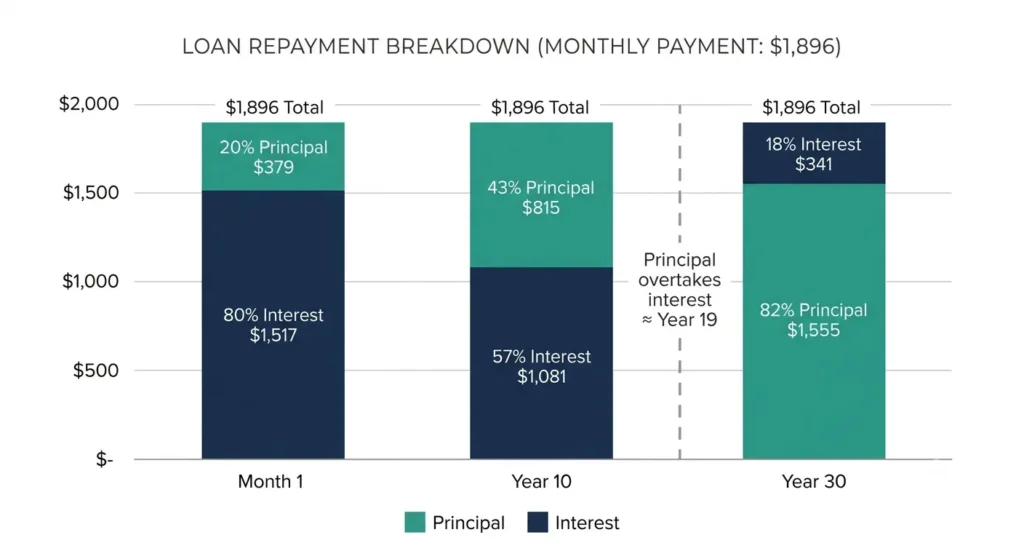
Interest is calculated on your current balance, which is highest at the start. On a $300,000 loan at 6.5% over 30 years, the payment is about $1,896. Month one splits to $1,625 interest and $271 principal. By year 10, that’s closer to $1,378 interest and $519 principal. Principal permanently overtakes interest around year 19, not at the halfway mark like most assume. For a closer look at how that split plays out across a full loan, see our principal vs interest breakdown guide.
At a glance comparison table
| Stage | Interest Portion | Principal Portion | Equity Growth |
|---|---|---|---|
| Beginning of the loan | High | Low | Slow |
| Middle of the loan | Balanced | Growing | Faster |
| End of the loan | Minimal | Nearly all | Rapid |
Beginning of the loan
Most of your payment covers interest. Your balance barely moves. This is normal on every fixed-rate mortgage.
Middle of the loan
The split evens out as your balance drops. Equity builds faster than in the early years.
End of the loan
Almost your entire payment goes to principal. Your balance drops fastest here, and payoff finally feels close.
How to Read Every Column in an Amortization Schedule
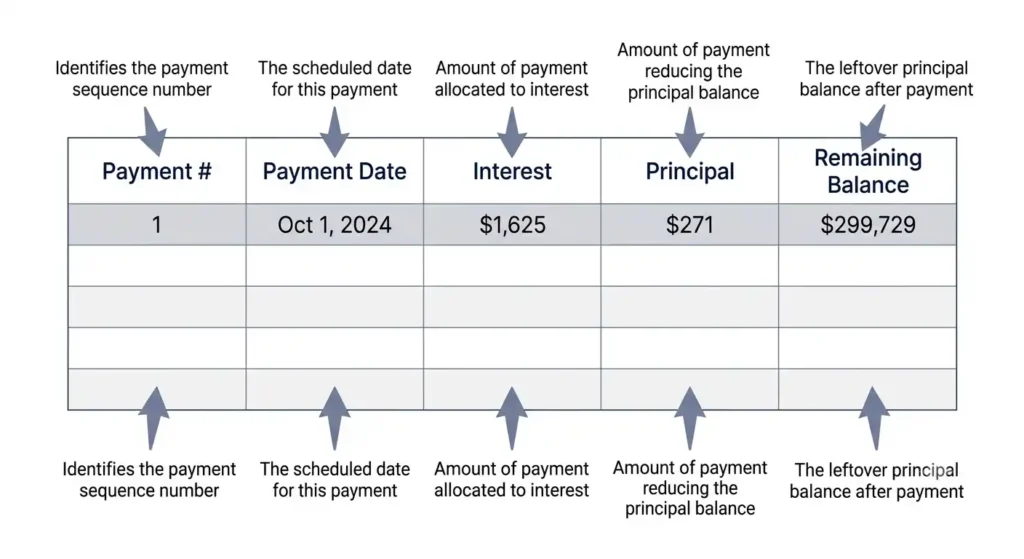
Every table uses the same columns. Once you know them, the document takes seconds to read.
Payment number
Payment number is the sequence, 1 through 360 on a 30-year loan or 180 on a 15-year loan, often paired with the exact payment date.
Monthly payment amount
This is your fixed principal and interest payment. It excludes property tax, insurance, and PMI, even if your servicer bundles those through escrow.
Interest payment
This is that month’s interest, based on your current balance. It shrinks slightly every month.
Principal payment
This is the part reducing what you owe. It grows every month as interest shrinks, since the total payment stays fixed.
Remaining loan balance
This is what you still owe after that payment, also called your principal balance or outstanding balance. It’s the number to watch for payoff planning or refinancing.
Why Early Mortgage Payments Are Mostly Interest
This catches most new homeowners off guard.
How lenders calculate interest
Interest equals your balance times your rate, divided by 12. On $300,000 at 6.5%, month one’s interest is $1,625. The rest of your fixed payment goes to principal. Miss a payment and interest keeps accruing on the full balance, pushing the shortfall forward. If you want the full formula behind that fixed payment, our guide on how your mortgage payment is calculated breaks it down step by step.
Why this surprises homeowners
Most people expect payments to chip away evenly from day one. They don’t, and lenders rarely explain it clearly at closing. It’s the same for every fixed-rate borrower, not a sign of a bad deal.
Factors That Change Your Amortization Schedule
Four things shape your schedule, whether your loan is conventional (backed by Fannie Mae), FHA (insured by the Federal Housing Administration under the U.S. Department of Housing and Urban Development (HUD)), or another type. The formula itself doesn’t change.
Loan amount
A bigger loan means bigger early interest charges. Borrow $400,000 instead of $300,000 at the same rate and term, and total interest paid climbs by roughly a third.
Interest rate
As of late July 2026, Freddie Mac’s weekly Primary Mortgage Market Survey puts the average 30-year fixed rate near 6.58% and the 15-year near 5.96%; these update most Thursdays. Moving from 6.5% to 7% adds about $100 to a $300,000 loan’s monthly payment. Your rate isn’t your annual percentage rate (APR); APR adds lender fees and closing costs, making it the better number for comparing offers.
Loan term
A 15-year loan builds equity faster than a 30-year, since more of each payment hits principal from the start, at the cost of a higher monthly payment.
Down payment
A bigger down payment shrinks your starting balance and interest from month one. Putting 20% down instead of 10% on a $350,000 home finances $70,000 less, saving tens of thousands over 30 years. Not sure what down payment fits your budget? Our how much house can I afford calculator factors that in alongside your income and debts.
Mortgage Amortization Comparison Table
15-year vs 30-year mortgage
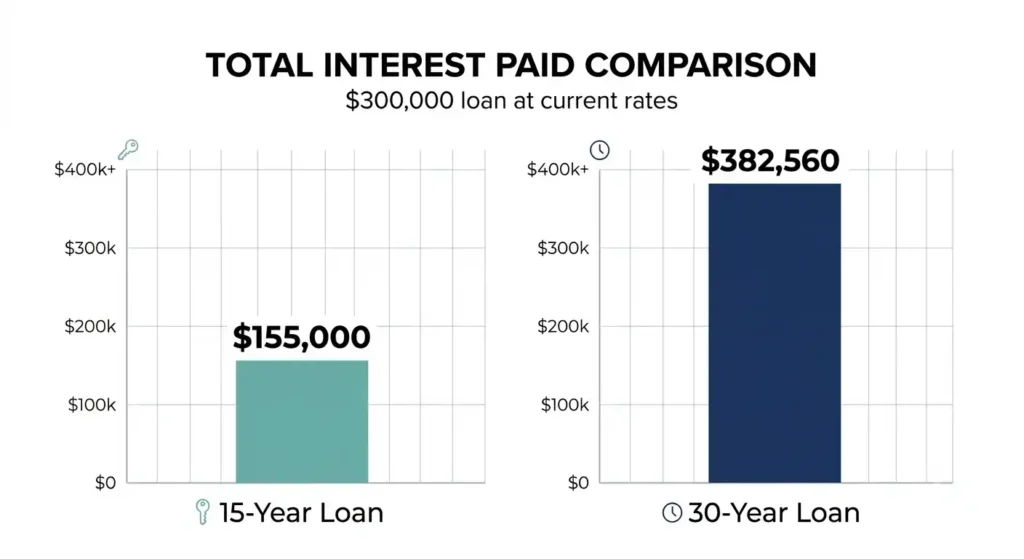
On that same $300,000 loan, the 30-year path costs roughly $382,000 in total interest, versus about $155,000 for the 15-year, though the 15-year payment runs several hundred dollars higher monthly.
| Factor | 15-Year | 30-Year |
|---|---|---|
| Monthly Payment | Higher | Lower |
| Total Interest Paid | Much lower | Much higher |
| Equity Growth | Fast | Slow, then speeds up |
| Best For | Buyers who want to be debt-free sooner | Buyers who want lower payments |
Fixed-rate vs ARM
An adjustable-rate mortgage (ARM) recalculates its schedule at each rate reset after the intro period; a fixed-rate loan never does.
| Factor | Fixed-Rate | ARM |
|---|---|---|
| Payment Stability | Locked for the full term | Changes after intro period |
| Schedule | Set once | Recalculated each adjustment |
| Interest Risk | None | Can rise with rates |
| Best For | Long-term buyers | Buyers selling or refinancing early |
Standard payments vs extra payments
| Factor | Standard Payments | Extra Payments |
|---|---|---|
| Total Interest | Full amount owed | Reduced, often by tens of thousands |
| Payoff Date | Full term | Years sooner |
| Equity Timeline | Standard pace | Accelerated |
Amortization and Home Equity
How equity builds over time
Equity grows from paying down principal and from home value appreciation. Amortization drives the first part, and every principal payment adds directly to it.
Why equity matters
Equity funds a cash-out refinance, home equity loan, or HELOC, and it’s your profit if you sell. Ten years into a 30-year loan builds meaningfully more equity than two years in, at the same price, since the schedule has shifted further toward principal.
Mortgage Amortization Example
Example using a fixed-rate mortgage
A $300,000, 30-year fixed loan at 6.5% carries a $1,896 monthly principal and interest payment.
First payment breakdown
Month one: $1,625 to interest, $271 to principal, balance drops to $299,729. Payments 2 through 12 barely move, shifting just a dollar or two more toward principal each time. Total interest over 30 years runs about $382,560, nearly matching the loan amount itself.
Mid-loan snapshot
Year 5 balance: around $282,000. Year 10: about $253,700, with $1,378 interest and $519 principal that month. Year 15: near $217,800. Year 20: around $167,000.
Final payment snapshot
Near the end, most of the $1,896 payment goes to principal, sometimes over $1,850, with interest down to a few dollars. The final payment closes the loan.
What Happens When You Make Extra Principal Payments?
One-time extra payment
A $10,000 lump sum toward principal shrinks your balance immediately, lowering all future interest and shaving years off payoff. Applied in year 2, it saves far more than the same amount applied in year 20.
Monthly extra payments
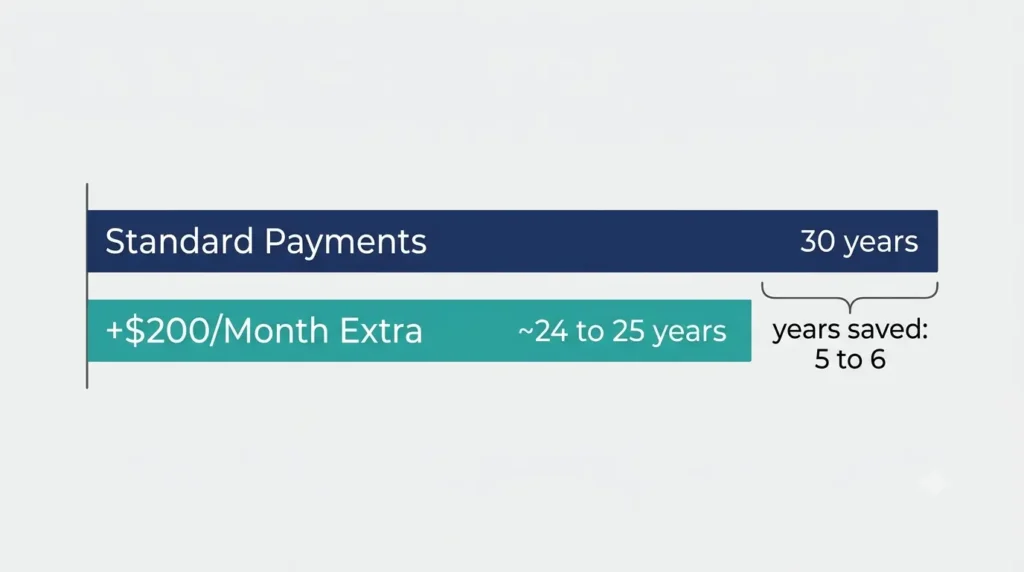
Adding $200 a month on that $300,000 loan at 6.5% can cut the term by 5 to 6 years and save tens of thousands in interest.
Biweekly payments
Half-payments every two weeks equal 13 full payments a year instead of 12. That extra payment can shorten a 30-year loan by 4 to 5 years.
How Refinancing Changes Your Amortization Schedule
Starting a new schedule
Refinancing replaces your old loan with a new one, resetting the amortization schedule to year one, even after 8 years of payments.
When refinancing makes sense
It pays off when you can meaningfully lower your rate, shorten your term affordably, or change loan structure. With 30-year rates near 6.58% in mid-2026, refinancing only helps if your current rate is notably higher and you’ll stay long enough to recoup closing costs.
Real-Life Scenarios
First-time homebuyer
The schedule shows exactly what you’re signing up for, month by month, for budgeting and comparing offers. Ask your lender to walk through year one and confirm any prepayment penalty, which is rare on most conventional owner-occupied loans today. Our first-time home buyer guide walks through the rest of the process, from pre-approval to closing.
Homeowner planning early payoff
Run the numbers with an extra $100, $300, or $500 a month to see years and interest saved. Once your balance hits zero, your lender sends a payoff statement, releases the lien, and payments stop.
Borrower considering refinancing
Compare your current schedule to a projected new one, add closing costs, and calculate the break-even point in months. Selling before that point means refinancing likely isn’t worth it.
Common Mistakes When Reading an Amortization Schedule
Assuming early payments are wasted
Heavy interest early doesn’t mean wasted money. You’re still building equity every month and paying for the cost of borrowing. It evens out over time.
Ignoring principal-only payments
Extra payments sent without specifying “principal only” may get applied to future interest instead. Always confirm with your servicer.
Confusing PITI with amortization
Amortization tracks only principal and interest. Taxes and insurance sit outside it, inside your full PITI (Principal, Interest, Taxes, Insurance) payment. See our full what is PITI breakdown for how those pieces stack on top of your loan payment.
Mortgage Amortization Myths Debunked
Myth: Early payments are only interest
False. Every payment includes some principal, even the first one, just a small amount.
Myth: Extra payments lower monthly payments
Extra payments cut your balance and term, not your required monthly bill, unless you formally recast or refinance.
Myth: All mortgages amortize the same way
Fixed loans follow one steady schedule. ARMs recalculate at each adjustment. Interest-only loans skip principal during that period. Balloon loans amortize partially then require a lump sum. A few loans even carry negative amortization, where the balance grows because the payment doesn’t cover full interest due.
Frequently Asked Questions
What is a mortgage amortization schedule?
A table showing every payment, split into interest, principal, and remaining balance, from first payment to last.
Why do I pay mostly interest at first?
Interest is calculated on your balance, which is highest at the start.
Can I pay off my mortgage early?
Yes, most mortgages allow extra principal payments with no penalty; a few carry prepayment penalties, so check your documents.
How do extra payments affect amortization?
They cut your balance immediately, reducing future interest and shortening your term by years.
Can I create my own amortization schedule?
Yes. Multiply your balance by the monthly rate for that month’s interest, subtract it from your fixed payment for principal, and repeat until the balance hits zero. Most people use an Excel amortization schedule or Google Sheets amortization schedule with the PMT function, or a free online amortization calculator, like the one on our mortgage calculator homepage. You need your loan amount, rate, term, and start date. Small differences from your lender’s schedule usually trace to rounding or your exact first payment date; verify it by checking that the interest column equals balance times rate divided by twelve.
Does refinancing reset amortization?
Yes, a new loan means a new schedule from year one.
What’s the difference between amortization and mortgage term?
The term is total loan length, like 15 or 30 years. Amortization is the process of paying it down through that schedule.
Are property taxes and insurance included in amortization?
No, only principal and interest. Taxes and insurance run through escrow separately, even when bundled into one PITI bill.
Key Takeaways
The most important lessons
Your amortization schedule shows exactly where every mortgage dollar goes, month by month. Use it to budget accurately, compare loan offers, and decide whether extra payments or refinancing fit your goals. Even small, consistent extra payments can cut years off your loan and save real money in interest. Learn more about how we build our tools and calculations on our about us page.
Internal links above draw from our post sitemap, page sitemap, and category sitemap.