A fixed-rate mortgage locks your interest rate for the full loan term, while an adjustable-rate mortgage (ARM) starts lower and adjusts after an introductory period. Which one costs less depends on how long you plan to stay in the home.
That timeline math holds up against 2026 rate data, where 5/1 ARMs and 30-year fixed loans track closely.
Even so, ARM savings aren’t guaranteed and can shrink or reverse once rates adjust.
Fixed vs Adjustable Rate Mortgage at a Glance
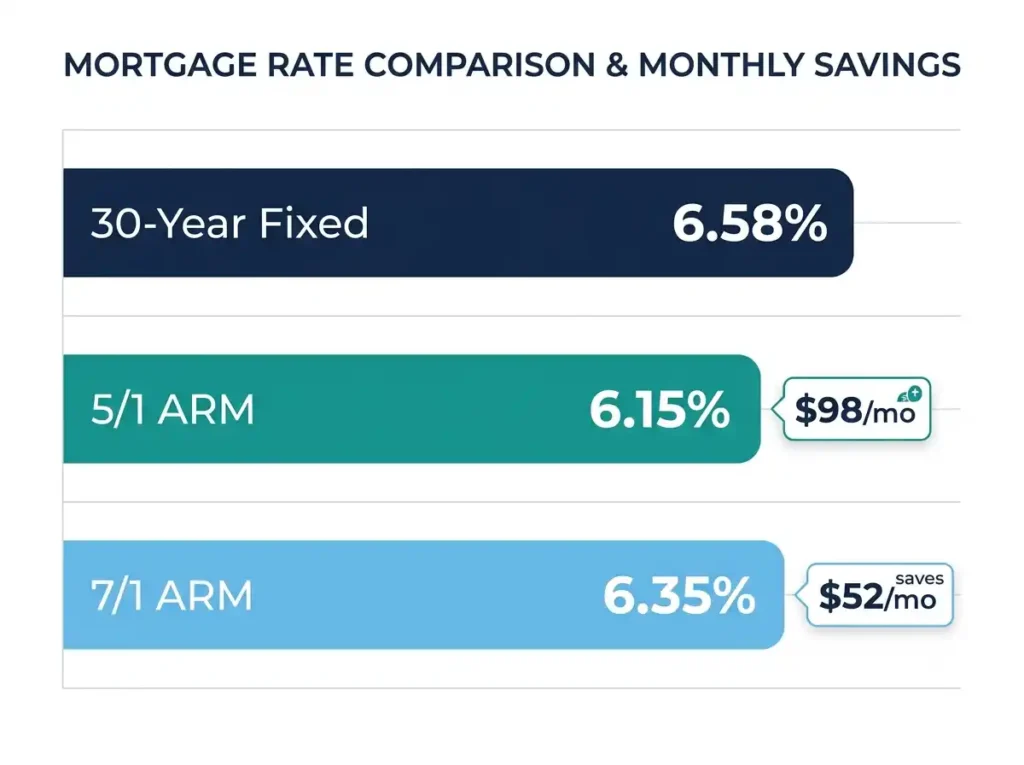
Here’s the side-by-side breakdown, current 2026 numbers included. On a $350,000 loan, a 5/1 ARM at 6.15% runs about $98 less per month than a 30 year fixed at 6.58%.
Quick Comparison Table
| Fixed Rate | ARM | |
|---|---|---|
| Payment stability | Locked for full term | Locked for 5, 7, or 10 years, then adjusts |
| Rate behavior | Never changes | Starts lower, moves with an index after intro period |
| Best for | Staying 8+ years, tight budgets | Selling or refinancing within 5 to 7 years |
| Risk level | Low | Moderate, capped by law |
Quick Answer
Fixed wins if you’re staying a decade or want zero payment risk. An ARM wins if you’ll sell, refinance, or pay off the loan before it adjusts. A five year window is the fuzziest case.
What Is a Fixed-Rate Mortgage?
Your rate locks at closing and never moves. Month one and year twenty five look the same.
How It Works
You pick a 15 or 30 year term, and that rate is frozen for the loan’s life. Payments split between interest and principal on a fixed amortization schedule. Taxes and insurance can still shift, the loan payment can’t. This applies across conventional loan, FHA loan (backed by the Federal Housing Administration), VA loan, and USDA loan products.
Main Advantages
Your payment never surprises you, which makes budgeting simple. A rate spike to 8% next year won’t touch you. Most first time buyers value this certainty over an ARM’s discount.
Potential Drawbacks
You start at a higher rate than an ARM, sometimes by a full point. On $350,000, that’s a bigger check from day one. If rates drop later, you’re stuck unless you refinance, which costs money and time.
What Is an Adjustable-Rate Mortgage (ARM)?
An ARM trades certainty for a cheaper start. Right now, 5/1 ARMs average 6.15% while 30 year fixed loans average 6.58%, though that gap has been shrinking and sometimes disappears entirely.
How an ARM Works
The loan opens with a fixed intro period, usually 5, 7, or 10 years. After that, the rate adjusts on schedule, often yearly, based on a market index plus your locked-in margin. Payment moves with it, inside rate caps.
Understanding ARM Types
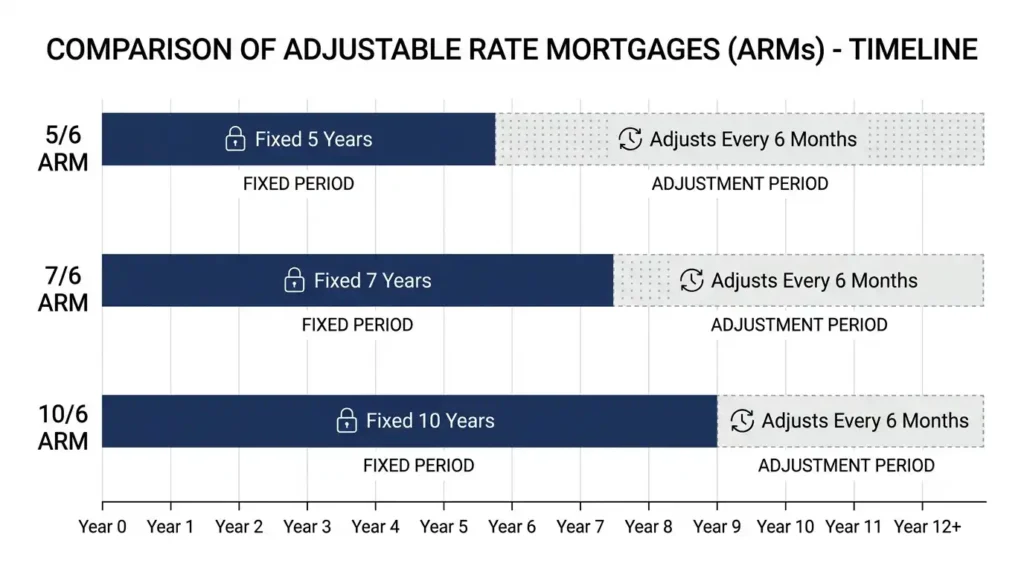
You’ll see these written as 5/1, 5/6, 7/1, or 10/1. The first number is always the fixed years; the second is how often it adjusts after that, in years (1) or months (6).
5/6 ARM
Fixed for 5 years, then adjusts every 6 months. Fits buyers expecting to move or refinance inside that window.
7/6 ARM
Fixed for 7 years, then adjusts every 6 months. Fits buyers wanting more runway, like a family expecting one more move in a decade. In 2026, 7/1 style ARMs price around 6.35%, about $52 a month cheaper than fixed on that same $350,000 loan.
10/6 ARM
10 full years before any adjustment, then it adjusts every 6 months. The discount is smaller than a 5/6 or 7/6 since the lender takes on less uncertainty. Fits buyers who want ARM pricing but aren’t sure they’ll move in five to seven years. Some lenders offer this as a 10/1 ARM, adjusting yearly instead of every six months.
What Controls Future Payments
Index
The market benchmark your rate follows after adjustment starts, most commonly SOFR (Secured Overnight Financing Rate). It moves with the economy, not your lender.
Margin
The lender’s markup added to the index, locked at closing for the loan’s life. Same index, different margin, different payment.
Rate Caps
Three interest rate caps apply:
- Initial adjustment cap: limits the first jump
- Periodic adjustment cap: limits each jump after that
- Lifetime adjustment cap: sets the ceiling
These stopped 2008 style blowups from repeating. Lenders must also qualify you at the higher of the fully indexed rate or your intro rate plus 2%, so approval already accounts for future risk. Ask for your maximum payment under the lifetime adjustment cap before signing.
Fixed vs Adjustable Rate Mortgage Comparison
The numbers decide this more than opinions do.
Interest Rate Comparison
30 year fixed rates sit around 6.5% to 6.7% now (as of late July 2026). 5/1 ARMs price near 6.15%, 7/1 near 6.35%. This spread has been shrinking through 2026 and sometimes flips, so check current rates before assuming an ARM saves money.
Monthly Payment Comparison
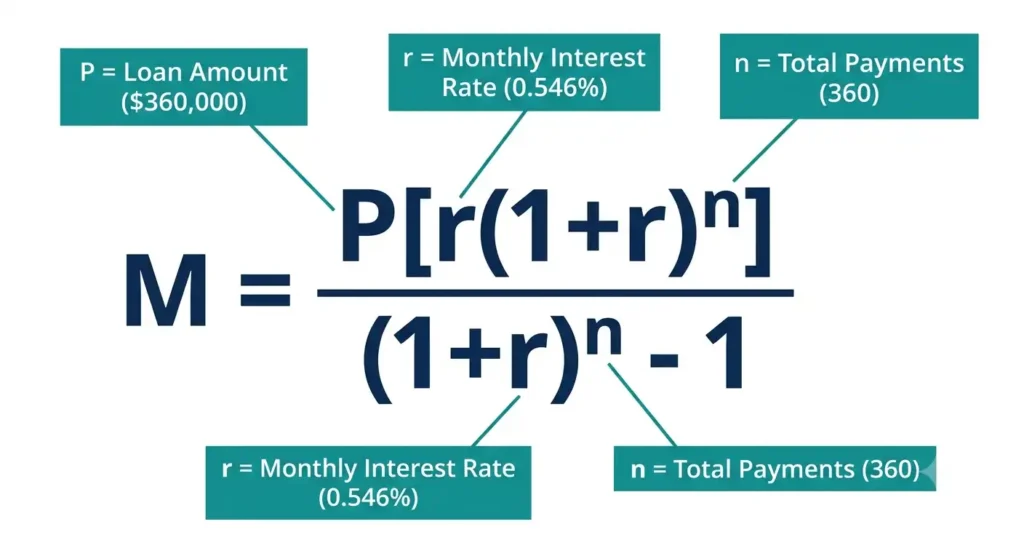
ARMs usually win early, currently by $50 to $100 a month on a $350,000 loan, a narrower gap than earlier in 2026. After adjustment, payment can swing either way. Fixed never moves. For the exact formula behind these numbers, see how mortgage payments are calculated.
Total Cost Comparison
The winner depends on how long you keep the loan and where rates sit at adjustment. Sell in year six with no adjustment hit, ARM wins. Keep it 20 years and hit a spike at year eight, fixed likely wins. It comes down to your break even point.
Risk Comparison
Fixed carries almost no rate risk. ARMs carry real risk after the intro period, capped by law but still able to add hundreds to your payment. A steady income absorbs an adjustment easier than a variable one.
What Happens If Interest Rates Change?
Three scenarios, plainly.
If Rates Rise
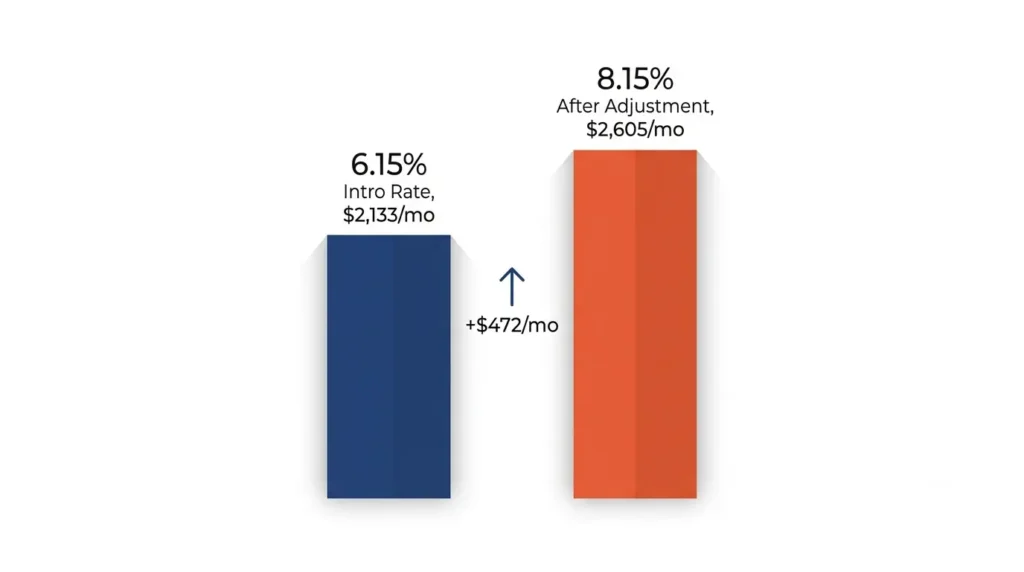
Fixed payment stays put. On a $350,000 loan, if your 5/1 ARM adjusts from 6.15% to 8.15% (a typical 2% first-adjustment cap), payment climbs from about $2,133 to about $2,605, a jump of roughly $472 a month. Still in the intro period? You’re untouched.
If Rates Fall
Fixed borrowers must refinance to capture savings, which costs fees and time. ARM borrowers may see their payment drop automatically at the next adjustment. Fannie Mae, Freddie Mac, and the MBA currently forecast rates holding in the low to mid 6% range through 2026 and 2027, and the FHFA (Federal Housing Finance Agency) tracks this data too. Betting on a future rate cut is a gamble, not a strategy.
If Rates Stay Similar
If rates barely move, the ARM keeps its edge through the intro period, then adjusts near where fixed already was. That’s actually the most common historical outcome.
Real-Life Scenarios
First-Time Homebuyer
Every dollar matters on a starter home. Stability usually wins, since a payment jump could break a tight budget. Our first-time home buyer guide walks through the full buying process if you’re just getting started.
Buyer Planning to Move in Five Years
A 5/6 ARM at 6.15% versus fixed at 6.58% saves close to $5,900 over five years on a $350,000 loan, assuming you sell before any adjustment. Risk: a life change that keeps you past year five.
Forever Home Buyer
Fixed wins. Decades of certainty beat a few years of early savings that could reverse hard at adjustment.
High-Income Professional
Growing income and investment priorities make an ARM’s freed-up cash flow appealing, since you can absorb a later adjustment without strain.
Which Mortgage Is Right for You?
Three questions: how long are you staying, how much risk can you take, how flexible is your budget. Your debt-to-income ratio and loan-to-value ratio affect qualifying for either loan, so it helps to know how much house you can afford before comparing rates.
Choose a Fixed-Rate Mortgage If
Staying 8+ years, want zero payment surprises, tight budget. Predictability is worth the higher starting rate.
Choose an ARM If
Selling, refinancing, or paying off within 5 to 7 years, growing income, comfortable absorbing an increase. Common among military families expecting relocation, investment property buyers, and vacation home buyers not tied to one location.
Decision Flowchart
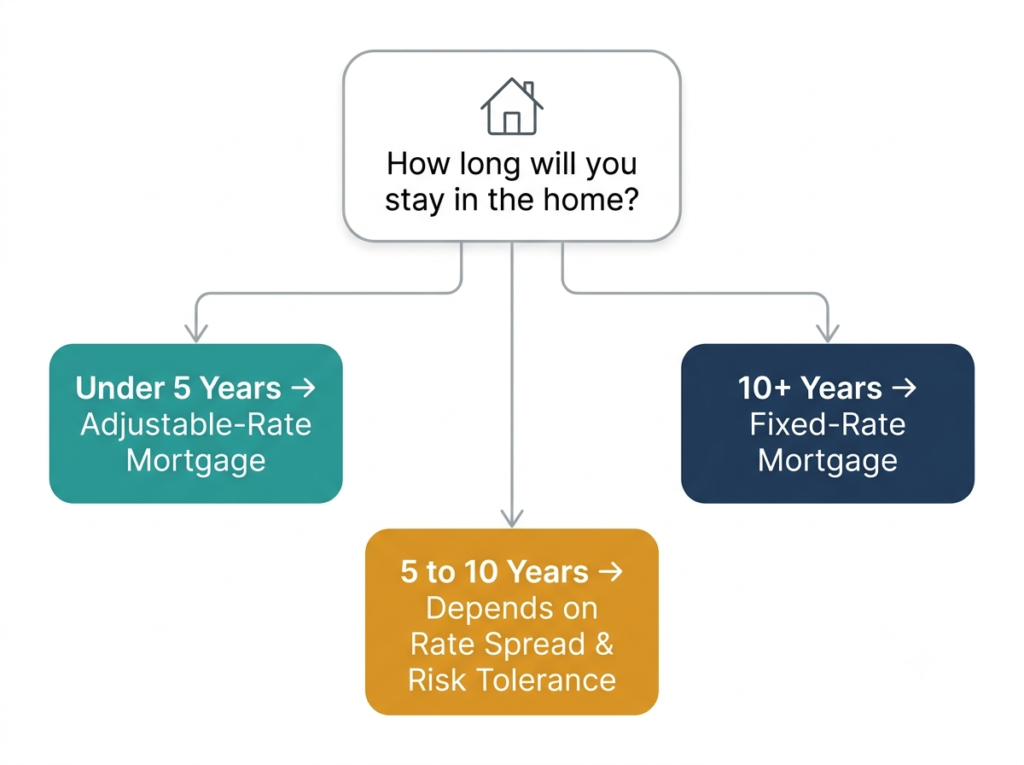
Under 5 years in the home points to ARM. Over 10 years points to fixed. In between, weigh risk tolerance and financial flexibility.
Common Myths About Fixed and Adjustable Mortgages
ARMs Are Always Dangerous
Modern ARMs have regulation-mandated rate caps. The 2008 problem loans mostly lacked these and skipped income verification. A qualified borrower with a clear timeline uses ARMs safely today.
Fixed Mortgages Always Save Money
Only if you hold the loan long enough for the math to flip. Sell or refinance before an ARM adjusts, and fixed can cost more in total interest.
You’ll Definitely Refinance Later
Not guaranteed. Income, credit, or home value shifts can block a refinance right when you need it. The Consumer Financial Protection Bureau (CFPB) flags this as one of the costliest ARM borrower mistakes.
Mistakes Homebuyers Make
Assuming You’ll Always Refinance
Refinancing requires qualifying again. A job change, home value dip, or stricter lending can shut that door.
Comparing Only Initial Interest Rates
The intro rate is half the story. What happens at first adjustment, and your worst case under the lifetime cap, matters just as much.
Ignoring Loan Estimate Details
Your Loan Estimate (required under the Truth in Lending Act) lists the index, margin, and every cap. Your lender’s Ability-to-Repay Rule check confirms you can handle the worst case, but verify it yourself. Fees buried in the same document affect true comparisons.
Questions to Ask Your Lender
Before Choosing a Fixed Mortgage
- Exact rate you’re locking
- Closing costs
- Prepayment penalty
- Future refinancing cost if rates drop
Before Choosing an ARM
- Which index applies
- Your margin
- All three rate caps in writing
- Your worst case monthly payment under the lifetime cap
Frequently Asked Questions
Is a fixed-rate mortgage safer than an ARM?
Yes, on payment risk. Fixed never changes; an ARM can rise after intro, even with caps.
Is an ARM ever better than a fixed mortgage?
Yes, if you’ll sell or refinance within 5 to 7 years. The lower start rate can save thousands before any adjustment hits.
Can an ARM payment go down?
Yes, if the index drops before your adjustment date, no refinance needed.
Can I refinance an ARM into a fixed mortgage?
Yes, if you still qualify on income, credit, and equity. Closing costs apply, so timing matters.
What happens after the ARM fixed period ends?
The rate adjusts using your index plus margin, on schedule, often yearly. The new payment applies immediately.
Which mortgage is best for first-time buyers?
Usually fixed, since budgets are tighter. With a short timeline and budget cushion, an ARM is still worth comparing.
Final Verdict: Fixed vs Adjustable Rate Mortgage
Best Choice by Homeownership Timeline
Under 5 years, ARM usually wins on total cost. 5 to 10 years, depends on the rate spread and your risk tolerance. Past 10 years, fixed wins nearly every time.
Final Decision Checklist
Know your realistic timeline. Check your budget’s room to absorb an ARM increase. Get every cap, index, and margin in writing, and run the worst case payment before signing. Our mortgage calculator makes that last step quick to check yourself.
Related Reading
Browse more guides in our mortgage basics category, or learn more about our site and how we build these guides.