A down payment for a house is the upfront cash paid toward the purchase price, financed loans cover the rest. Most buyers don’t need 20%, loan type and credit score set the actual minimum required to qualify.
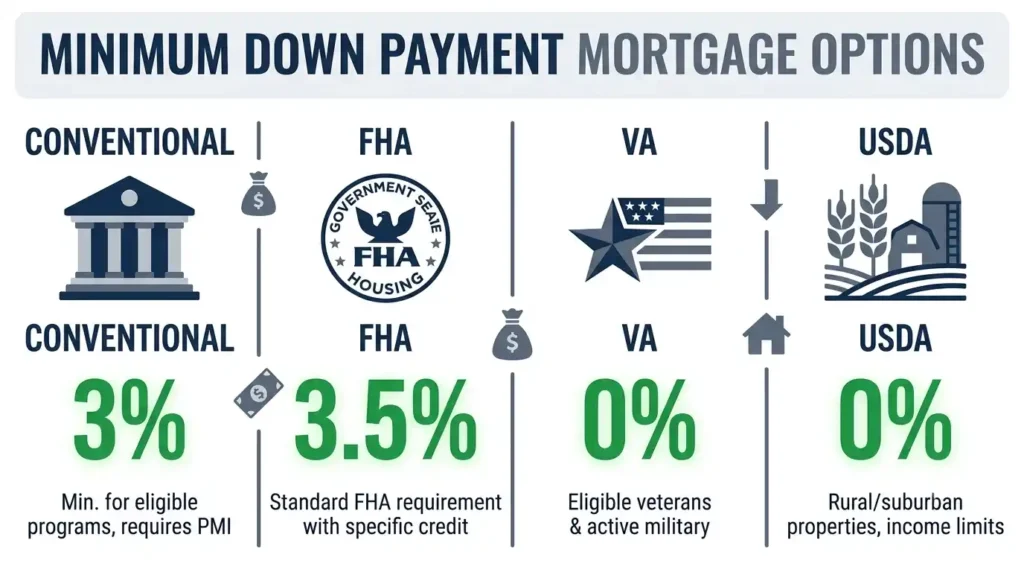
That minimum shifts by program: conventional loans start near 3%, FHA at 3.5%, and VA or USDA allow 0% for eligible buyers.
Skipping 20% usually means paying private mortgage insurance until enough equity builds up.
Quick Answer: How Much Down Payment Do You Need?
The Short Answer
The median down payment sits around 15% in 2026, but first time buyers typically put down just 6% to 10%. The table below breaks down exact cash needed and PMI impact at each level, so you can match a number to your own budget, credit score, and comfort with monthly payment. Running your own numbers through a mortgage calculator makes this concrete before you commit to a figure, and our mortgage basics hub covers the surrounding terms if any of this is new to you.
Down Payment Comparison Table
3% vs 5% vs 10% vs 20%
| Down Payment | On a $400,000 Home | Loan Amount | PMI Required? | Best For |
|---|---|---|---|---|
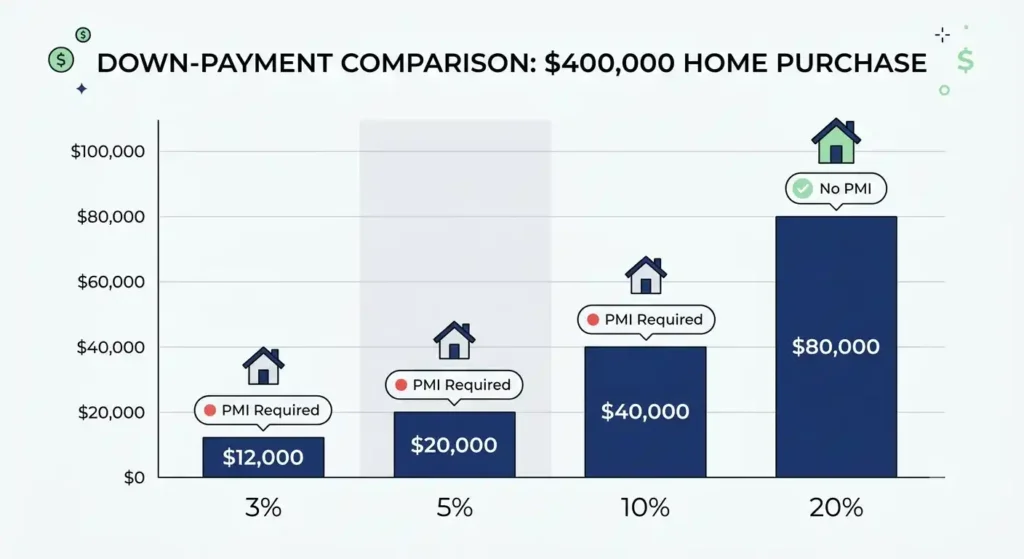
| 3% | $12,000 | $388,000 | Yes | First time buyers with strong income but thin savings |
| 5% | $20,000 | $380,000 | Yes | Buyers who want lower PMI cost than 3% down |
| 10% | $40,000 | $360,000 | Yes | Buyers balancing savings with a lower monthly payment |
| 20% | $80,000 | $320,000 | No | Buyers who want the lowest monthly cost and no PMI |
The cash gap between 3% and 20% here is $68,000, which is why so many buyers accept PMI instead of waiting years. PMI runs 0.5% to 1.5% of your loan a year, on $388,000 that’s $160 to $485 a month. Cheaper than another two or three years of rent.
What Is a Down Payment?
Simple Definition
A down payment is the cash you pay upfront toward the home’s price. The lender covers the rest through your mortgage. Buy a $350,000 home with 10% down, you bring $35,000, the lender finances $315,000. That money goes to the seller, not the lender. Lenders require it because it lowers their risk, buyers with skin in the game rarely walk away.
What a Down Payment Does Not Cover
Your down payment doesn’t include closing costs, typically 2% to 5% of the price, covering appraisal, title insurance, and origination fees. It also doesn’t include earnest money, usually 1% to 3% of the price, credited back at closing. Moving costs, furniture, and early repairs come out of pocket separately. Budget for all of it.
Do You Really Need 20% Down?
Where the 20% Rule Came From
20% is the point where lenders drop private mortgage insurance on a conventional loan. Decades ago, before FHA and low down payment programs existed, 20% was closer to standard. The myth stuck even as lending changed. PMI protects the lender, not you, and falls away once your equity crosses that line.
When 20% Makes Sense
If the cash is there and it won’t drain your emergency fund, 20% down lowers your payment, skips PMI, often earns a better rate, and starts you with more equity.
When Less Than 20% Makes Sense
Saving 20% on an $800,000 home in a market like LA or San Francisco means $160,000, a decade for many households, while rents and prices keep climbing. Buying sooner with 5% or 10% down builds equity now and keeps reserves intact for emergencies. A strong offer under 20% down still wins bidding wars in a competitive market, especially with a solid pre-approval letter, and it’s smarter for a fixer-upper, since cash held back covers repairs instead of the purchase price.
Minimum Down Payment by Loan Type
| Loan Type | Min Down Payment | Backed By | Mortgage Insurance |
|---|---|---|---|
| Conventional | 3% (5% repeat buyers) | Fannie Mae / Freddie Mac | PMI, cancels at 20% equity |
| FHA | 3.5% (580+ credit), 10% (below 580) | Federal Housing Administration | MIP, often life of loan |
| VA | 0% | Department of Veterans Affairs | None, funding fee 1.25%-3.3% |
| USDA | 0% | U.S. Department of Agriculture | Guarantee fee, income limits apply |
Conventional Loans
Conventional loans backed by Fannie Mae or Freddie Mac come through programs like HomeReady and Home Possible. Staying within conforming loan limits makes it a conforming loan, which most first-time buyers use. Credit score expectations start around 620, with 680+ getting better pricing. PMI cancels automatically once you cross 20% equity, no need to request it in many cases.
FHA Loans
FHA loans, backed by the Federal Housing Administration, are popular with thinner credit files, but come with a mortgage insurance premium (MIP) that, unlike PMI, often lasts the life of the loan unless you refinance. At 680+ credit, conventional usually beats FHA since you skip MIP and PMI cancels at 20% equity.
VA Loans
Eligible veterans, active service members, and surviving spouses buy through VA loans, guaranteed by the Department of Veterans Affairs. The funding fee can be rolled into the loan instead of paid upfront. Often the best program available for eligible buyers.
USDA Loans
USDA loans, backed by the U.S. Department of Agriculture, apply only in eligible rural and certain suburban areas under specific income limits. Instead of PMI, they charge a 1% upfront guarantee fee plus a 0.35% annual fee. Many qualifying zones sit closer to cities than buyers expect, worth checking an address before ruling it out.
How Much Should You Actually Put Down?
Base Your Decision on Your Financial Situation
Start with your actual bank balance, not a calculator’s ideal. Knowing the real difference between gross pay and net pay keeps this budget honest, since your down payment math should run on take-home pay, not your salary number. Pairing that with our guide on how much house you can afford gives you the full picture before you set a number. If 20% down wipes your emergency fund, that’s not a smart trade even PMI-free, that’s the pattern I’ve seen work best. Keep three to six months of expenses in reserve after closing. Your debt-to-income ratio (DTI), or DTI ratio, shapes your loan approval chances as much as your down payment, since lenders weigh monthly debts against income. Stretch too thin and you risk becoming house poor, unable to cover repairs once you’re in.
Questions to Ask Yourself
Can You Still Handle Unexpected Expenses?
Job stability matters most. Unpredictable income, freelance or commission work, means keeping more cash on hand, and it helps to know how 1099 income compares to a W-2 paycheck before you count on it for a mortgage application. Water heaters die, roofs leak, medical bills don’t wait. If a $3,000 surprise expense would sink you right after closing, you put down too much. Maxed out cards, no savings left, or a payment eating over 35% of take-home pay are red flags many financial advisors point to.
How Your Down Payment Changes Your Mortgage
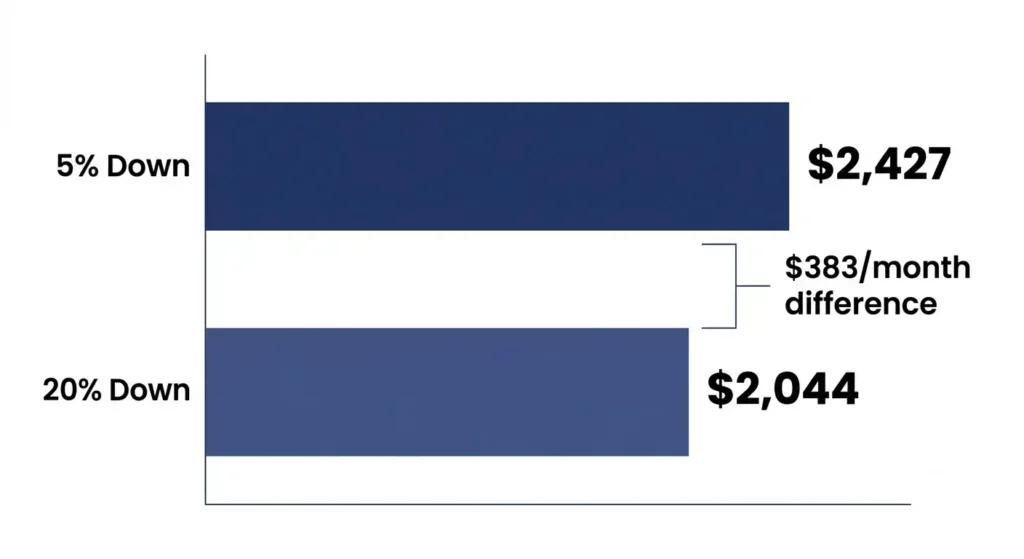
Monthly Mortgage Payment
Less borrowed means a smaller principal and interest payment, and if you want the full breakdown of how your mortgage payment is calculated, that’s covered separately. On a $400,000 home at 6.6% over 30 years, 5% down runs about $2,427 a month; 20% down drops that to about $2,044, a $383 difference. An annual salary calculator shows exactly how much room that leaves in your own budget. A lower payment also stretches your home affordability, letting you qualify for a higher purchase price without more income.
Mortgage Insurance (PMI)
PMI applies to conventional loans under 20% down, running 0.5% to 1.5% of your loan balance yearly, and it’s one piece of your full PITI payment each month. On a $380,000 loan at 1%, that’s about $317 a month. It ends at 20% equity, through payments or rising value, and you can request removal rather than wait. This threshold is your loan-to-value ratio (LTV), or LTV ratio, the share of the home’s value you still owe. Some buyers refinance specifically to clear that 80% LTV line and drop PMI sooner.
Interest Costs Over Time
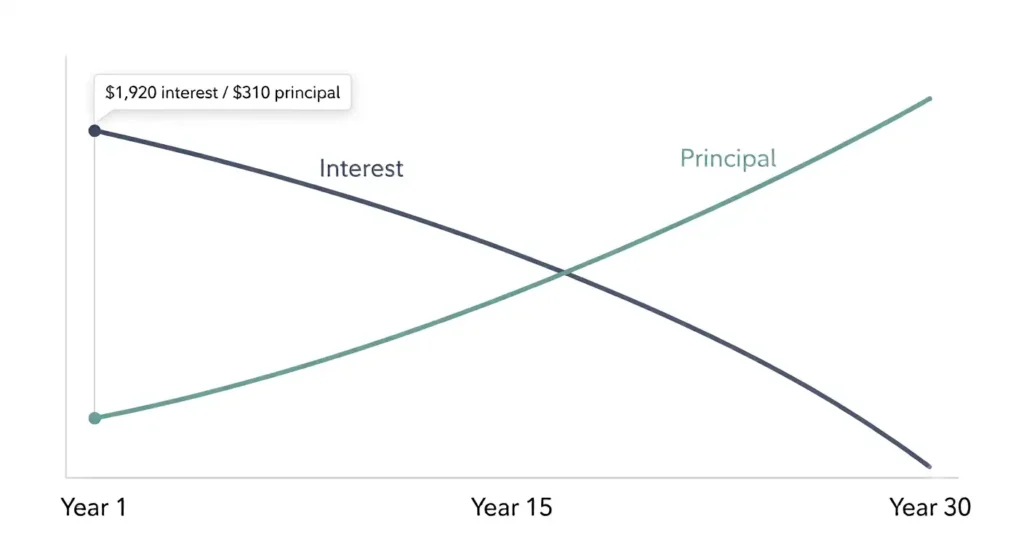
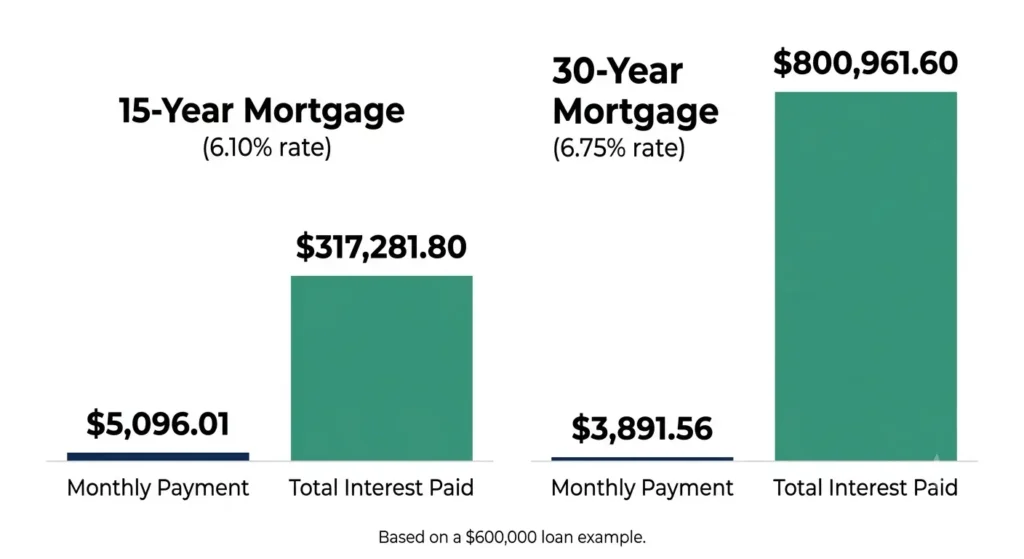
A bigger down payment cuts total interest, not just the monthly bill. On that same $400,000 home, financing $380,000 instead of $320,000 costs roughly $78,000 more in interest over 30 years at 6.6%. Seeing the principal vs interest split laid out on a full amortization schedule makes that $78,000 gap easy to visualize payment by payment. Smaller down payments cost more long term but get you in sooner.
Real Down Payment Examples
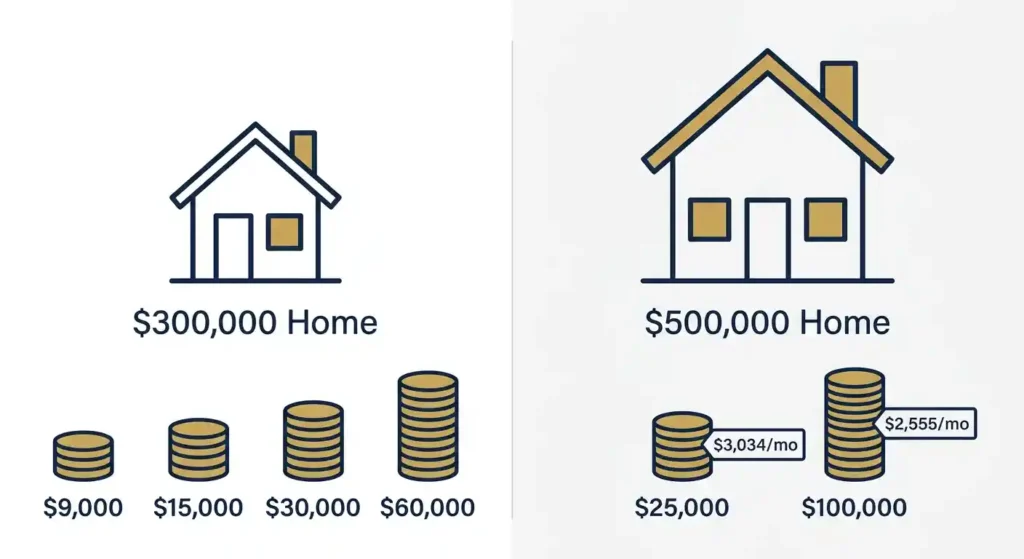
$300,000 Home
- 3% down: $9,000 cash, $291,000 loan
- 5% down: $15,000 cash, $285,000 loan
- 10% down: $30,000 cash, $270,000 loan
- 20% down: $60,000 cash, $240,000 loan
$500,000 Home
- 5% down: $25,000 cash, $475,000 loan, PMI required, ~$3,034/month at 6.6%
- 20% down: $100,000 cash, $400,000 loan, no PMI, ~$2,555/month at 6.6%
The upfront gap is huge, so is the monthly savings.
Which Buyer Benefits Most From Each Option?
First time buyers with steady income but thin savings do best with 3% to 5% down, our first-time home buyer guide walks through the full process step by step. Higher income buyers with strong reserves often prefer 20% to kill PMI. Buyers with limited savings but solid job security can lean into a low down payment loan. Buyers relocating for work often benefit from keeping cash liquid instead of locking it into equity.
Down Payment vs Other Upfront Costs
Closing Costs
Closing costs run 2% to 5% of the price on top of your down payment, $8,000 to $20,000 more on a $400,000 home. They cover origination, appraisal, title search, title insurance, recording fees, and prepaid insurance and tax escrow.
Cash to Close
Cash to close is your down payment plus closing costs, minus your earnest money deposit, which gets credited back. Many first time buyers budget only for the down payment and get blindsided by the real total.
Other Costs to Budget For
Moving runs $1,000 to $5,000. Furniture and window treatments add up fast. Older homes need early repairs. Utility deposits catch new owners off guard.
Ways to Afford a Down Payment Faster
Savings Strategies
Automate a transfer on payday. Trim a recurring expense and redirect it, understanding why your paycheck feels smaller than expected makes it easier to find that extra room. Tax refunds, bonuses, and side income make strong lump sums, the average federal refund runs around $3,500, covering a big slice of a 3% down payment. Some buyers tap retirement or investment accounts, though early withdrawals can trigger taxes and penalties, so check this year’s 401(k) contribution limits and run the numbers first. Repeat buyers often roll equity from selling their current home into the next down payment. Rising home prices push your savings goal higher over time, while higher interest rates make a bigger down payment more valuable for lowering monthly cost. It’s worth comparing a fixed vs adjustable rate mortgage alongside that decision too.
Down Payment Assistance Programs
Grants and forgivable loans help close the gap, and California runs one of the most generous systems nationwide. CalHFA’s MyHome program offers a deferred, zero interest second loan covering 3% to 3.5% of the price, worth $27,000 to $29,000 on a median California home near $823,000. No monthly payments, repayment comes due at sale, refinance, or transfer. Income limits vary by county. Some employers offer homebuyer assistance too, worth asking HR before assuming state programs are the only option.
Using Gift Funds
Family gifts are allowed on most loans, but lenders require a signed gift letter and a paper trail showing the funds moved from giver to buyer. FHA and conventional loans both allow gift funds, though some cap how much of the total can come from gifts versus your own savings.
Common Myths About Down Payments
Myth vs Reality
Needing 20% is false, plenty close with far less. Bigger isn’t always better, tying up too much cash can leave you exposed. PMI is often cheaper than years of rent spent avoiding it. Zero down loans aren’t automatically risky, VA and USDA loans have strong track records under strict underwriting.
Common Down Payment Mistakes
Financial Mistakes
Draining every dollar of savings for a bigger down payment is a mistake I see often, and a costly one. Skipping emergency reserves leaves you exposed. Underestimating closing costs catches people off guard. Stretching past your budget turns homeownership stressful.
Mortgage Mistakes
Believing 20% is mandatory keeps ready buyers renting longer than needed. Picking the wrong loan type without comparing FHA, conventional, VA, and USDA can cost thousands. Ignoring the PMI tradeoff misses math that often favors buying sooner. Skipping lender comparisons, settling for one quote instead of shopping at least three, leaves savings on the table.
Frequently Asked Questions
Is 20% required to buy a house?
No, it’s the level lenders use as the PMI cutoff on a conventional loan, not a legal minimum. Most programs qualify well below it, see the loan type table above for exact minimums.
Can I buy a house with 3% down?
Yes, through HomeReady and Home Possible for qualified first time buyers. You’ll pay PMI until you build equity, but you buy years sooner than waiting for 20%.
Is it better to put down 10% or 20%?
Depends on reserves. 20% kills PMI and lowers payments further but ties up more cash. 10% keeps more liquid while still cutting PMI cost versus 3% or 5%. No universal answer, it’s about risk comfort and cash cushion.
What if I don’t have enough saved?
Assistance programs, gift funds, and low down payment loans bridge the gap. California offers thousands in assistance for qualified buyers. Waiting isn’t always safer, prices tend to rise faster than most savings.
Does a larger down payment lower my interest rate?
Often yes. A larger down payment signals lower risk, which can mean a better rate. Not guaranteed on every loan, worth asking your lender directly.
Should I use all my savings for a down payment?
No. Keep three to six months of expenses in reserve after closing. A bigger down payment that leaves you exposed isn’t actually the safer choice.
Final Takeaway: Choosing the Right Down Payment
Key Decision Checklist
- Confirm real monthly affordability, not spreadsheet math
- Compare conventional, FHA, VA, and USDA side by side
- Protect your emergency savings instead of draining it into equity
- Get pre-approved before house hunting
- Ask your lender for a loan estimate in writing
- Document your down payment funds clearly, lenders and the Consumer Financial Protection Bureau (CFPB) require a paper trail, undocumented deposits are a top reason closings get delayed
- Gather pay stubs, bank statements, and tax returns early
The right down payment isn’t the biggest one you can scrape together, it’s the one that gets you into a home you can actually keep. You can read more about who’s behind these numbers on our about page.