HOA fees in Texas are separate monthly dues paid directly to a homeowners association, not part of your mortgage payment. They still count toward your debt-to-income ratio, which can lower how much home a lender approves you to buy.
That distinction matters because lenders across Texas routinely fold HOA dues into affordability math, not just the sale listing.
Fees vary widely by community and can rise or trigger special assessments without warning.
Quick Answer: Are HOA Fees Included in Your Mortgage Payment?
| Question | Answer |
|---|---|
| Part of your mortgage payment? | No |
| Paid to your lender? | No, paid directly to the HOA |
| Counted in your DTI for approval? | Yes |
The short answer
Your mortgage payment goes to your loan servicer. Your HOA payment goes to the homeowners association or its management company, on its own schedule. A small number of lenders set up an escrow-style arrangement to collect HOA dues with the mortgage payment, but this is rare and mostly limited to certain condo loans. Plan on two separate bills.
What this means before buying a home
Buyers often budget principal, interest, taxes, and insurance, then fall for a home with a $350 HOA fee on top. Their real monthly cost jumps higher than planned, and higher than what the lender will qualify them for. Total monthly housing cost, not just the mortgage line, decides whether a home fits your budget.
What Your Monthly Mortgage Payment Actually Covers
Your mortgage payment is built from four pieces, and HOA dues aren’t one of them.
Understanding PITI
PITI stands for principal, interest, taxes, and insurance, and we break down each piece in detail in what is PITI. Principal pays down what you borrowed. Interest is the cost of borrowing it, explained further in how mortgage interest works. Taxes and insurance sit inside an escrow account your lender manages, so both bills get paid on time. Add the four together and you get your official mortgage payment, the number on your Loan Estimate and monthly statement.
Costs that are usually separate
HOA dues, utilities, and routine maintenance all live outside PITI. Pool, gate, or clubhouse upkeep gets funded by the HOA fee, paid on your own, not through your servicer. Some of these costs are predictable, like a flat HOA bill. Others, like a broken water heater, are not.
PITI vs Total Monthly Housing Cost
PITI is what your lender bills you. Total monthly housing cost is what homeownership actually costs. Add your HOA dues to PITI, and that’s the real number to compare against your paycheck. If you want the full breakdown of what goes into that number, see our guide on how your mortgage payment is calculated. Lenders already do this math. You should too.
How HOA Fees Affect Mortgage Approval in Texas
You pay HOA dues separately, but they still shrink how much house a lender will approve. This catches Texas buyers off guard, especially in master-planned communities where HOA fees are the norm.
How lenders calculate affordability
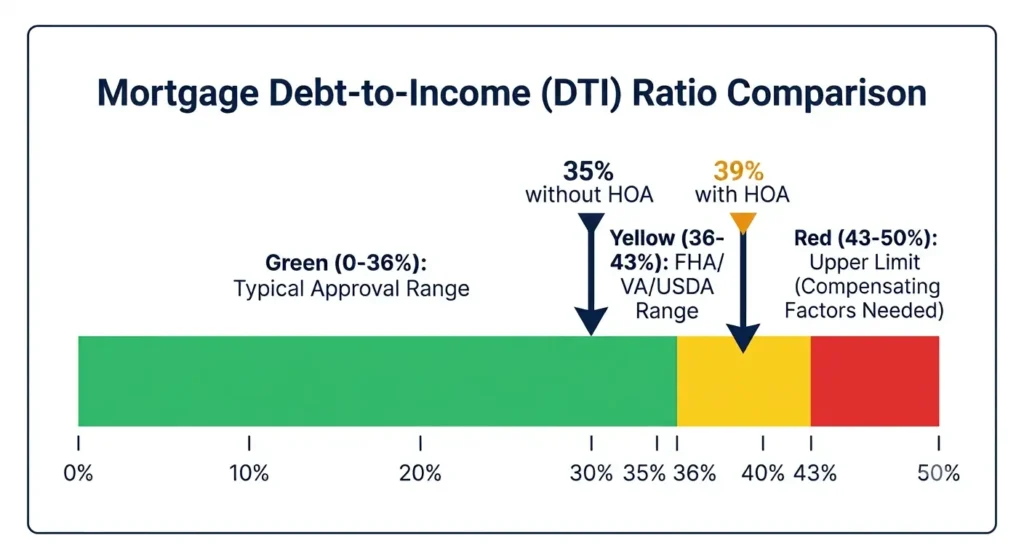
Lenders lean on your debt-to-income ratio, or DTI, to judge what you can handle, the same math we walk through in how much house you can afford. Your front-end DTI covers housing costs alone: PITI plus HOA dues, divided by gross monthly income. Most lenders want that at or below 28 to 36 percent, depending on the program. An FHA loan generally caps the front-end ratio near 31 percent and the back-end DTI ratio, which adds in your other debts, at 43 percent. Some conventional loan files through Fannie Mae’s automated underwriting can stretch to 50 percent. A VA loan and a USDA loan each use their own benchmark, usually around 41 percent. Before closing, your lender verifies the HOA dues directly with the association’s management company, so a guessed number can shift once underwriting confirms the real fee.
How HOA fees reduce borrowing power
Picture two identical $350,000 Texas homes. One has no HOA. The other charges $300 a month. That fee eats directly into your approved loan amount, since lenders treat it as a fixed housing cost. A buyer earning $7,000 a month at 36 percent DTI has about $2,520 for total housing costs. Take out $300 for HOA dues and you lose roughly $50,000 to $60,000 of borrowing power, based on typical 2026 lender DTI guidelines at current rates, though the exact number moves with interest rates and the loan program’s DTI limit.
Why Texas buyers notice this late
Listings sell the mortgage number first. HOA fees show up in fine print, if at all. Buyers fall in love with the home, get preapproved on a rough number, then see the real fee once their Loan Estimate arrives. Ask about the HOA fee before you write an offer, not after.
What HOA Fees Usually Cover in Texas
HOA fees fund specific, ongoing work that keeps a community maintained.
Common services
Most Texas HOA dues cover common-area landscaping, shared amenities like pools and playgrounds, entrance and street upkeep, and general management. Gated or master-planned neighborhoods often add security, signage, and sometimes trash pickup. Most operate as a planned unit development (PUD), governed by CC&Rs that set rules from paint colors to parking.
What HOA fees usually do not cover
Your HOA fee won’t fix your roof, replace your water heater, or pay your electric bill. It doesn’t touch your mortgage. Anything inside your own walls, repairs, upgrades, routine maintenance, is on you.
Why fees vary
A small HOA with no pool might charge $70 to $100 a month. A large master-planned community with a clubhouse and full-time security can run $300 to $500 or more. Houston single-family homes average around $150 a month, below the roughly $310 national average reported for 2026. Reserve funding also drives the fee: a well-funded reserve means a higher cost now but fewer surprise assessments later.
HOA Fees vs Other Texas Housing Costs
HOA fees are one line item among several recurring Texas housing costs.
HOA vs Property Taxes
Property taxes fund local government. HOA fees fund your private community. Texas’s statewide effective property tax rate averages 1.4 to 1.6 percent of assessed value, but combined county, school, and city levies in fast-growing metros like Austin and Dallas often run 1.8 to 2.5 percent. Property taxes go through escrow with your mortgage. HOA fees are a separate bill you pay directly.
HOA vs PMI
Private mortgage insurance protects your lender when your down payment is under 20 percent. Most buyers know this cost as private mortgage insurance (PMI), a topic we cover in full in what is PMI, usually collected through your mortgage bill. PMI disappears once you build enough equity. HOA fees don’t.
HOA vs Homeowners Insurance
Homeowners insurance protects your property and is usually collected through mortgage escrow. In condos, the HOA fee may include a master insurance policy that lowers your own premium. In single-family HOA neighborhoods, you still carry a full separate policy on top of the dues.
HOA vs MUD and PID Assessments
Municipal Utility Districts (MUDs) and Public Improvement Districts (PIDs) are common in newer Texas developments. A MUD tax Texas buyers see on their statement funds water and road infrastructure bonds, while a Public Improvement District (PID) assessment covers a separate improvement project. Both show up as a separate line on your property tax bill, not inside your HOA fee. In fast-growing suburbs near Houston or Fort Worth, you can pay property taxes, a MUD tax, a PID assessment, and an HOA fee, all in one month.
Can HOA Fees Increase After You Buy?
Yes. HOA fees are not locked in for life.
Regular increases
HOAs usually review budgets annually. A modest 3 to 6 percent yearly bump is normal, driven by insurance, maintenance, and inflation.
Special assessments
A special assessment is a one-time charge when the HOA needs money it doesn’t have in reserve, often for a roof, storm damage, or major repair. These range from a few hundred dollars to tens of thousands. Some financial statements label this exact charge an HOA special assessment. Under Texas Property Code Chapter 209, also known as the Texas Residential Property Owners Protection Act, HOAs can pursue foreclosure in serious, prolonged cases, though the process is strictly regulated.
Signs an HOA may become expensive
Check the reserve fund balance before buying. Thin reserves mean a special assessment is more likely. Deferred maintenance, like a closed pool or peeling paint, is a visible warning sign. Rising community insurance costs, common across Texas due to storm exposure, also push future dues higher.
Texas Home Example: Mortgage Payment With HOA Fees
Rates shift daily, so treat the 6.75 percent used here as illustrative, reflecting the roughly 6.5 to 6.9 percent range seen across major lenders in 2026, not a quote for your specific loan. For the full year-by-year payment breakdown, see our mortgage amortization schedule guide.
Example without HOA
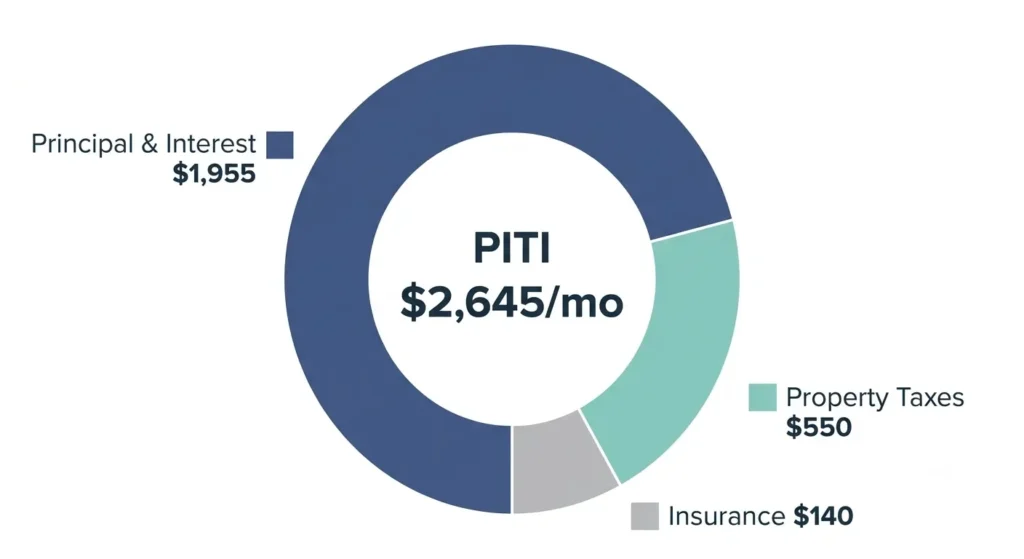
A $335,000 home, 10 percent down, loan amount $301,500. At 6.75 percent on a 30-year mortgage, principal and interest runs about $1,955 a month. Add roughly $550 in property taxes and $140 for insurance, and PITI totals about $2,645 a month.
Example with HOA
Same loan terms, but this $335,000 home carries a $280 monthly HOA fee. PITI stays $2,645, but total monthly housing cost rises to $2,925. On $7,500 gross monthly income, DTI moves from about 35 percent without the HOA to nearly 39 percent with it, enough to push some buyers past certain loan programs’ limits.
Side-by-side comparison table
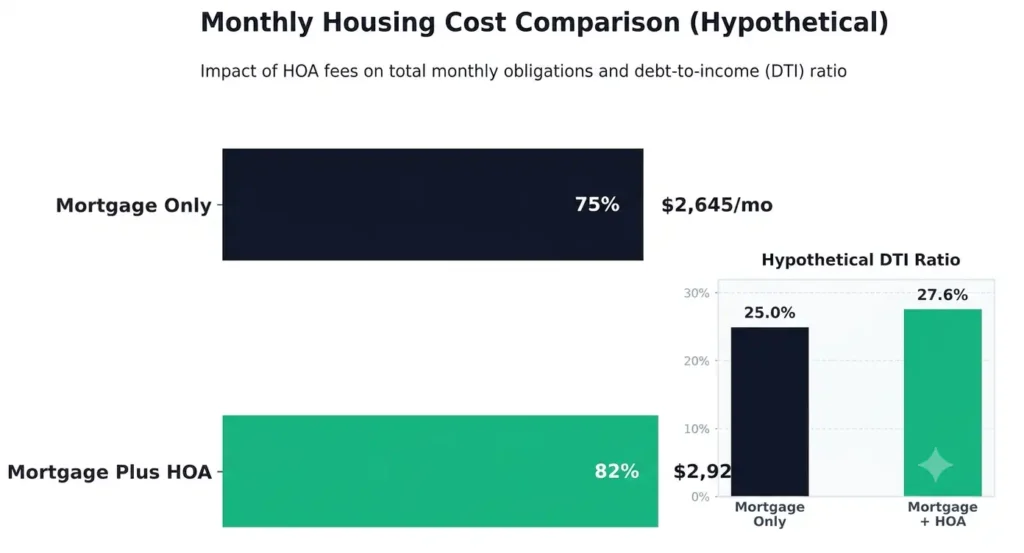
| Mortgage Only | Mortgage Plus HOA | |
|---|---|---|
| Monthly PITI | $2,645 | $2,645 |
| HOA Dues | $0 | $280 |
| Total Monthly Housing Cost | $2,645 | $2,925 |
| Annual Ownership Cost | $31,740 | $35,100 |
| DTI at $7,500 gross income | ~35% | ~39% |
That $280 fee adds $3,360 a year, buying community upkeep but narrowing your qualifying room.
Real-World Buying Scenarios
A few patterns repeat across Texas.
First-time buyer choosing between two homes
One home has no HOA and a slightly higher price. Another has a $250 HOA fee and a slightly lower price. Total monthly cost often closes that gap, or flips it. If this is your first purchase, our first-time home buyer guide walks through the full decision process. The right call comes down to what you value: a maintained look and shared amenities, or no recurring bill and fewer rules.
Condo versus single-family home
Condo HOA fees run higher than single-family fees almost every time, since condos share more structure. That fee often covers building insurance and exterior upkeep you’d otherwise pay for yourself, so it’s cost shifted, not purely added.
Master-planned Texas community
Fast-growing areas around Dallas-Fort Worth, Austin, and Houston are dominated by master-planned communities built after 2000, where an HOA is close to unavoidable. Budget $200 to $400 a month as part of living there. Ask honestly whether you’ll use the pool, trails, and clubhouse enough to justify that cost.
Common Mistakes Buyers Make With HOA Fees
The same avoidable mistakes repeat.
Assuming HOA is included in the mortgage
Buyers see “$2,600/month” advertised and assume it covers everything. It doesn’t. Some never budget for the separate HOA bill at all.
Looking only at mortgage payment
Focusing on PITI alone, while ignoring HOA dues, utilities, and maintenance, creates a false sense of affordability.
Ignoring future HOA increases
A fee that’s comfortable at $200 a month can feel tight at $260 in five years. Build a cushion into your long-term budget instead of assuming the number stays frozen.
Myths About HOA Fees and Mortgages
A few misconceptions keep circulating.
Myth: HOA fees are part of every mortgage payment
Not true. Outside rare escrow arrangements on certain condo loans, HOA fees are paid separately, directly to the association or its management company.
Myth: Lenders ignore HOA fees
Also not true. Lenders fold HOA dues directly into your DTI calculation, which can be the difference between approval and denial.
Myth: Low HOA fees always mean better value
A suspiciously low fee can signal underfunded reserves, meaning a painful special assessment later. The flip side holds too: a higher fee that fully funds reserves and covers costs you’d otherwise pay yourself can be better value than it looks.
Questions Every Texas Buyer Should Ask Before Making an Offer
Get real answers before you sign anything.
Questions about monthly dues
- What’s the current fee?
- How often is it billed?
- Is an increase planned?
- Has there been a special assessment in the last five years?
Questions about HOA finances
- Reserve fund balance
- Annual budget
- Delinquency rate among homeowners
The Texas Real Estate Commission (TREC) requires certain HOA disclosures during a sale, and both the Consumer Financial Protection Bureau (CFPB) and the Texas Department of Housing and Community Affairs (TDHCA) publish buyer resources worth checking.
Questions for your lender
- How the HOA fee factors into your DTI
- Whether escrow is an option
- What HOA documentation underwriting requires
Your Loan Estimate and Closing Disclosure will show HOA dues in the housing expense section. Closing itself often adds a one-time HOA transfer fee and an HOA working capital contribution, plus a resale certificate or HOA questionnaire fee, all worth reviewing alongside our full guide to Texas mortgage closing costs. Refinancing later brings a similar questionnaire fee.
Frequently Asked Questions
Are HOA fees included in every Texas mortgage payment?
No. HOA fees are paid separately from your mortgage in nearly all cases.
Do lenders count HOA fees toward DTI?
Yes. Lenders add HOA dues to your housing expense when calculating debt-to-income, affecting how much they’ll approve.
Can HOA fees stop mortgage approval?
Yes. A high HOA fee on top of PITI can push DTI past what a loan program allows.
Are HOA fees tax deductible?
For most primary residences, no. Exceptions can apply for rental or business use; ask a tax professional.
Can HOA fees change after closing?
Yes. Annual increases are common, and special assessments hit when a major expense isn’t covered by reserves.
What happens if HOA fees are not paid?
Unpaid dues can lead to a lien on your property, known as an HOA lien, separate from your mortgage. HOA foreclosure risk is real even when every mortgage payment is current. Under Texas Property Code Chapter 209, also the Texas Residential Property Owners Protection Act, HOAs can pursue foreclosure in serious cases, though the process requires significant notice, a right to a payment plan, and often a court order.
Final Takeaway: How to Know Whether a Texas Home Is Truly Affordable
Five-step affordability checklist
- Calculate total monthly payment, not just PITI
- Add HOA dues on top
- Pull the HOA’s financial documents and reserve fund report
- Confirm with your lender how the fee affects qualification
- Compare that full number against your paycheck
A mortgage affordability calculator or home affordability calculator only gives an honest answer if HOA dues are included alongside taxes and insurance.
When to move forward with the purchase
Move forward once you’re confident in the math, the lender’s approval, and the HOA’s financial health. A home is affordable when total cost fits your budget with room to spare, not when the mortgage payment alone looks good on paper. Run your own numbers with our Texas mortgage calculator, and browse more guides in our mortgage basics section before you make an offer.