Borrow $350,000 at 6.58 percent, and the interest bill runs close to $453,000 by the time a 30 year loan is paid off, though your own number shifts with rate and term.
That $453,000 number comes from amortizing the loan at current market rates, the same calculation every lender’s system runs behind the scenes.
The downside: rates shift daily, so your actual total could land higher or lower than shown here.
Quick Answer: How Mortgage Interest Works in Simple Terms
The short explanation
Mortgage interest is the price of borrowing a lender’s money, charged on your remaining balance, not the original loan amount. As your balance drops, so does the interest. That one fact explains most of this guide.
Where your monthly payment goes
Your payment splits into interest, principal, and, if you have an escrow account, property taxes and homeowners insurance, together known as PITI. Principal is what builds your equity. Early on, interest eats most of the payment. Later, principal takes over.
Fixed-Rate vs Adjustable-Rate Mortgage Interest
Fixed-rate mortgage
A fixed rate locks your rate for the whole term. A $400,000 loan at 6.5 percent pays the same in year one and year twenty five. Predictable, but you will not benefit automatically if rates fall, you would need to refinance.
Adjustable-rate mortgage (ARM)
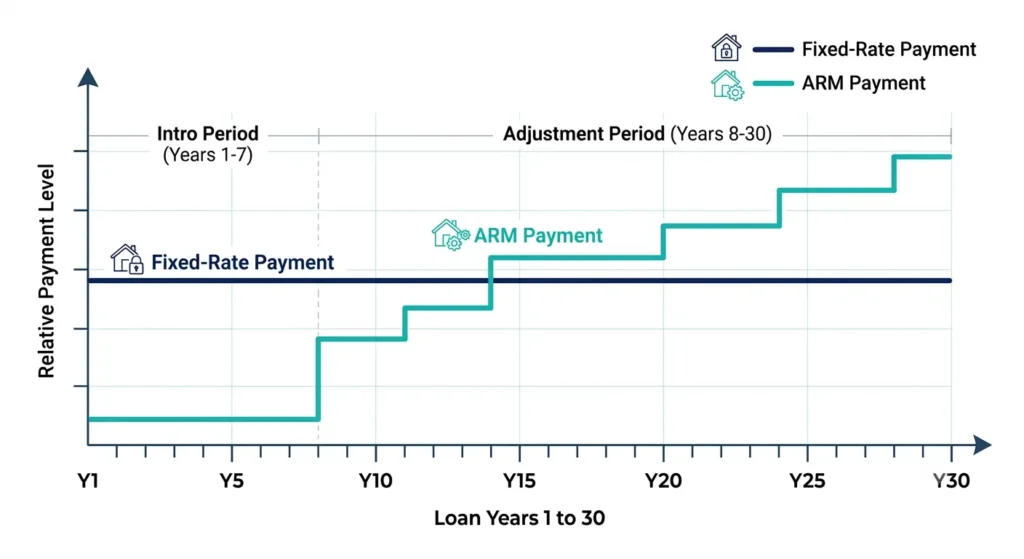
An ARM starts with a lower rate, often fixed for 5, 7, or 10 years, then adjusts. A 7/1 ARM might start in the mid-6 percent range, then reset annually. An ARM loan fits buyers planning to sell or refinance before the fixed period ends. For a deeper side-by-side breakdown, see our full fixed vs adjustable rate mortgage comparison.
Comparison table
| Factor | Fixed-Rate | ARM |
|---|---|---|
| Monthly payment stability | Locked for life of loan | Stable only during intro period |
| Interest rate risk | None after closing | Rises if market rates rise |
| Long-term cost | Higher upfront rate, but predictable | Lower upfront rate, unpredictable later |
| Best-fit borrower | Staying 10+ years | Selling or refinancing within 5 to 7 years |
Mortgage Interest Explained for First-Time Homebuyers
What mortgage interest actually is
Mortgage interest is the cost of borrowing, not part of the home price. Two buyers paying $350,000 for the same home can owe very different totals, based only on rate and term. A 6.58 percent rate is charged fresh every month on your current balance. Every borrower pays interest, no matter their credit, because that is how lenders earn money.
Principal vs interest
Principal is what you borrowed and still owe. Interest is the fee on top of it. Every payment splits between the two, and that split shows how fast you are actually building ownership versus paying to have borrowed. Our full principal vs interest breakdown walks through this split payment by payment.
How Mortgage Interest Is Calculated
The basic calculation
Lenders quote an annual rate but charge interest monthly. Divide the annual rate by 12, multiply by your current balance, and that is the month’s interest. If you want the full payment formula, our guide on how your mortgage payment is calculated breaks down every piece.
Simple numerical example
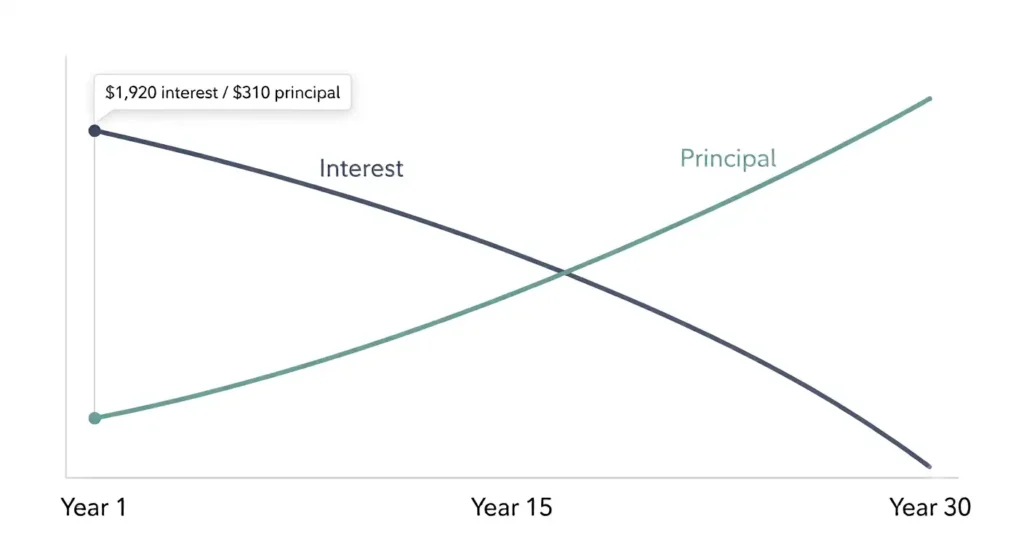
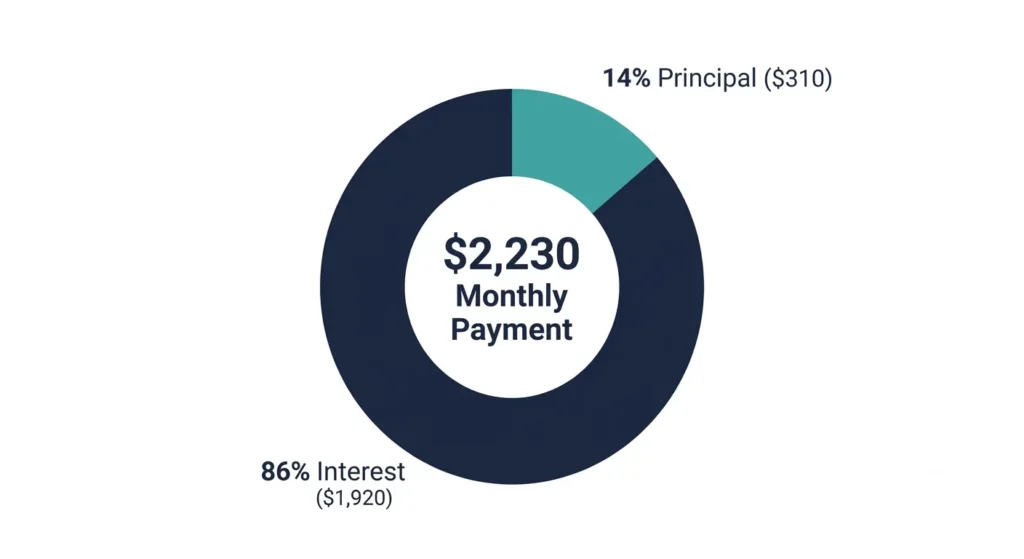
Borrow $350,000 at 6.58 percent. Your monthly rate is about 0.548 percent. Month one interest on the full balance is roughly $1,920. With a $2,230 payment, about $310 goes to principal.
Why the interest amount changes every month
Once that $310 comes off, next month’s interest is calculated on a smaller balance, so it drops a little and more goes to principal. This repeats every month, accelerating over the years.
Why Early Mortgage Payments Mostly Go Toward Interest
Understanding amortization
Amortization spreads a loan into equal payments over its term, even as the interest and principal split inside each one keeps shifting. Early on, your balance is highest, so interest is highest and principal reduction is slow. See a full mortgage amortization schedule to watch this play out month by month.
Month 1 vs Year 15 vs Final Payment
Beginning of the loan
At the start of a 30 year loan, the balance and interest charge are both at their highest. Equity builds slowly in these first years.
Middle of the loan
By roughly year 15 of a 30 year term, interest and principal are close to even, and equity grows noticeably faster.
End of the loan
In the final years, interest shrinks to almost nothing and nearly the whole payment goes to principal, dropping the balance fast.
Factors That Affect Your Mortgage Interest Rate
Personal financial factors
Credit score is a major lever, a 760 score beats a 640 score on rate. A bigger down payment shrinks your loan-to-value ratio (LTV) and can lower your rate. Your debt-to-income ratio and loan size matter too.
Market factors
Rates move with economic conditions, inflation, and 10 year Treasury yields. As of late July 2026, Freddie Mac’s Primary Mortgage Market Survey put the average 30 year fixed rate at 6.58 percent, while Fannie Mae expects a similar range through year end. Daily surveys have run higher, closer to 6.75 to 6.87 percent, so shop around rather than anchor to one number.
Loan choices
A 15 year term usually beats a 30 year term on rate. Options that price differently than a conventional loan:
- An FHA loan (Federal Housing Administration)
- A VA loan (Department of Veterans Affairs)
- A USDA loan (U.S. Department of Agriculture)
- An interest-only mortgage, charging interest alone for 5 to 10 years before principal payments begin and payments jump
Discount points at closing can lower your rate for cash upfront.
Interest Rate vs APR: What’s the Difference?
Mortgage interest rate
The interest rate drives your principal and interest payment directly, but it ignores lender fees, so it does not show the full cost.
APR
The annual percentage rate (APR) adds lender fees, points, and closing costs into one yearly percentage, so you can compare loans fairly. A lower rate with heavy fees can carry a higher APR than a higher rate with low fees. The Consumer Financial Protection Bureau (CFPB) requires lenders to disclose both on your loan estimate and again on your Closing Disclosure before you sign.
How Much Does Mortgage Interest Really Cost?
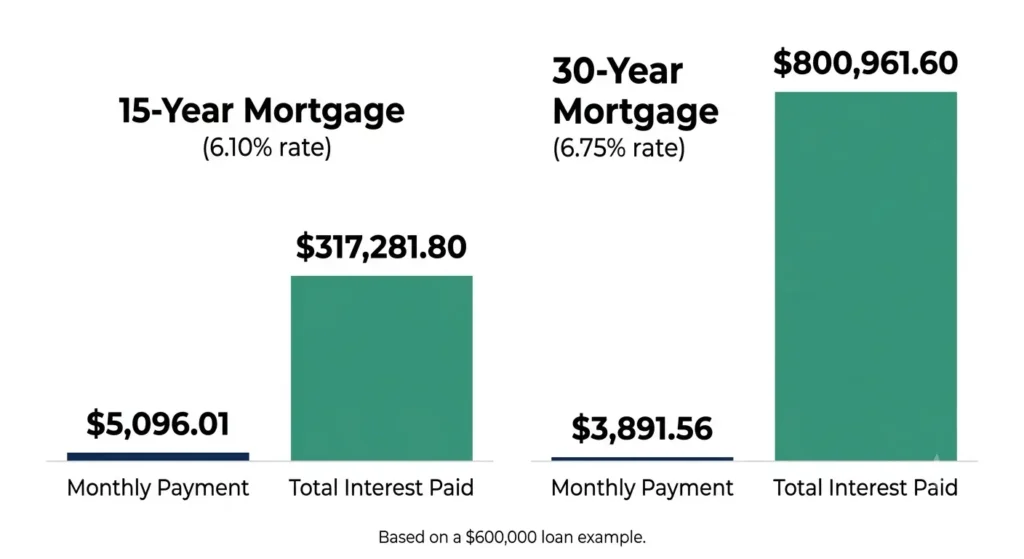
Total interest over 15 years
A $350,000 loan at 5.96 percent over 15 years costs roughly $178,000 in total interest, with a higher monthly payment but half the payoff time.
Total interest over 30 years
The same $350,000 over 30 years at 6.58 percent costs close to $453,000 in total interest, nearly double the 15 year version. The mortgage interest deduction can offset part of that if you itemize, though it will not erase it.
Comparison table
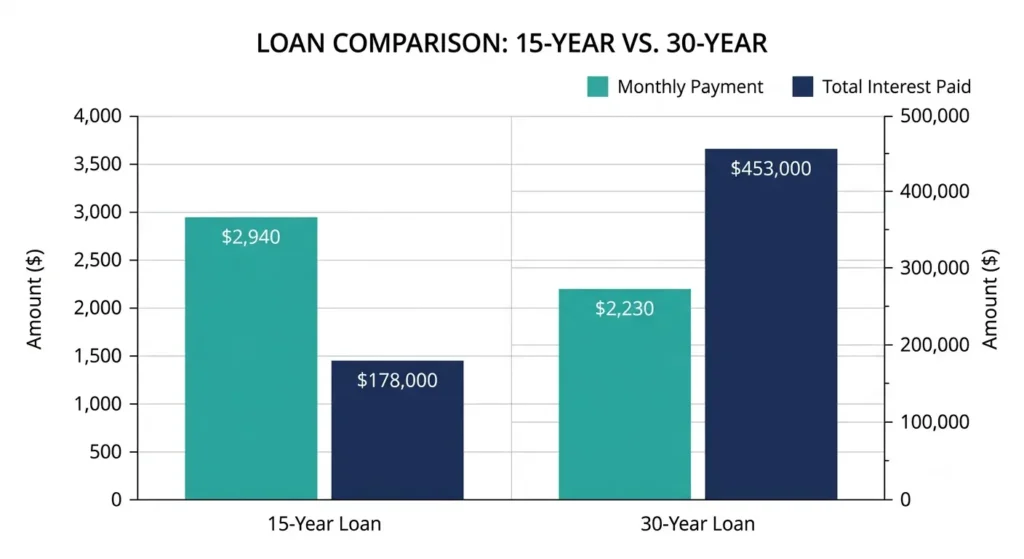
| Term | Monthly Payment (approx) | Total Interest Paid | Total Repaid |
|---|---|---|---|
| 15-year at 5.96% | $2,940 | $178,000 | $528,000 |
| 30-year at 6.58% | $2,230 | $453,000 | $803,000 |
Visual Example: Where Your Money Actually Goes
Payment breakdown example
On that $350,000 loan at 6.58 percent, the $2,230 payment splits into about $1,920 interest and $310 principal in month one, leaving a balance near $349,690.
Amortization table walkthrough
Each row of an amortization table shows the payment number, interest, principal, and balance left. Watch interest shrink and principal grow down the table. Total the interest column for the loan’s true lifetime cost.
Real-Life Mortgage Interest Scenarios
First-time buyer purchasing a starter home
A $320,000 starter home with 10 percent down means a $288,000 loan. At 6.6 percent, that is about $1,840 a month in principal and interest, before taxes and insurance. Check our first-time home buyer guide for the full purchase timeline, and use our how much house can I afford breakdown to size that payment against your own income.
Choosing between a 15-year and 30-year mortgage
15 years means a bigger payment, less total interest, and a faster payoff. 30 years means more monthly room but more total interest. The right choice depends on flexibility versus long-term cost.
Making one extra payment every year
One extra full payment a year on a $350,000, 30 year loan at 6.58 percent can cut four to five years off the term and save tens of thousands in interest.
Common Myths About Mortgage Interest
“The bank is unfairly taking my money”
It feels that way early on, but it is not rigged. Interest is front loaded because the balance is highest at the start, using the same formula every month.
“Extra payments don’t help”
Extra payments cut the balance interest is calculated on right away. An extra $100 a month can cut years off a 30 year loan. They just will not lower next month’s required payment unless you refinance or recast.
“Lower interest always means a cheaper loan”
A lower rate with high fees can cost more overall than a higher rate with low fees, which is why APR, not just the rate, matters when shopping lenders.
Common Mortgage Interest Mistakes
Focusing only on monthly payment
A lower payment from a longer term can hide a much bigger lifetime interest bill. Compare total interest, not just what fits today’s budget.
Ignoring amortization
A balance that barely moves after two years is normal for the early stretch of any fixed mortgage, not a red flag.
Confusing APR with interest rate
Treating them as the same leads to comparing the wrong number and possibly overpaying in fees.
Ways to Pay Less Mortgage Interest
Improve your loan before closing
Before closing, the highest leverage moves are:
- Raise your credit score
- Save a bigger down payment
- Get quotes from at least three lenders
- Lock your rate once you like it, since rates can rise before closing
Reduce interest after buying
After buying, ways to cut total interest:
- Extra principal payments
- Biweekly payments
- Refinancing when rates drop
- Recasting after a lump sum
If rates fall well below what you locked in, start comparing refinance offers.
Buying discount points
One point costs about 1 percent of the loan and typically lowers your rate roughly 0.25 percent, though it can range from 0.125 to 0.375 percent by lender. It only pays off if you stay past the break-even point.
Frequently Asked Questions
Is mortgage interest calculated daily or monthly?
Most mortgages calculate interest monthly on the remaining balance, though some use daily accrual with nearly the same result.
Why doesn’t my balance drop quickly?
Your highest payments toward interest happen when the balance is largest, right at the start. That is normal for early years.
Can I pay off my mortgage early?
Yes, extra principal payments cut both balance and total interest. Confirm there is no prepayment penalty first.
Does refinancing reduce total interest?
It can, with a meaningfully lower rate, but it resets your amortization schedule. Run the break-even math on closing costs first.
Is APR more important than the interest rate?
Yes, for comparing offers. APR includes fees on top of rate.
Does paying biweekly save money?
Yes, it adds one extra payment a year, cutting principal and total interest faster.
Should I buy mortgage points?
Only if you will stay past the break-even point where savings outweigh the upfront cost.
Key Takeaways
The most important lessons
Interest is charged on your remaining balance, not the original loan, which is why early payments feel interest-heavy. Amortization shifts payments from interest-heavy to principal-heavy over time. Compare loans by APR and total interest, not just the rate. Extra principal payments remain one of the most reliable ways to cut lifetime cost.
Run your own numbers with our free mortgage calculator, or browse more guides in our mortgage basics category for related breakdowns. You can learn more about who writes these guides on our about us page, or contact us directly with questions.