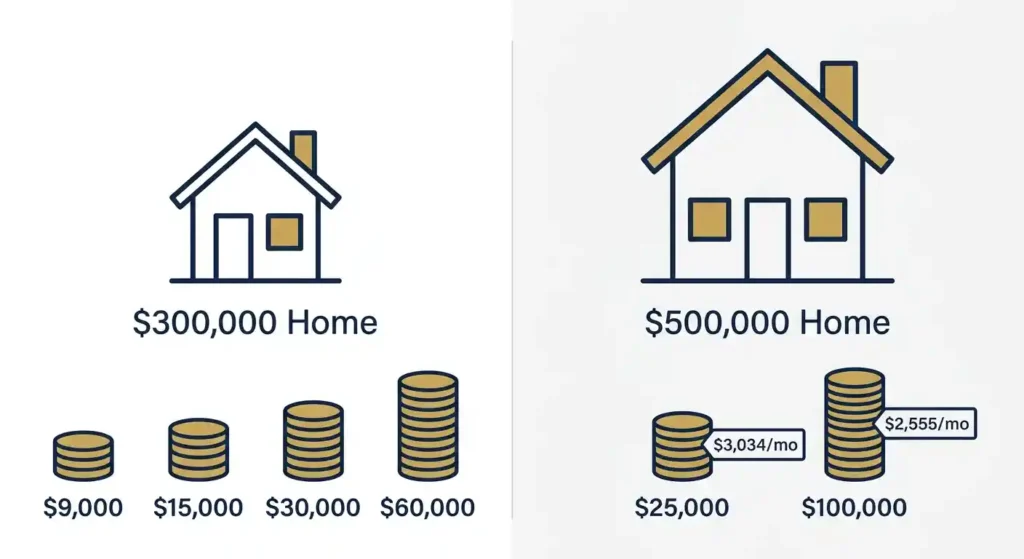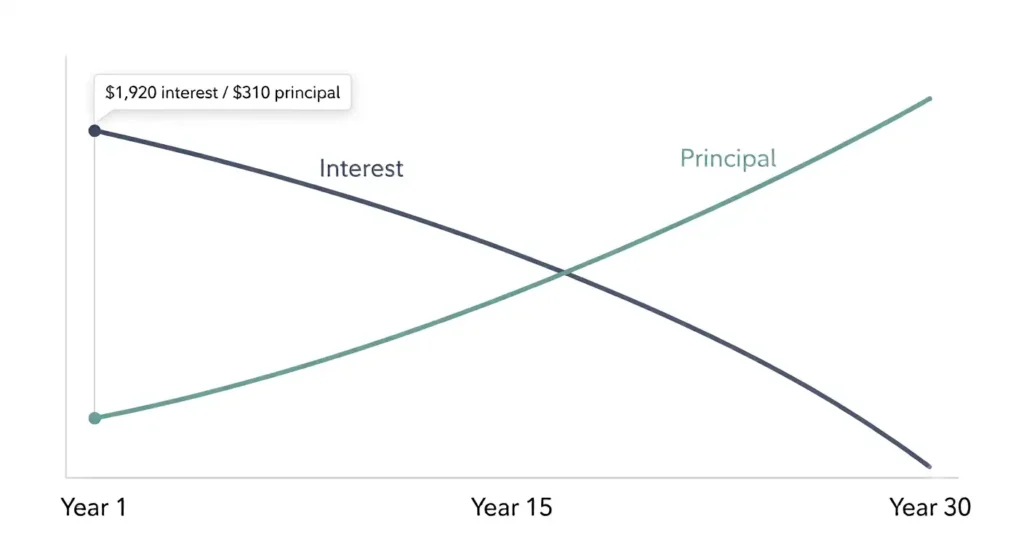
PMI is private mortgage insurance, a monthly fee added to a conventional loan when your down payment is under 20%. It protects the lender, not you, and it ends once your equity reaches 78% to 80%.
In 8 years reviewing loan estimates with buyers, that 78-80% threshold is the number clients ask about most.
PMI adds real monthly cost, so removing it as soon as you qualify matters.
What Is PMI? (Quick Answer)
Private Mortgage Insurance (PMI) is the fee lenders charge on conventional loans below 20% down. It is one piece of your full PITI payment breakdown, and the rest of this guide covers cost, types, and how to remove it.
What PMI actually means
PMI is a policy your lender buys, and you pay for it. If you default and the home forecloses, PMI repays part of your lender’s loss. You get nothing from that payout. In exchange, you get to buy years sooner instead of waiting to save 20%. It applies to any conventional loan with a down payment under 20%.
Quick facts at a glance
| Fact | Detail |
|---|---|
| Annual cost | 0.46% to 1.50% of loan amount |
| Typical duration | 2 to 11 years |
| Governing guidelines | Fannie Mae and Freddie Mac |
Should You Pay PMI or Wait for 20% Down?
Waiting usually costs more than PMI does.
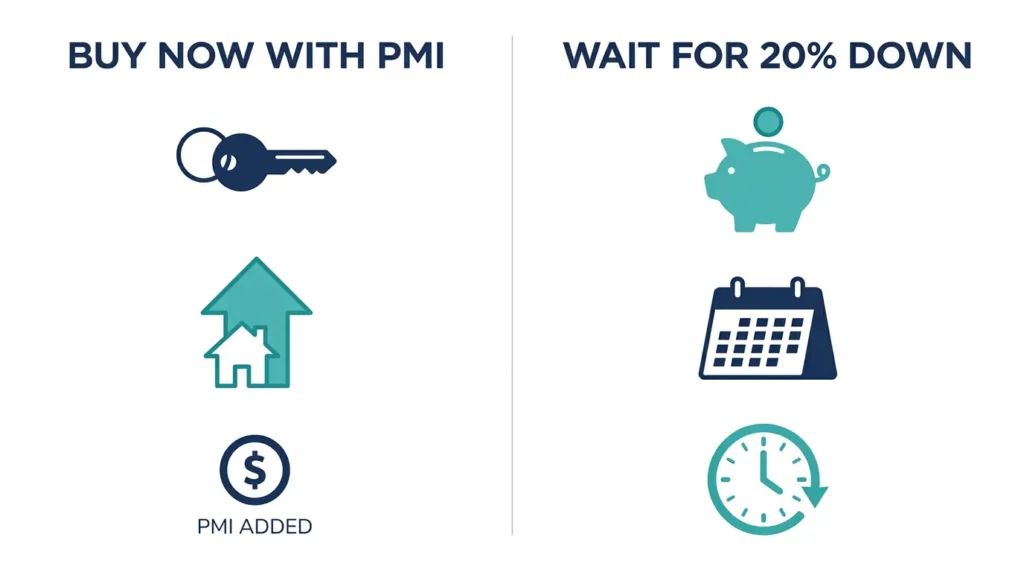
Buying now with PMI
You start building equity immediately instead of renting while you save. The tradeoff is a higher monthly payment. In a rising market, buyers who wait years to save 20% often find prices climbed faster than their savings did.
Waiting to save 20%
No PMI, lower payment from day one. But every year spent saving is a year without equity, and rents rise too. If local home values climb 4-5% a year, how much down payment you actually need keeps growing along with them.
Side-by-side comparison table
| Factor | Buy Now With PMI | Wait For 20% Down |
|---|---|---|
| Monthly payment | Slightly higher (PMI added) | Lower from day one |
| Upfront cash needed | 5-10% down | Full 20% down |
| Equity timeline | Starts building immediately | Delayed by years of saving |
| Total cost over time | Often lower if prices rise | Can be higher if home values outpace savings |
Why Do You Have to Pay PMI?
Lenders shift their risk to you through PMI.
Why lenders require PMI
A borrower with 5% down has less at stake than one with 20% down, so the lender loses more if the loan fails. PMI shifts that risk to an insurer, and you cover the premium.
When PMI is required
PMI applies once your loan-to-value ratio (LTV) is above 80%, meaning your down payment is under 20%. It is standard on conventional loans in that range, following guidelines Fannie Mae and Freddie Mac set for lenders. VA loans skip it entirely. Refinancing follows the same rule: if your new balance stays above 80% of your home’s value, PMI applies again.
Types of PMI You May Be Offered
Your lender usually offers a choice of how you pay.
Borrower-paid PMI
Borrower-paid PMI (BPMI) is the common option: a monthly premium on your mortgage payment, gone once you hit 20% equity.
Lender-paid PMI
With lender-paid PMI (LPMI), the lender covers the premium but charges a higher rate for the life of the loan. It cannot be cancelled later.
Single-premium PMI
You pay the full PMI cost upfront at closing. Good if you have cash and plan to stay long term, but you likely will not get it back if you sell or refinance early.
Split-premium PMI
Part upfront, smaller monthly payments after. A middle ground between the two.
| Type | When You Pay | Cancellable? |
|---|---|---|
| Borrower-paid (BPMI) | Monthly | Yes, at 78-80% LTV |
| Lender-paid (LPMI) | Built into rate | No, life of loan |
| Single-premium | Upfront lump sum | Not refundable if you sell/refinance early |
| Split-premium | Partial upfront + monthly | Monthly part cancellable at 78-80% LTV |
PMI vs Other Types of Mortgage Insurance
Three terms people mix up constantly.
PMI vs FHA MIP
PMI applies to conventional loans. FHA loans, backed by the Federal Housing Administration (FHA), use Mortgage Insurance Premium (MIP) instead, with rules set by HUD. PMI can be cancelled with enough equity. MIP on an FHA loan with under 10% down lasts the entire loan term.
PMI vs homeowners insurance
Homeowners insurance protects your home and belongings, and it benefits you. PMI protects your lender if you default. You likely carry both, but they do different jobs.
PMI vs mortgage life insurance
Mortgage life insurance pays off your loan if you die, and it is optional. PMI kicks in with less than 20% down and protects your lender, not your family.
How Much Does PMI Cost?
PMI usually runs 0.46% to 1.50% of your loan amount per year, one of several pieces in how your mortgage payment is calculated.
Average PMI costs
On a $300,000 loan, that is roughly $115 to $375 a month depending on credit and down payment.
What determines your PMI rate
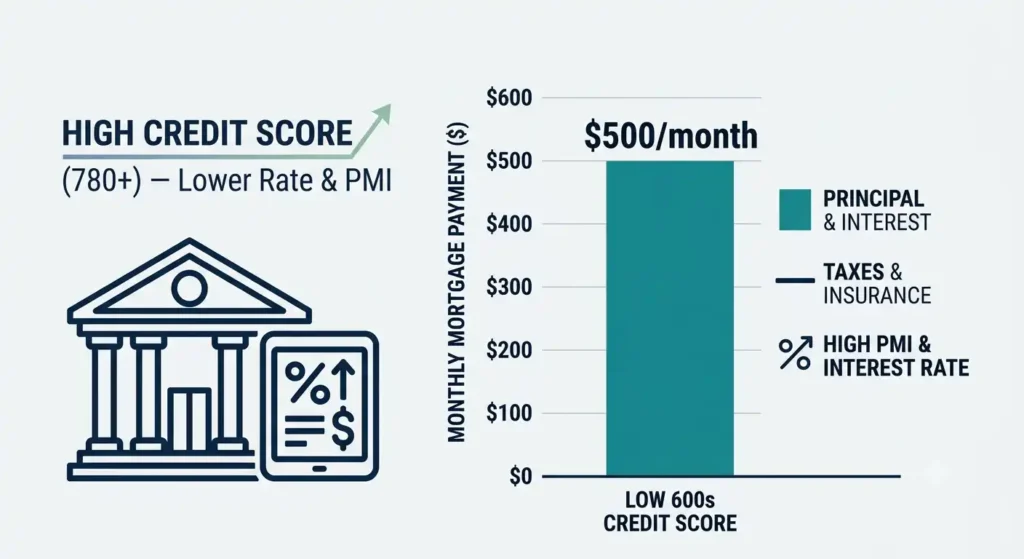
Credit score matters most. On the same loan, a borrower with a 780+ score can pay a fraction of what a borrower in the low 600s pays, sometimes the gap is $30 a month versus $500 a month. Down payment, loan amount, and property type matter too. Investment properties and second homes cost more than a primary residence. On a fixed vs adjustable rate mortgage, PMI can shift as your rate adjusts.
PMI cost examples
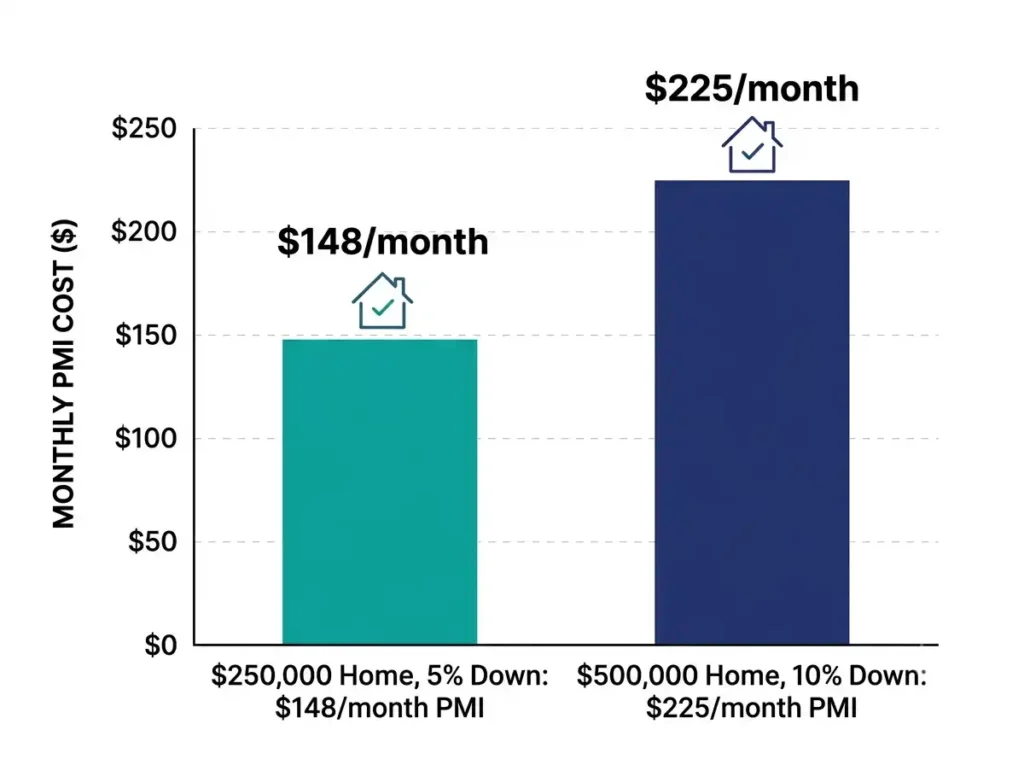
$250,000 home example
With 5% down, you finance $237,500. At a 0.75% rate, that is about $148 a month, or $1,780 a year.
$500,000 home example
With 10% down, you finance $450,000. At a 0.6% rate, that is about $225 a month, roughly $13,500 over five years.
| Example | Loan Amount | Rate | Monthly PMI | Yearly PMI |
|---|---|---|---|---|
| $250,000 home, 5% down | $237,500 | 0.75% | ~$148 | ~$1,780 |
| $500,000 home, 10% down | $450,000 | 0.6% | ~$225 | ~$2,700 |
How to Remove PMI
PMI is not permanent, and you have more control than most people realize.
Automatic PMI removal
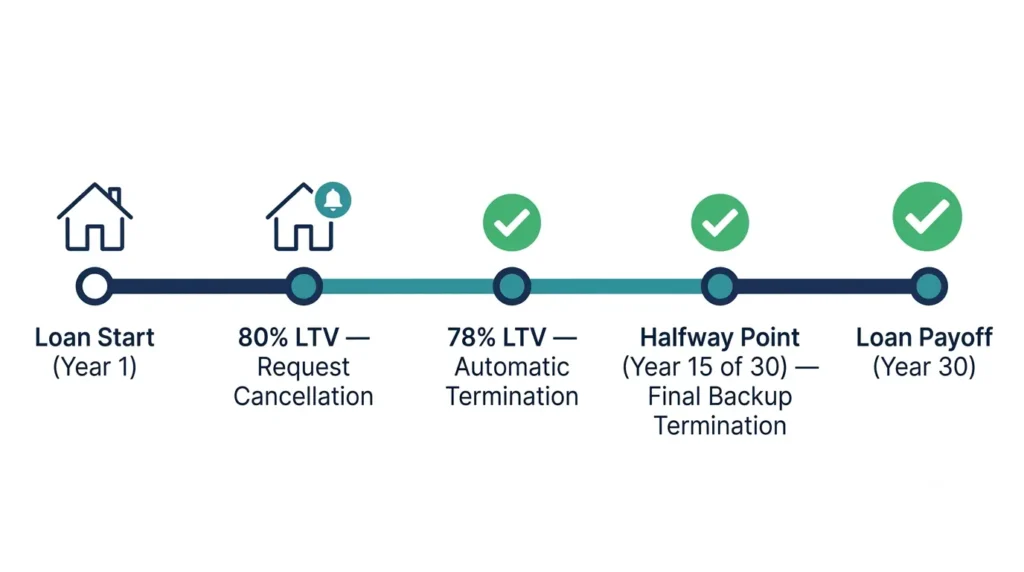
The Homeowners Protection Act, also called the PMI Cancellation Act, requires automatic cancellation at 78% loan-to-value if you are current on payments, a rule the CFPB explains in detail. There is a backup rule too: if you have not hit 78% by the halfway point of your loan’s amortization schedule, say year 15 on a 15-year vs 30-year mortgage, PMI ends then anyway. If you fall behind on payments, the automatic date gets pushed back until you are current again. Your terms appear on the Loan Estimate and Closing Disclosure, forms the CFPB requires every lender to provide.
Request PMI cancellation early
You can request cancellation at 80% LTV, two points earlier than automatic termination. Expect a new appraisal and a clean payment history requirement. Many borrowers overpay for years simply because nobody asks.
Remove PMI through refinancing
Refinancing can get you to 20% equity faster if your home’s value rose, but only if the rate and closing costs make sense. If your home’s value drops instead, appreciation will not help, and refinancing usually will not either. Your regular payment schedule becomes the only path.
Build equity faster
Extra principal vs interest payments and home appreciation both shrink your LTV faster than minimum payments alone. Understanding how mortgage interest works helps you see exactly how much of each extra payment reduces your balance. Renovations can help too, but usually need a fresh appraisal to count.
Ways to Avoid PMI
A few routes skip PMI entirely.
Make a 20% down payment
The most direct fix, but saving that much takes years for most buyers.
Use a piggyback loan
An 80-10-10 loan splits financing into an 80% first mortgage, a 10% second loan, and 10% down, avoiding PMI by keeping the primary loan at 80% LTV. Works best with strong income and credit.
Explore loan alternatives
VA loan and USDA loan programs skip PMI for eligible buyers. FHA loans use MIP instead, so they are not really an escape from mortgage insurance.
Real-World PMI Scenarios
Three examples from real buyers.
First-time buyer with 5% down
Following the steps in a typical first-time home buyer guide, a couple bought a $280,000 home with 5% down, PMI around $165 a month. Thanks to steady payments and rising local values, they hit 80% LTV two years ahead of schedule.
Buyer with excellent credit
A 780 credit score buyer with 10% down got a 0.35% rate, keeping PMI under $100 a month on a $350,000 loan.
Home value increases after purchase
A neighborhood surge pushed one buyer past 80% equity within two years. A new appraisal confirmed it, and PMI was cancelled right away.
Common PMI Myths
I hear these three constantly, and they cost buyers money.
PMI protects the homeowner
False. PMI does not stop foreclosure if you fall behind. It only reimburses your lender.
You must always put 20% down
False. Programs allow 3%, 5%, or 10% down, with PMI as the tradeoff.
PMI is always a waste of money
Not true if home prices rise faster than you can save 20%. PMI can let you build equity sooner and come out ahead.
Frequently Asked Questions
Is PMI required on every mortgage?
No. Only on conventional loans with under 20% down.
Can PMI be removed before 20% equity?
Generally not, you need to reach 80% LTV through payments, appreciation, or both, confirmed by appraisal.
Is PMI tax deductible?
Starting with the 2026 tax year, yes. The One Big Beautiful Bill Act, signed in 2025, permanently restored the deduction after it expired in 2021, according to U.S. Mortgage Insurers (USMI). It phases out between $100,000 and $110,000 in adjusted gross income.
Does PMI affect mortgage approval?
It counts toward your debt-to-income ratio (DTI), which affects how much you can borrow. The Consumer Financial Protection Bureau (CFPB) enforces PMI disclosure rules, with narrower roles for the U.S. Department of Housing and Urban Development (HUD), the Federal Reserve, and the Office of the Comptroller of the Currency (OCC).
Can I avoid PMI with an FHA loan?
No, you trade PMI for MIP, which often cannot be cancelled if your down payment was under 10%.
Is lender-paid PMI better?
Only if you plan to keep the loan a long time. Otherwise borrower-paid PMI usually wins, since it can be cancelled.
Key Takeaways Before Choosing a Mortgage
The most important facts to remember
PMI applies below 20% down on conventional loans, costs 0.46% to 1.50% yearly, and ends automatically at 78% LTV or by request at 80%. Credit score drives the rate most. Starting in 2026, it is tax deductible.
Next steps before talking to a lender
Calculate your full payment including PMI, starting with how much house you can afford. Compare conventional, FHA, and VA options. Estimate how long you will carry PMI, and ask your lender which PMI type they offer and how they handle cancellation at 80% equity.
Run your own numbers with our free mortgage calculator, browse more guides in our Mortgage Basics category, or learn more about how we build our estimates on our About Us page. Still have questions? Contact us directly.