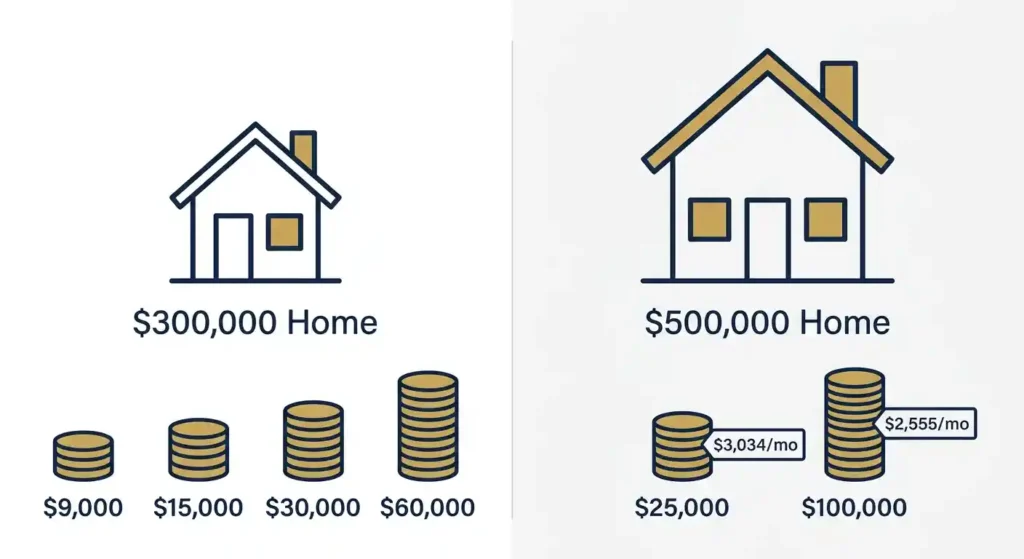
A good Texas mortgage rate sits close to the market average, roughly 6.6% to 6.8% on a 30-year fixed and near 6.0% on a 15-year fixed. Your quote depends on credit, down payment, and loan type.
These benchmarks move daily and include APR, not just the headline rate, so treat them as a same-day starting point.
No advertised number is a personal offer, your final rate can differ by lender.
What Is a Good Mortgage Rate in Texas Right Now?
“Good” isn’t one fixed number, it shifts with your credit, down payment, and loan type, covered section by section below.
Current Texas mortgage rates at a glance
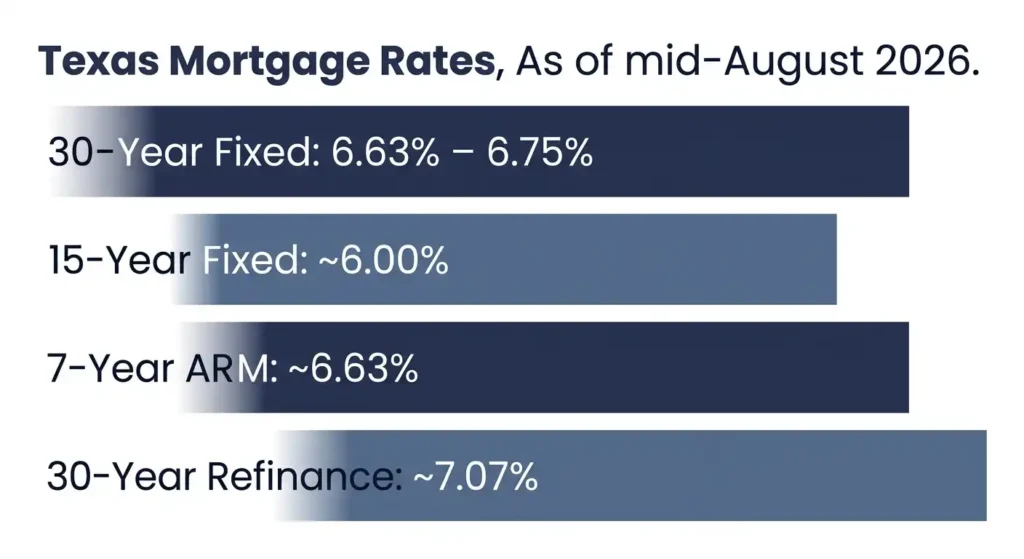
As of mid-August 2026:
| Loan Type | Rate |
|---|---|
| 30-year fixed | 6.63% – 6.75% |
| 15-year fixed | ~6.00% |
| 7-year ARM | ~6.63% |
| 30-year refinance | ~7.07% |
The advertised number is the interest rate, not APR, which runs higher once fees and points are added. Rates shift daily, so treat anything a week old as a starting point. Texas tracks within a few basis points of the national average. Rates have eased modestly over the past year, not sharply.
Is a 6% mortgage rate good in Texas?
Yes, especially on a 15-year loan (averaging 6.00% to 6.06%). On a 30-year loan, 6% beats the average by half a point or more, usually needing strong credit or paid points. A 780-score borrower with 25% down might land at 6.1%; a 690-score borrower with 5% down might see 6.9%, both fair for their risk profile.
What rate should you expect based on your situation?
Your rate depends on credit, loan size, and risk.
Excellent-credit borrower
Score above 760, 20%+ down, conventional: best pricing tier, around 6.1% to 6.4% on a $300,000 Texas home. Even with excellent credit, a small down payment adds PMI and nudges pricing slightly above the top tier.
Average-credit borrower
Score 660 to 700, DTI near 43%: adds a quarter to half a point, so 6.5% to 7.0% on that same home. Many first-time homebuyers land in this range, which is why a first-time home buyer guide is worth reading before you shop.
Low-down-payment or government-loan borrower
FHA (3.5% down) prices around 6.5% APR; VA (0% down) often lower, near 6.1% APR. FHA loans, backed by the Federal Housing Administration, carry ongoing mortgage insurance. VA loans, guaranteed through the U.S. Department of Veterans Affairs, skip mortgage insurance but charge a funding fee. If cash upfront is the real hurdle, the Texas Department of Housing and Community Affairs, or TDHCA, runs the My First Texas Home program, offering down payment and closing-cost assistance up to 5% of your loan amount. The Texas Mortgage Credit Certificate Program issues a Mortgage Credit Certificate (MCC) worth 20% to 40% of annual mortgage interest paid, capped at $2,000 a year, applied directly against federal tax liability. First-time buyers and veterans often qualify.
Texas Mortgage Rates Today: 30-Year, 15-Year, FHA, VA and ARM
Here’s how loan types compare right now.
30-year fixed mortgage rates
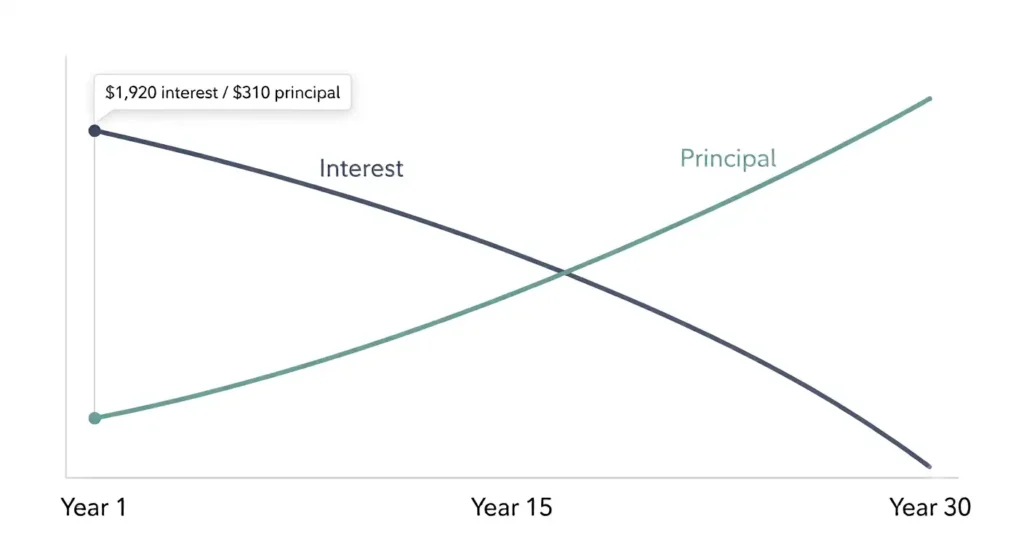
6.63% to 6.75%, APR near 6.9% to 7.0%. Lowest monthly payment, most total interest, since the principal vs interest split leans heavily toward interest early on. Fits buyers wanting payment stability over speed.
15-year fixed mortgage rates
Near 6.00%, about half a point below the 30-year. Payment jumps by several hundred dollars a month, but can save well over $100,000 in interest on a $300,000 loan, as a full mortgage amortization schedule makes clear.
FHA and VA mortgage rates
FHA near 6.5% APR, VA near 6.1% APR. FHA adds upfront and monthly mortgage insurance; VA skips it but charges a funding fee. Weigh total monthly cost, since the rate alone doesn’t tell the full story.
Adjustable-rate mortgage rates
7-year ARM near 6.63%, 5-year ARM near 6.24%. Fixed for an initial period, then adjusts. Fits buyers planning to sell or refinance before that adjustment hits. Chasing the lowest initial rate without an exit plan is risky.
How Much Would a Mortgage Cost at Today’s Texas Rates?
Real numbers on a typical Texas home.
Monthly payment examples at different interest rates
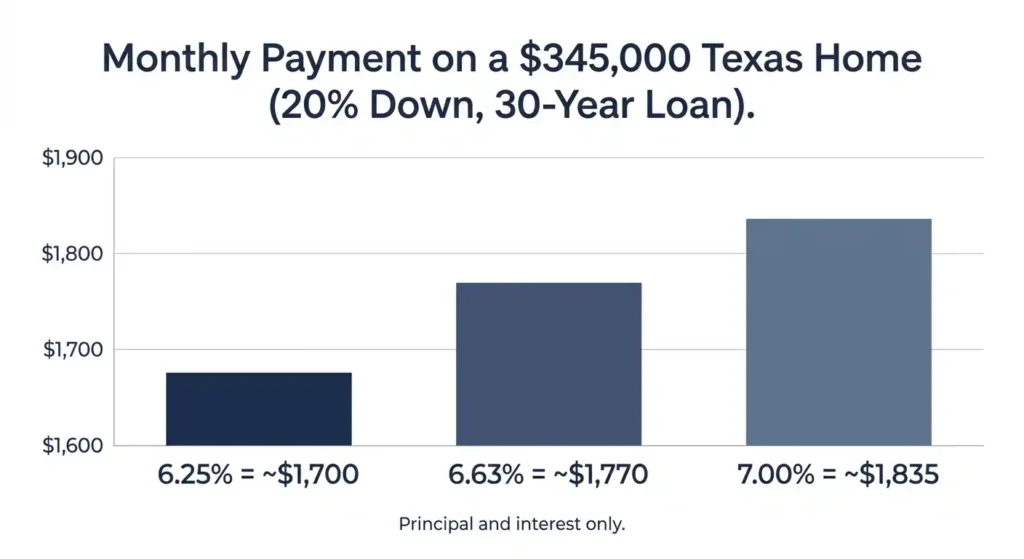
Median Texas home: $345,000 (Redfin, June 2026). At 20% down, 30-year loan, principal and interest only:
| Rate | Monthly Payment |
|---|---|
| 6.25% | ~$1,700 |
| 6.63% | ~$1,770 |
| 7.00% | ~$1,835 |
Keeping total housing payment under 28% of gross monthly income keeps most Texas budgets comfortable, and running your own numbers through a guide on how much house you can afford in Texas helps confirm where you land.
What does a 0.25% rate difference really cost?
On a $240,000 loan, 6.5% to 6.25% saves about $35/month, over $12,000 over 30 years. A full 1% gap (6.25% vs 7.25% on $300,000) can mean over $70,000 in lifetime interest.
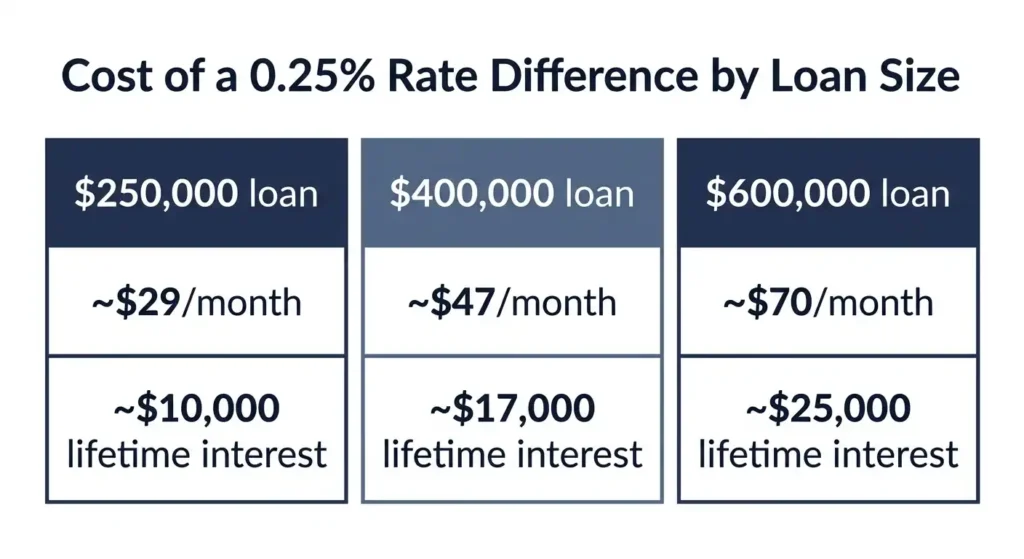
A quarter-point move at other loan sizes:
| Loan Amount | Monthly Change | Lifetime Interest Change |
|---|---|---|
| $250,000 | ~$29 | ~$10,000 |
| $400,000 | ~$47 | ~$17,000 |
| $600,000 | ~$70 | ~$25,000 |
How Texas property taxes and insurance change the payment
Texas property taxes run 1.4% statewide up to 2%+ in high-cost counties like Austin, Houston, and Dallas suburbs, about $400 to $575/month on a $345,000 home, though a Texas homestead exemption can lower that bill for owner-occupied homes. Homeowners insurance in Texas runs higher than average, adding another $150 to $250/month. HOA dues stack on top. Budget another 2% to 5% of purchase price for Texas mortgage closing costs beyond the down payment.
What Determines Your Personal Texas Mortgage Rate?
Five factors, working together.
Credit score
760+: best tier. 700 to 739: about a quarter point added. 660 to 699: half a point or more. Avoid new credit applications before applying. Limited credit history may require alternative proof of on-time payments (utility, rent). The Equal Credit Opportunity Act bars pricing based on race, religion, or marital status; the Home Mortgage Disclosure Act requires lenders to report loan-level data for fair-pricing checks.
Down payment and loan-to-value ratio
More down, lower LTV, better pricing. Comparing down payment options side by side helps before you decide how much to put down. 20%+ down on conventional skips PMI. See how PMI works if you’re putting down less. An extra $10,000 down on a $300,000 purchase can shave a touch off the rate and shrink PMI, sometimes more valuable than paying for points.
Debt-to-income ratio and income
Most conventional lenders like to see DTI at or below 43% to 45%, though this is a practical guideline rather than a fixed legal cap. Bonus, overtime, or commission income gets averaged over two years, with documentation required. Self-employed borrowers usually need two years of tax returns. A recent job or industry change can raise questions in underwriting. Student loan payments count against DTI even on income-driven plans. High credit card balances relative to limits can raise your rate and shrink what you qualify for. DTI limits also enforce ability-to-repay rules that keep a loan classified as a qualified mortgage.
Loan type, property and occupancy
Conventional usually prices better for strong credit; FHA and VA can beat it for lower credit or lower down payment. Primary residence prices best; investment property prices notably higher. Condos and multi-unit properties can carry adjustments.
Loan amount and Texas conforming limits
The 2026 conforming loan limit, set annually by the FHFA, is $832,750 in most Texas counties, more in high-cost counties. Above that, it’s a jumbo loan, usually stricter requirements and a higher rate, since it can’t be sold to Fannie Mae or Freddie Mac, the entities that buy and resell most conventional loans and whose guidelines set that limit.
Interest Rate vs. APR: Which Number Should You Compare?
Both matter, for different reasons.
What the mortgage interest rate tells you
The note rate drives your principal and interest payment, and understanding how mortgage interest actually works makes it easier to see why. It doesn’t show upfront costs like points or lender fees.
What APR tells you
APR wraps in the rate plus most lender fees and points, as a yearly cost, usually a few tenths of a point (or more) above the plain rate. It assumes you keep the loan the full term, which most people don’t. The Truth in Lending Act and Regulation Z govern how lenders calculate and disclose APR.
Why the lowest advertised rate may not be the best deal
The lowest rate often bakes in points you’d pay upfront. Compare total upfront cost via the Loan Estimate, not the homepage number. Points only pay off if you keep the loan long enough to recoup the cost, so check the break-even math. A temporary rate buydown, like a 2-1 buydown, starts lower for a year or two then steps up to the permanent rate, different from a permanent buydown (points paid upfront for the full term). A seller-paid rate buydown can lower your payment at no extra cost to you.
Texas Mortgage Rate Comparison: 30-Year vs. 15-Year vs. ARM
30-year fixed vs. 15-year fixed
30-year: lower payment, more total interest. 15-year: higher payment, dramatically less interest, faster payoff. See a full 15-year vs 30-year mortgage breakdown for the numbers side by side.
Fixed-rate vs. adjustable-rate mortgage
Fixed never changes. ARM holds an initial rate, then adjusts by index plus margin, with caps. This fixed vs adjustable-rate mortgage comparison walks through both structures in more detail. Betting on refinancing before adjustment is risky since future rates aren’t guaranteed.
Conventional vs. FHA vs. VA vs. USDA
Conventional: stronger credit needed, no permanent mortgage insurance past 20% equity. FHA: 3.5% down, ongoing mortgage insurance. VA: often 0% down, no mortgage insurance, one-time funding fee. USDA, backed by the U.S. Department of Agriculture: eligible rural properties, no down payment for qualifying buyers.
How to Tell Whether a Texas Mortgage Quote Is Actually Good
Compare the same loan from multiple lenders
Same loan amount, term, price, down payment, and lock period across at least three lenders. A 30-day lock isn’t comparable to a 60-day lock.
What to check on a Loan Estimate
Look past the rate to projected payment, total loan costs, lender credits, and cash to close. The Real Estate Settlement Procedures Act requires a standardized Loan Estimate within three days of applying, enforced by the Consumer Financial Protection Bureau. It replaced the old good faith estimate.
Questions to ask before accepting a mortgage rate
How many points, what fees, how long the lock lasts, what happens if closing is delayed past expiration.
Should You Lock Your Texas Mortgage Rate or Wait?
How a mortgage rate lock works
Freezes your rate, usually 30 to 60 days. Rates can move before you lock. Changes to loan amount, credit, or property can still affect the final rate after locking.
What happens if mortgage rates fall after you lock?
Some lenders offer a float-down option, for a fee or under conditions, not universal. Lock extensions usually cost money too.
When waiting for lower rates can backfire
Waiting risks losing the house or facing higher prices later. A rate you can afford today beats a gamble on tomorrow.
Should You Buy a Texas Home Now or Wait for Lower Rates?
When buying now may make sense
If today’s payment fits your budget and you’re staying years, buying now locks in cost while rents and prices climb. Statewide inventory has grown in 2026, with Dallas seeing the sharpest year-over-year price correction among major Texas metros and Houston holding steadier (Redfin, ManageCasa 2026 market data).
When waiting may make more sense
If the payment stretches your budget, or credit needs a few months to improve, waiting can help. A bigger down payment built over another year can meaningfully lower cost.
Why nobody can guarantee future mortgage rates
Rates track the 10-year Treasury yield, which has held near 4.6% to 4.7% through mid-August 2026, more closely than Fed moves. That yield reflects demand for U.S. Treasury debt, moved by inflation data, jobs reports, and global events nobody can predict months out.
Texas Mortgage Rate Scenarios Real Buyers Face
A buyer gets a rate higher than the online advertised rate
Usually credit, loan type, or down payment doesn’t match the advertised assumptions. Check points, fees, and APR; get a second quote.
A buyer has excellent credit but still gets an expensive quote
Loan type or property type (condo, investment, cash-out refinance) may be driving cost. Review points and fees; shop another lender.
A buyer is offered a lower rate with high upfront fees
Divide extra upfront cost by monthly savings for the break-even point. Staying shorter than that means it’s not really saving you money. The reverse works too: a cash-strapped buyer might prefer a slightly higher rate with a lender credit covering closing costs.
A buyer is close to closing when the rate changes
Confirm whether the rate is locked, check the expiration date, ask extension cost, and confirm nothing in the application has changed.
Common Texas Mortgage Rate Myths That Can Cost You Money
“The Federal Reserve sets mortgage rates directly”
The Fed sets the federal funds rate; mortgage rates follow the bond market and the 10-year Treasury yield more closely, so they don’t always move with Fed cuts.
“The lowest advertised rate is the best mortgage”
Points, fees, and lender credits change the real cost. The homepage rate is only part of the picture, so line up APR and total closing costs before trusting it.
“A rate lock guarantees the rate no matter what”
A lock protects against market movement, not against changes in your own file, like a lower appraisal or new debt.
“If rates fall, I can always refinance”
Refinancing costs thousands in closing costs and requires requalifying. Rates dropping isn’t guaranteed. It tends to make sense once the new rate is at least three-quarters of a point below your current one, and you’ll stay past the break-even point.
What to Do After You Find a Competitive Texas Mortgage Rate
Build a side-by-side lender comparison
Rate, APR, points, fees, monthly payment, and cash to close for each lender, side by side.
Confirm the rate before moving forward
Verify it’s locked, note the expiration date, get conditions in writing.
Know when you are ready to proceed
Confirm the payment fits your budget with taxes and insurance, that you understand the full PITI payment breakdown, that adequate cash reserves remain, and that you’ve reviewed the Loan Estimate line by line.
Texas Mortgage Rate FAQ: Questions Buyers Ask Before Applying
What is a good mortgage interest rate in Texas right now?
Roughly 6.6% to 6.8% on a 30-year fixed, around 6.0% on a 15-year, as of August 2026. Compare your quote against that day’s benchmark.
Is 6% a good mortgage rate in Texas?
Yes on a 15-year loan. On a 30-year loan, it beats the typical rate and usually needs strong credit, a solid down payment, or paid points.
What is the average 30-year mortgage rate in Texas?
Around 6.63% to 6.75% as of mid-August 2026, based on recent lender data. It shifts regularly.
Should I lock my mortgage rate today?
If closing is within 30 to 60 days and today’s rate fits your budget, lock it. If further out, ask about float-down options.
Is it better to get a lower rate or lower closing costs?
Depends on how long you’ll keep the loan. Calculate your break-even point on any points paid for a lower rate.
How can I get the lowest mortgage rate in Texas?
Improve credit before applying, compare Loan Estimates from at least three lenders, and weigh total cost, not just the headline rate.
Can mortgage rates go below 6% in 2026?
Possible if inflation keeps cooling and the Fed resumes cuts, but the 10-year Treasury yield holding near 4.6% to 4.7% has acted as a floor. Treat forecasts as possibilities, not plans.
Final Takeaway: What Counts as a Good Texas Mortgage Rate?
The rate matters, but the whole loan matters more
A great rate with high fees or mortgage insurance can cost more than a slightly higher rate with a clean cost structure. Weigh APR, points, taxes, insurance, and total monthly payment together.
The best rate is the one that fits your complete financial picture
Match loan term to how long you’ll stay, compare real offers, and decide based on your full budget, not one headline number. Read more about how we put these guides together, and browse the full library of mortgage basics guides for more on rates, payments, and Texas homebuying costs.